Gauteng Health Department, Charlotte Maxeke Johannesburg Academic Hospital, Johannesburg, South Africa.
Glob Health Action. 2013 Jan 24;6:19810. doi: 10.3402/gha.v6i0.19810.
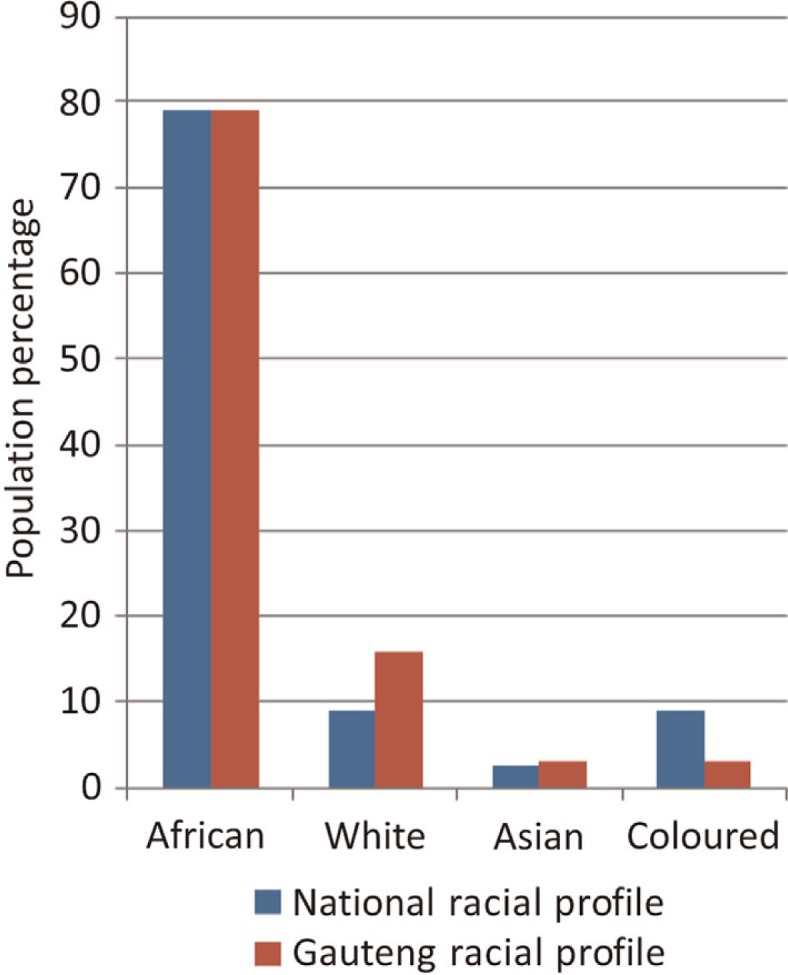
In light of global concerns about insufficient numbers of doctors, midwives, and nurses, the World Health Organization (WHO) has identified the scale-up of the production of medical professionals who are competent and responsive to community needs as urgent and necessary. Coincident with this imperative, South African medical schools have also had to consider redressing apartheid-era inequities in access to medical education and changing the racial and gender profile of medical graduates to be representative of the population. In this article, we explore progress and challenges with regard to transformation, defined as intentional and planned changes aimed at addressing historical disadvantages, in the Gauteng Province of South Africa.
A cross-sectional, descriptive analysis was conducted using data on medical school admissions and graduations from the Health and Education Departments for the period 1999-2011. Admission and graduation statistics of 1999, 2005, 2008, and 2011 were analysed according to race and gender.
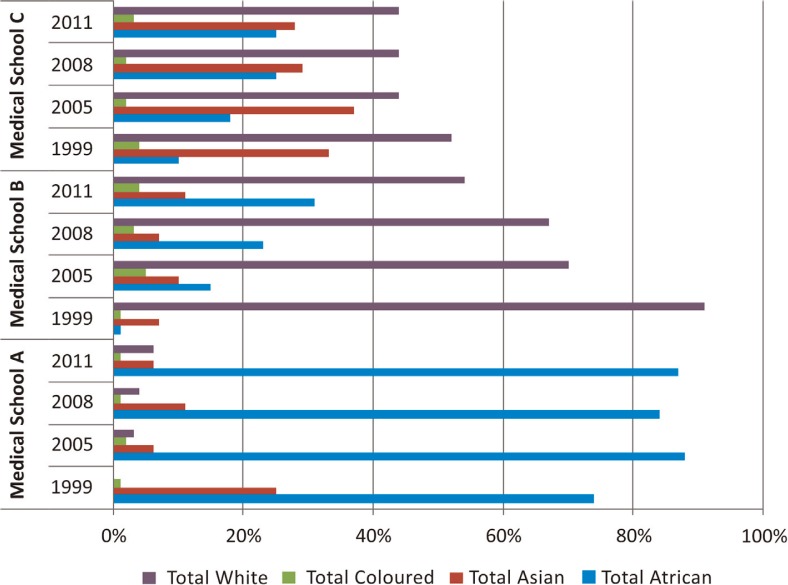
The results show that there has been progress in transforming the race and gender composition of medical students and graduates, in line with the transformation strategies of the South African government. In 1999, black African enrolments and graduates were conspicuously low in two of the three medical schools in the Gauteng province. By 2011, an almost six-fold increase in black African student enrolments was seen in one medical school that was previously designated as a white institution. In contrast, at the historically black medical school, whites only represented 0.40% of enrolments in 1999 and 7.4% in 2011. Since 1999, the number and proportion of female medical enrolments and graduates has also increased substantially.
While there has been progress with redressing historical disparities and inequities in terms of race and gender, further efforts are needed to ensure that student intakes and graduations are in line with the South African population profile.
鉴于全球对医生、助产士和护士人数不足的担忧,世界卫生组织(WHO)已将扩大对社区需求有能力且有响应的医疗专业人员的培养规模确定为当务之急。与此同时,南非医学院也不得不考虑纠正种族隔离时代在获得医学教育方面的不平等,并改变医学生的种族和性别构成,以反映人口的代表性。在本文中,我们探讨了南非豪登省转型方面的进展和挑战,转型定义为旨在解决历史劣势的有意和计划中的变革。
使用卫生和教育部在 1999 年至 2011 年期间的医学院入学和毕业数据进行了横断面描述性分析。根据种族和性别分析了 1999 年、2005 年、2008 年和 2011 年的入学和毕业统计数据。
结果表明,按照南非政府的转型战略,在改变医学生和毕业生的种族和性别构成方面已经取得了进展。在 1999 年,在豪登省的三所医学院中,有两所医学院的黑人非洲学生入学率和毕业率明显较低。到 2011 年,一所以前被指定为白人机构的医学院的黑人非洲学生入学人数增加了近六倍。相比之下,在历史上的黑人医学院,白人在 1999 年的入学人数仅占 0.40%,而 2011 年则占 7.4%。自 1999 年以来,女性医学生的入学人数和比例也大幅增加。
尽管在解决种族和性别方面的历史差距和不平等方面已经取得了进展,但仍需要进一步努力,确保学生入学率和毕业率与南非人口结构相匹配。