Department of Health Care Management, Technische Universität (TU) Berlin, Straße des 17. Juni 135, H80, 10623 Berlin, Germany.
Eur Heart J. 2013 Jul;34(26):1972-81. doi: 10.1093/eurheartj/ehs482. Epub 2013 Jan 30.
As part of the diagnosis related groups in Europe (EuroDRG) project, researchers from 11 countries (i.e. Austria, England, Estonia, Finland, France, Germany, Ireland, Netherlands, Poland, Spain, and Sweden) compared how their DRG systems deal with patients admitted to hospital for acute myocardial infarction (AMI). The study aims to assist cardiologists and national authorities to optimize their DRG systems.
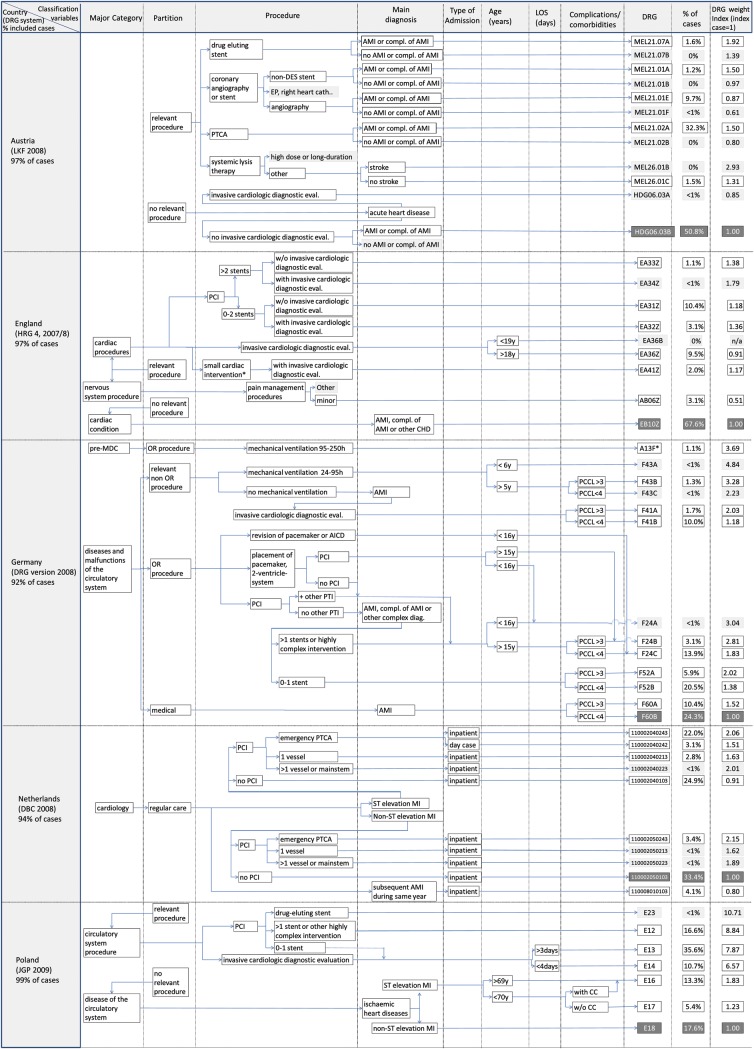
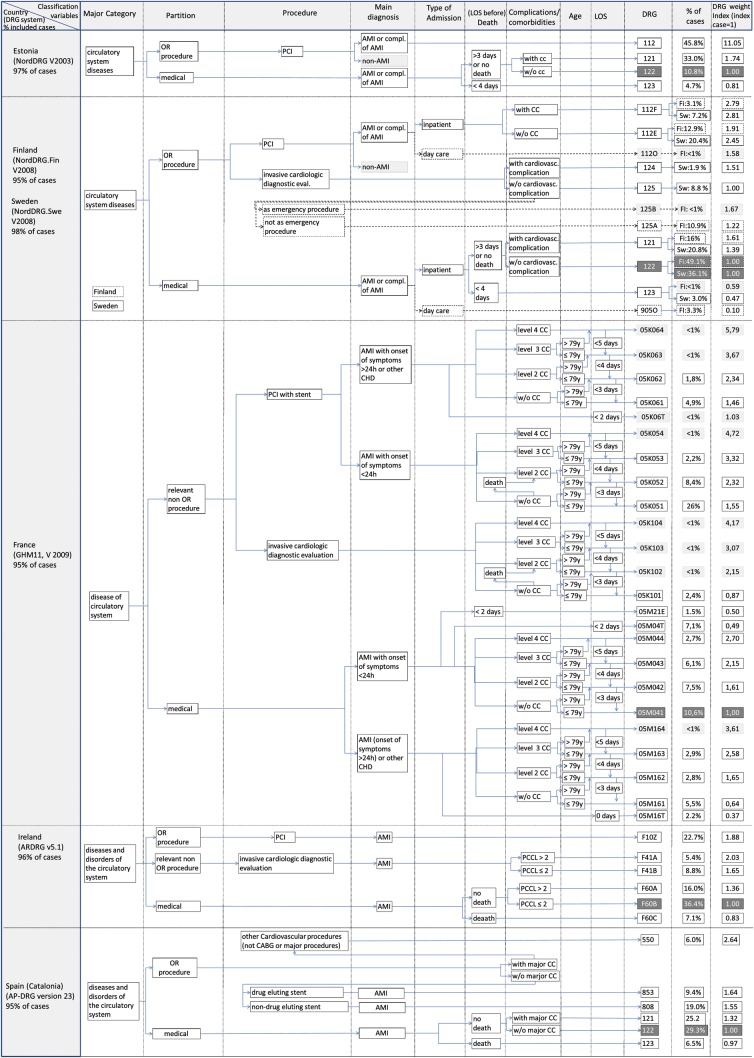
National or regional databases were used to identify hospital cases with a primary diagnosis of AMI. Diagnosis-related group classification algorithms and indicators of resource consumption were compared for those DRGs that individually contained at least 1% of cases. Six standardized case vignettes were defined, and quasi prices according to national DRG-based hospital payment systems were ascertained. European DRG systems vary widely: they classify AMI patients according to different sets of variables into diverging numbers of DRGs (between 4 DRGs in Estonia and 16 DRGs in France). The most complex DRG is valued 11 times more resource intensive than an index case in Estonia but only 1.38 times more resource intensive than an index case in England. Comparisons of quasi prices for the case vignettes show that hypothetical payments for the index case amount to only €420 in Poland but to €7930 in Ireland.
Large variation exists in the classification of AMI patients across Europe. Cardiologists and national DRG authorities should consider how other countries' DRG systems classify AMI patients in order to identify potential scope for improvement and to ensure fair and appropriate reimbursement.
作为欧洲诊断相关分组(EuroDRG)项目的一部分,来自 11 个国家(奥地利、英国、爱沙尼亚、芬兰、法国、德国、爱尔兰、荷兰、波兰、西班牙和瑞典)的研究人员比较了其各自的疾病诊断相关分组系统如何处理因急性心肌梗死(AMI)住院的患者。本研究旨在协助心脏病专家和国家当局优化其疾病诊断相关分组系统。
利用国家或地区数据库,识别出主要诊断为 AMI 的住院病例。对于包含至少 1%病例的个别疾病诊断相关分组,比较了疾病诊断相关分组分类算法和资源消耗指标。定义了 6 个标准化病例情节,并根据国家按疾病诊断相关分组的医院支付系统确定了准价格。欧洲疾病诊断相关分组系统差异很大:它们根据不同的变量集将 AMI 患者分类为不同数量的疾病诊断相关分组(爱沙尼亚为 4 个,法国为 16 个)。最复杂的疾病诊断相关分组比爱沙尼亚的指数病例资源密集度高 11 倍,但比英国的指数病例资源密集度仅高 1.38 倍。对病例情节的准价格比较表明,波兰的指数病例的假设支付额仅为 420 欧元,但爱尔兰的指数病例的假设支付额为 7930 欧元。
欧洲各国在 AMI 患者分类方面存在很大差异。心脏病专家和国家疾病诊断相关分组当局应考虑其他国家的疾病诊断相关分组系统如何对 AMI 患者进行分类,以确定潜在的改进空间,并确保公平和适当的报销。