Department of Ophthalmology, Mayo Clinic, Rochester, Minnesota 55905, USA.
Ophthalmology. 2013 Apr;120(4):687-94. doi: 10.1016/j.ophtha.2012.09.022. Epub 2013 Jan 28.
To assess interobserver agreement between 2 corneal specialists grading Fuchs' dystrophy clinically and to determine if the corneal central-to-peripheral thickness ratio (CPTR) may be an alternative and objective metric of disease severity.
Cross-sectional study.
Forty-five eyes (26 subjects) with mild and moderate Fuchs' dystrophy, 73 eyes (60 subjects) with advanced Fuchs' dystrophy, and 267 eyes (142 subjects) with normal corneas.
Corneas with Fuchs' dystrophy were graded by 2 corneal specialists based on the confluence and area of guttae and the presence or absence of edema. Central corneal thickness (CCT) and peripheral corneal thickness at 4 mm from the center (PCT4) were measured by using scanning-slit pachymetry. The value of CPTR4 was the quotient of CCT and PCT4.
Interobserver agreement for clinical grade and CPTR4.
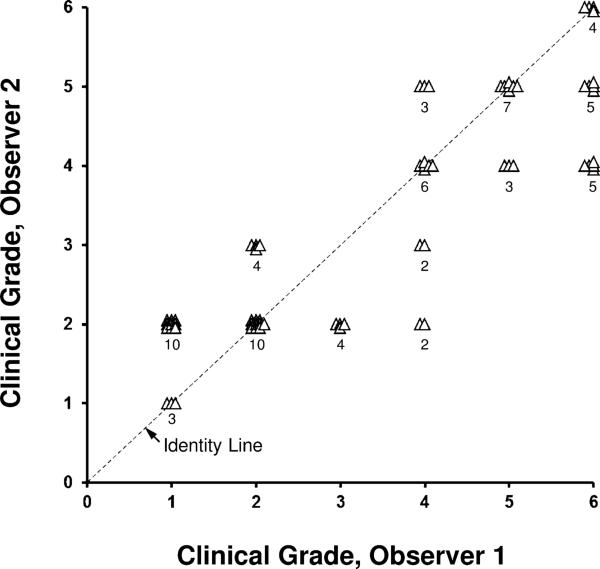
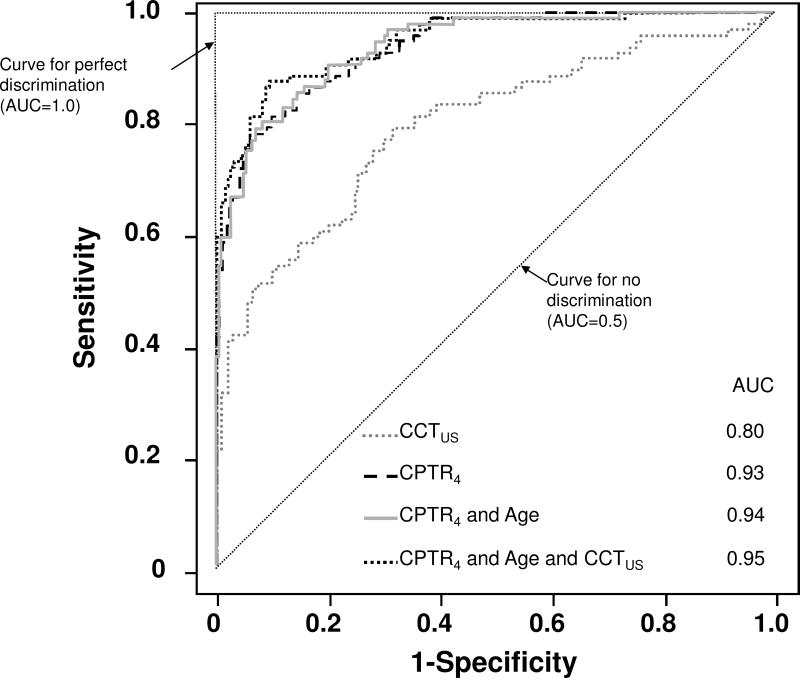
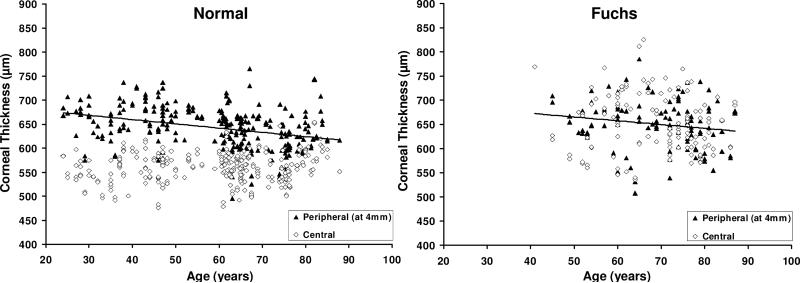
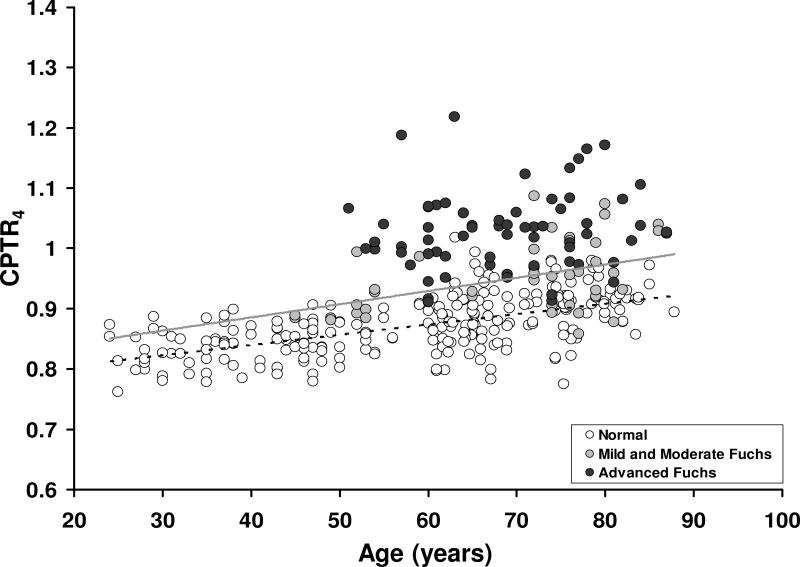
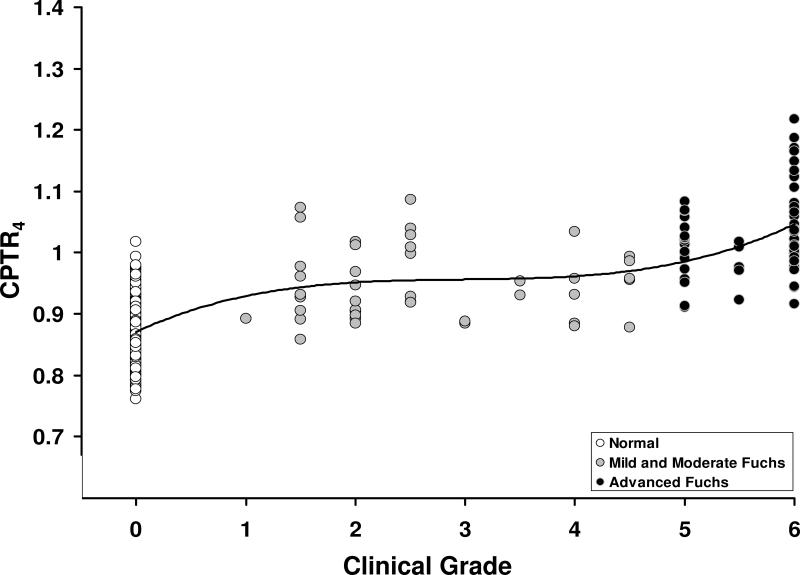
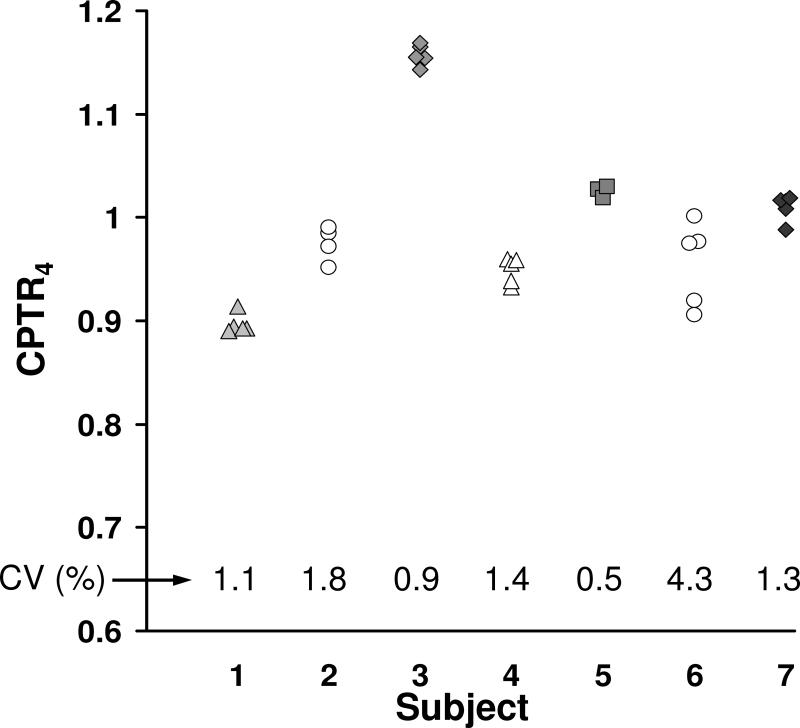
Interobserver agreement for clinical grading of Fuchs' dystrophy was moderate (κ = 0.32; 95% confidence interval, 0.19-0.45). In normal corneas, CCT was not correlated with age (r = -0.10; P = 0.28; n = 267), PCT4 decreased with age (r = -0.33; P<0.001; n = 254), and CPTR4 increased with age (r = 0.59; P<0.001; n = 254). Central corneal thickness was higher in Fuchs' dystrophy (652 ± 61 μm; n = 118) than in normal corneas (559 ± 31 μm; n = 267; P<0.001). Also, PCT4 was higher in Fuchs' dystrophy (650 ± 51 μm; n = 107) than in normal corneas (643 ± 43 μm; n = 254; P<0.001 after adjusting thickness for age). Furthermore, CPTR4 was higher in advanced Fuchs' dystrophy (1.03 ± 0.07; n = 65) than in mild and moderate Fuchs' dystrophy (0.95 ± 0.07; n = 42; age-adjusted P<0.001), which in turn was higher than in normal corneas (0.87 ± 0.05; n = 254; age-adjusted P<0.001). Finally, CPTR4 was highly correlated with clinical grade of Fuchs' dystrophy (r = 0.77; P<0.001; n = 361), was repeatable (median coefficient of variation, 1.3%), and provided excellent discrimination between Fuchs' dystrophy and normal corneas (area under the receiver operator characteristic curve, 0.93).
Agreement between corneal specialists for the subjective and morphologic clinical grading of Fuchs' dystrophy is only moderate. The corneal CPTR is an objective, repeatable, and possibly functional, metric of severity of Fuchs' dystrophy that warrants further investigation to determine its role in monitoring disease progression and predicting the need for keratoplasty.
评估 2 位角膜专家在临床分级 Fuchs 角膜营养不良方面的观察者间一致性,并确定角膜中央-周边厚度比(CPTR)是否可以作为疾病严重程度的替代和客观指标。
横断面研究。
45 只眼(26 例)患有轻度和中度 Fuchs 角膜营养不良,73 只眼(60 例)患有晚期 Fuchs 角膜营养不良,267 只眼(142 例)患有正常角膜。
使用角膜地形图仪,2 位角膜专家根据角膜滴状混浊的融合和面积以及是否存在水肿来对角膜进行分级。中央角膜厚度(CCT)和距中心 4mm 处的周边角膜厚度(PCT4)通过扫描狭缝式角膜测厚仪进行测量。CPTR4 的值为 CCT 与 PCT4 的商。
临床分级和 CPTR4 的观察者间一致性。
Fuchs 角膜营养不良临床分级的观察者间一致性为中度(κ=0.32;95%置信区间,0.19-0.45)。在正常角膜中,CCT 与年龄无相关性(r=-0.10;P=0.28;n=267),PCT4 随年龄下降(r=-0.33;P<0.001;n=254),CPTR4 随年龄增加(r=0.59;P<0.001;n=254)。Fuchs 角膜营养不良的 CCT(652±61μm;n=118)高于正常角膜(559±31μm;n=267;P<0.001)。此外,Fuchs 角膜营养不良的 PCT4(650±51μm;n=107)高于正常角膜(643±43μm;n=254;P<0.001,在调整厚度以适应年龄后)。此外,晚期 Fuchs 角膜营养不良的 CPTR4(1.03±0.07;n=65)高于轻度和中度 Fuchs 角膜营养不良的 CPTR4(0.95±0.07;n=42;调整年龄后的 P<0.001),而后者又高于正常角膜的 CPTR4(0.87±0.05;n=254;调整年龄后的 P<0.001)。最后,CPTR4 与 Fuchs 角膜营养不良的临床分级高度相关(r=0.77;P<0.001;n=361),具有可重复性(中位数变异系数,1.3%),并能很好地区分 Fuchs 角膜营养不良与正常角膜(受试者工作特征曲线下面积,0.93)。
角膜专家在 Fuchs 角膜营养不良的主观和形态学临床分级方面的一致性仅为中度。角膜 CPTR 是一种客观、可重复且可能具有功能性的疾病严重程度指标,值得进一步研究以确定其在监测疾病进展和预测角膜移植需求方面的作用。