
新型隐球菌诱导的细胞因子模式与其他隐球菌属物种明显不同。
Cryptococcus gattii induces a cytokine pattern that is distinct from other cryptococcal species.
机构信息
Department of Medicine and Nijmegen Institute for Infection, Inflammation & Immunity (N4i), Radboud University Nijmegen Medical Centre, Nijmegen, The Netherlands.
出版信息
PLoS One. 2013;8(1):e55579. doi: 10.1371/journal.pone.0055579. Epub 2013 Jan 31.
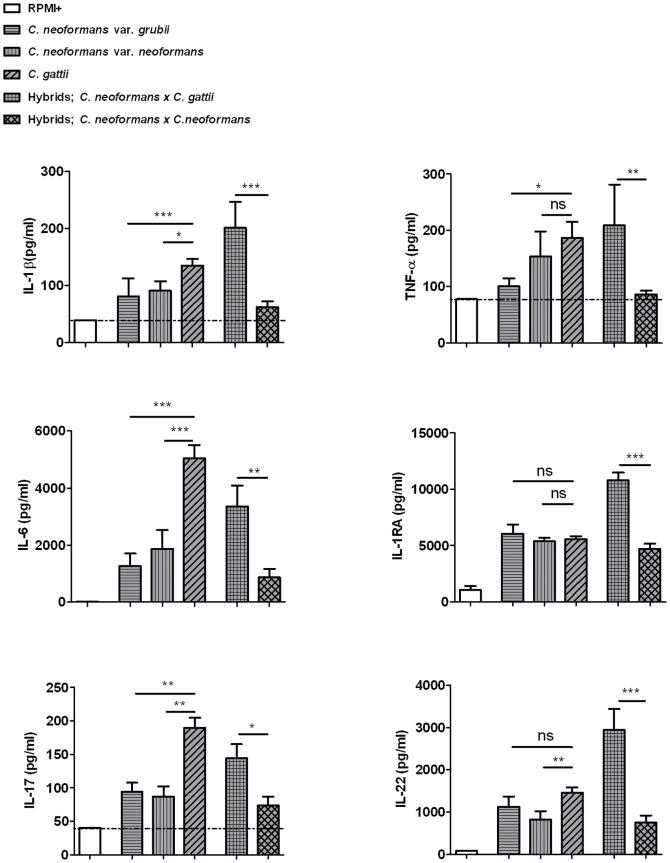
Understanding more about the host's immune response to different Cryptococcus spp. will provide additional insight into the pathogenesis of cryptocococcis. We hypothesized that the ability of C. gattii to cause disease in immunocompetent humans depends on a distinct innate cytokine response of the host to this emerging pathogen. In the current study we assessed the cytokine profile of human peripheral blood mononuclear cells (PBMCs) of healthy individuals, after in vitro stimulation with 40 different well-defined heat-killed isolates of C. gattii, C. neoformans and several hybrid strains. In addition, we investigated the involvement of TLR2, TLR4 and TLR9 in the pro-inflammatory cytokine response to C. gattii. Isolates of C. gattii induced higher concentrations of the pro-inflammatory cytokines IL-1β, TNF-α and IL-6 and the Th17/22 cytokine IL-17 and IL-22 compared to C. neoformans var neoformans and C. neoformans var grubii. In addition, clinical C. gattii isolates induced higher amounts of cytokines than environmental isolates. This difference was not observed in C. neoformans var. grubii isolates. Furthermore, we demonstrated a likely contribution of TLR4 and TLR9, but no role for TLR2, in the host's cytokine response to C. gattii. In conclusion, clinical heat-killed C. gattii isolates induced a more pronounced inflammatory response compared to other Cryptococcus species and non-clinical C. gattii. This is dependent on TLR4 and TLR9 as cellular receptors.
了解宿主对不同隐球菌属的免疫反应将为隐球菌病的发病机制提供更多的认识。我们假设,新生隐球菌能够在免疫功能正常的人群中引起疾病,这取决于宿主对这种新兴病原体的固有细胞因子反应的不同。在本研究中,我们评估了健康个体外周血单个核细胞(PBMCs)在体外受到 40 种不同的、明确的热灭活新生隐球菌、新型隐球菌和几种杂交株刺激后的细胞因子谱。此外,我们还研究了 TLR2、TLR4 和 TLR9 参与新生隐球菌促炎细胞因子反应的情况。与新型隐球菌 var neoformans 和新型隐球菌 var grubii 相比,新生隐球菌属的分离株诱导了更高浓度的促炎细胞因子 IL-1β、TNF-α 和 IL-6 以及 Th17/22 细胞因子 IL-17 和 IL-22。此外,临床新生隐球菌分离株诱导的细胞因子量高于环境分离株。在新型隐球菌 var grubii 分离株中没有观察到这种差异。此外,我们证明了 TLR4 和 TLR9 在宿主对新生隐球菌的细胞因子反应中可能起作用,但 TLR2 不起作用。总之,与其他隐球菌属和非临床新生隐球菌相比,临床热灭活的新生隐球菌分离株诱导了更明显的炎症反应。这依赖于 TLR4 和 TLR9 作为细胞受体。




 Zotero 插件