College of Mechatronics and Automation, National University of Defense Technology, Changsha, China.
Biomed Eng Online. 2013 Feb 7;12:10. doi: 10.1186/1475-925X-12-10.
Recently, a growing number of neuroimaging studies have begun to investigate the brains of schizophrenic patients and their healthy siblings to identify heritable biomarkers of this complex disorder. The objective of this study was to use multiclass pattern analysis to investigate the inheritable characters of schizophrenia at the individual level, by comparing whole-brain resting-state functional connectivity of patients with schizophrenia to their healthy siblings.
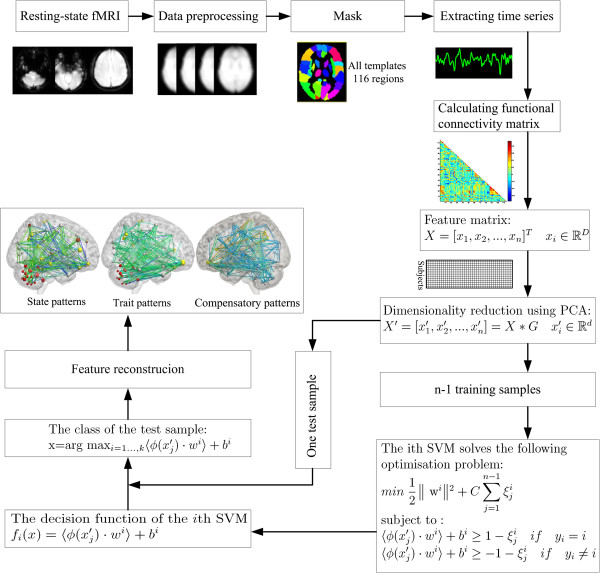
Twenty-four schizophrenic patients, twenty-five healthy siblings and twenty-two matched healthy controls underwent the resting-state functional Magnetic Resonance Imaging (rs-fMRI) scanning. A linear support vector machine along with principal component analysis was used to solve the multi-classification problem. By reconstructing the functional connectivities with high discriminative power, three types of functional connectivity-based signatures were identified: (i) state connectivity patterns, which characterize the nature of disruption in the brain network of patients with schizophrenia; (ii) trait connectivity patterns, reflecting shared connectivities of dysfunction in patients with schizophrenia and their healthy siblings, thereby providing a possible neuroendophenotype and revealing the genetic vulnerability to develop schizophrenia; and (iii) compensatory connectivity patterns, which underlie special brain connectivities by which healthy siblings might compensate for an increased genetic risk for developing schizophrenia.
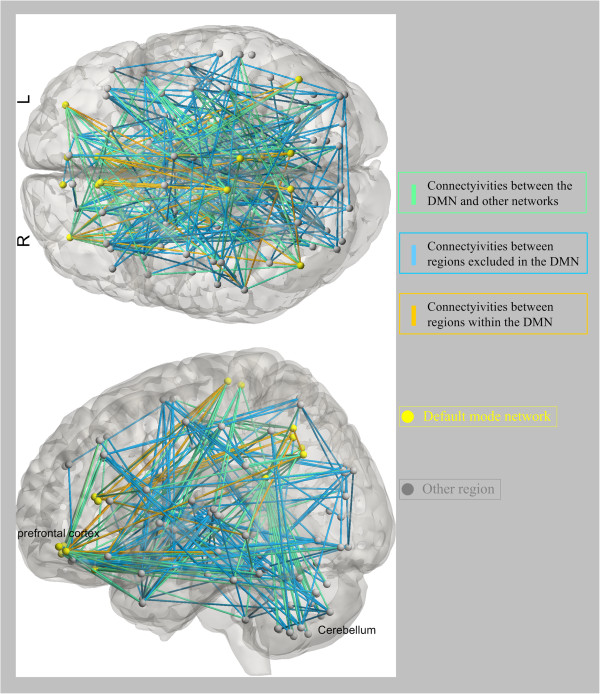
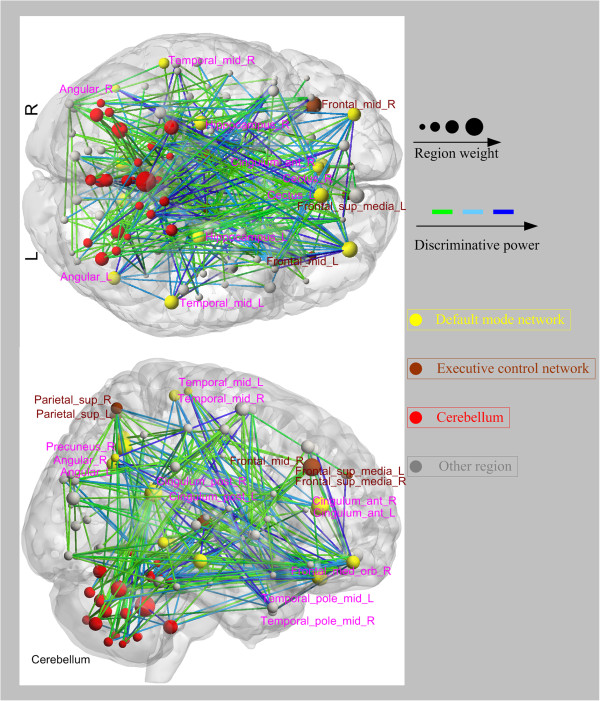
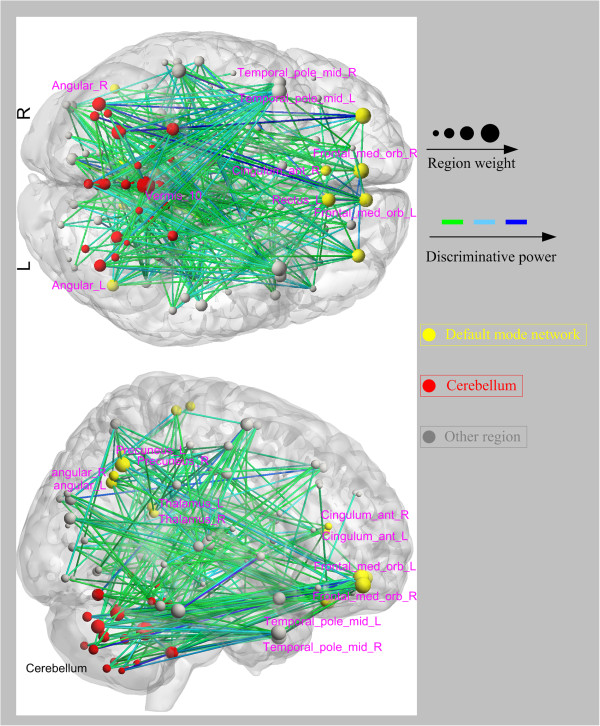
Our multiclass pattern analysis achieved 62.0% accuracy via leave-one-out cross-validation (p < 0.001). The identified state patterns related to the default mode network, the executive control network and the cerebellum. For the trait patterns, functional connectivities between the cerebellum and the prefrontal lobe, the middle temporal gyrus, the thalamus and the middle temporal poles were identified. Connectivities among the right precuneus, the left middle temporal gyrus, the left angular and the left rectus, as well as connectivities between the cingulate cortex and the left rectus showed higher discriminative power in the compensatory patterns.
Based on our experimental results, we saw some indication of differences in functional connectivity patterns in the healthy siblings of schizophrenic patients compared to other healthy individuals who have no relations with the patients. Our preliminary investigation suggested that the use of resting-state functional connectivities as classification features to discriminate among schizophrenic patients, their healthy siblings and healthy controls is meaningful.
最近,越来越多的神经影像学研究开始对精神分裂症患者及其健康兄弟姐妹的大脑进行研究,以确定这种复杂疾病的可遗传生物标志物。本研究旨在通过比较精神分裂症患者与健康兄弟姐妹的全脑静息态功能连接,采用多类模式分析方法,从个体水平上研究精神分裂症的可遗传性特征。
24 名精神分裂症患者、25 名健康兄弟姐妹和 22 名匹配的健康对照者接受了静息态功能磁共振成像(rs-fMRI)扫描。采用线性支持向量机和主成分分析解决多分类问题。通过重建具有高判别能力的功能连接,确定了三种基于功能连接的特征类型:(i)状态连接模式,其特征是精神分裂症患者大脑网络的破坏性质;(ii)特征连接模式,反映了精神分裂症患者及其健康兄弟姐妹的功能连接的共享,从而提供了一种可能的神经内表型,并揭示了精神分裂症的遗传易感性;(iii)代偿性连接模式,通过这种模式,健康的兄弟姐妹可能会代偿增加的精神分裂症遗传风险。
通过留一法交叉验证,我们的多类模式分析达到了 62.0%的准确率(p<0.001)。所识别的状态模式与默认模式网络、执行控制网络和小脑有关。对于特征模式,确定了小脑与前额叶、中颞叶、丘脑和中颞极之间的功能连接。右侧楔前叶、左侧中颞叶、左侧角回和左侧rectus、扣带皮层与左侧 rectus 之间的连接以及两者之间的连接显示出更高的补偿模式判别能力。
根据我们的实验结果,我们发现精神分裂症患者的健康兄弟姐妹与其他与患者没有关系的健康个体的功能连接模式存在一些差异。我们的初步研究表明,使用静息态功能连接作为分类特征来区分精神分裂症患者、其健康兄弟姐妹和健康对照者是有意义的。