Department of Community Medicine, West Virginia University, Morgantown, WV 26506, USA ; Meta-Analytic Research Group, Department of Biostatistics, School of Public Health, Robert C. Byrd Health Sciences Center, West Virginia University, P.O. Box 9190, Morgantown, WV 26506-9190, USA.
Int J Endocrinol. 2013;2013:741639. doi: 10.1155/2013/741639. Epub 2013 Jan 17.
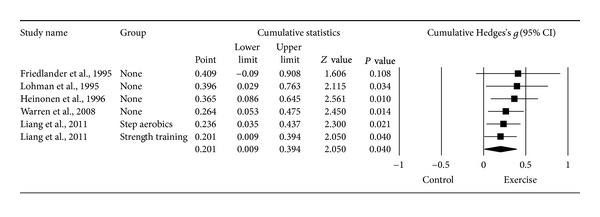
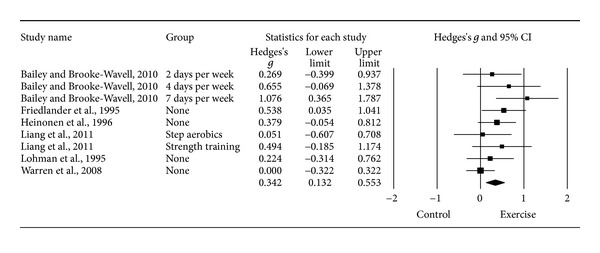
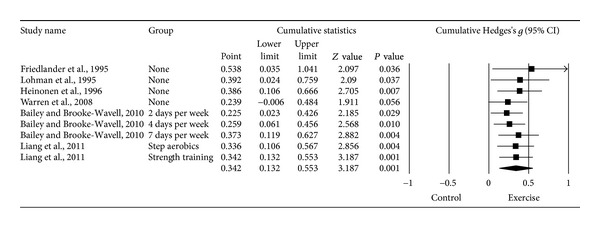
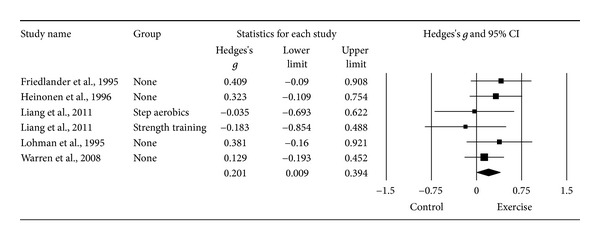
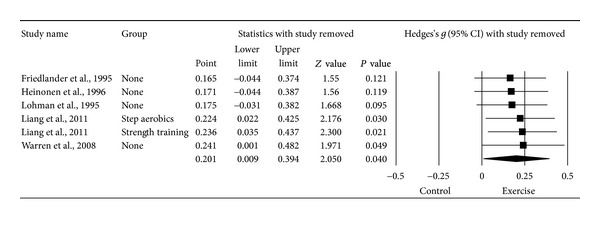
Objective. Examine the effects of exercise on femoral neck (FN) and lumbar spine (LS) bone mineral density (BMD) in premenopausal women. Methods. Meta-analysis of randomized controlled exercise trials ≥24 weeks in premenopausal women. Standardized effect sizes (g) were calculated for each result and pooled using random-effects models, Z score alpha values, 95% confidence intervals (CIs), and number needed to treat (NNT). Heterogeneity was examined using Q and I(2). Moderator and predictor analyses using mixed-effects ANOVA and simple metaregression were conducted. Statistical significance was set at P ≤ 0.05. Results. Statistically significant improvements were found for both FN (7g's, 466 participants, g = 0.342, 95% CI = 0.132, 0.553, P = 0.001, Q = 10.8, P = 0.22, I(2) = 25.7%, NNT = 5) and LS (6g's, 402 participants, g = 0.201, 95% CI = 0.009, 0.394, P = 0.04, Q = 3.3, P = 0.65, I(2) = 0%, NNT = 9) BMD. A trend for greater benefits in FN BMD was observed for studies published in countries other than the United States and for those who participated in home versus facility-based exercise. Statistically significant, or a trend for statistically significant, associations were observed for 7 different moderators and predictors, 6 for FN BMD and 1 for LS BMD. Conclusions. Exercise benefits FN and LS BMD in premenopausal women. The observed moderators and predictors deserve further investigation in well-designed randomized controlled trials.
目的。研究运动对绝经前女性股骨颈(FN)和腰椎(LS)骨密度(BMD)的影响。
方法。对绝经前女性进行至少 24 周随机对照运动试验的荟萃分析。对每个结果计算标准化效应量(g),并使用随机效应模型、Z 分数α值、95%置信区间(CI)和需要治疗的人数(NNT)进行汇总。使用 Q 和 I(2)检验异质性。使用混合效应 ANOVA 和简单元回归进行了调节和预测分析。统计学意义设定为 P ≤ 0.05。
结果。FN(7g,466 名参与者,g=0.342,95%CI=0.132,0.553,P=0.001,Q=10.8,P=0.22,I(2)=25.7%,NNT=5)和 LS(6g,402 名参与者,g=0.201,95%CI=0.009,0.394,P=0.04,Q=3.3,P=0.65,I(2)=0%,NNT=9)BMD 均有统计学意义的改善。在非美国发表的研究和在家中而非在机构中进行运动的研究中,FN BMD 的益处更大。观察到 7 个不同的调节因子和预测因子与 FN BMD 有统计学意义或有统计学意义的趋势,其中 6 个与 FN BMD 有关,1 个与 LS BMD 有关。
结论。运动有益于绝经前女性的 FN 和 LS BMD。观察到的调节因子和预测因子值得在精心设计的随机对照试验中进一步研究。