Huang Dongsheng, Sangthong Rassamee, McNeil Edward, Chongsuvivatwong Virasakdi, Zheng Weibin, Yang Xuemei
Department of Preventing and Controlling HIV/AIDS, Baoshan Prefecture Center for Disease Control and Prevention, Baoshan, Yunnan 678000, China.
AIDS Res Treat. 2013;2013:580974. doi: 10.1155/2013/580974. Epub 2013 Jan 17.
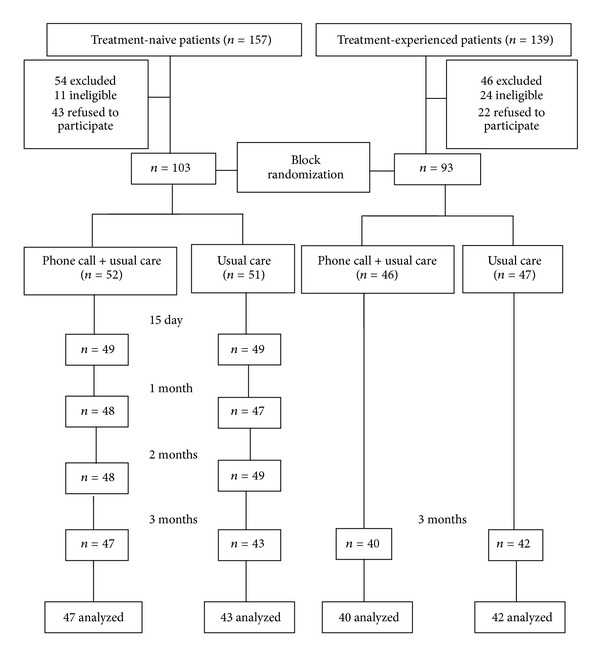
Background. Suboptimal adherence to antiretroviral therapy (ART) is still pervasive. The effect of using a mobile phone call intervention to improve patient adherence is currently not known. Objective. This study aims to investigate the effects of a phone call intervention on adherence to ART and quality of life (QOL) of treatment-naive and treatment-experienced patients. Methods. A randomized controlled trial was conducted in the three largest public hospitals. Adherence was measured by self-completed questionnaires. QOL was assessed by the WHOQOL-HIV BREF. Outcomes were assessed at day 15, at 1, 2, and 3 months after start of treatment for treatment-naive patients and at 3 months after study enrollment for treatment-experienced patients. Results. A total of 103 treatment-naive and 93 treatment-experienced HIV/AIDS patients were consecutively recruited. Results show that a phone call intervention could maintain high self-reported adherence among both treatment-naive and treatment-experienced patients. After three months, significant QOL improvements were observed in domains of physical health (P = 0.003), level of independence (P = 0.018), environment (P = 0.002), and spirituality/religion/personal beliefs (P = 0.021) among treatment-naive patients. Conclusion. A mobile phone call intervention to patients could maintain high adherence rates although no statistically significant differences were found. A phone call could improve some domains of QOL among treatment-naive patients.
背景。对抗逆转录病毒疗法(ART)的依从性欠佳现象仍然普遍存在。目前尚不清楚使用手机通话干预来提高患者依从性的效果。目的。本研究旨在调查电话干预对初治患者和经治患者的ART依从性及生活质量(QOL)的影响。方法。在三家最大的公立医院进行了一项随机对照试验。通过自我填写问卷来测量依从性。采用世界卫生组织生活质量HIV简明量表(WHOQOL-HIV BREF)评估生活质量。对于初治患者,在治疗开始后的第15天、1、2和3个月评估结果;对于经治患者,在研究入组后的3个月评估结果。结果。共连续招募了103例初治和93例经治的HIV/AIDS患者。结果显示,电话干预能够使初治患者和经治患者自我报告的依从性均维持在较高水平。三个月后,初治患者在身体健康(P = 0.003)、独立水平(P = 0.018)、环境(P = 0.002)以及精神/宗教/个人信仰(P = 0.021)等领域的生活质量有显著改善。结论。对患者进行手机通话干预虽未发现统计学上的显著差异,但可维持较高的依从率。电话干预可改善初治患者生活质量的某些领域。