Department of Medical Psychology (W 26), University Medical Center Hamburg-Eppendorf, Martinistr, 52, Hamburg, 20246, Germany.
BMC Med Inform Decis Mak. 2013 Feb 13;13:24. doi: 10.1186/1472-6947-13-24.
Type 2 diabetes is an increasingly common chronic condition whose prognosis can be improved by patient involvement and self-management. Patient involvement can be fostered by web-based Interactive Health Communication Applications (IHCAs) combining health information with decision support, social support and/or behaviour change support. They reach great numbers of patients at low cost and provide high-quality information and support at the time, place and learning speed patients prefer. Still, online tools often suffer from high attrition. Tailoring content and tone of IHCAs to the individual patient´s needs might improve their effectiveness. This study aims to test the effectiveness and usage of a tailored IHCA combining health information with decision support and behaviour change support for patients with type 2 diabetes.
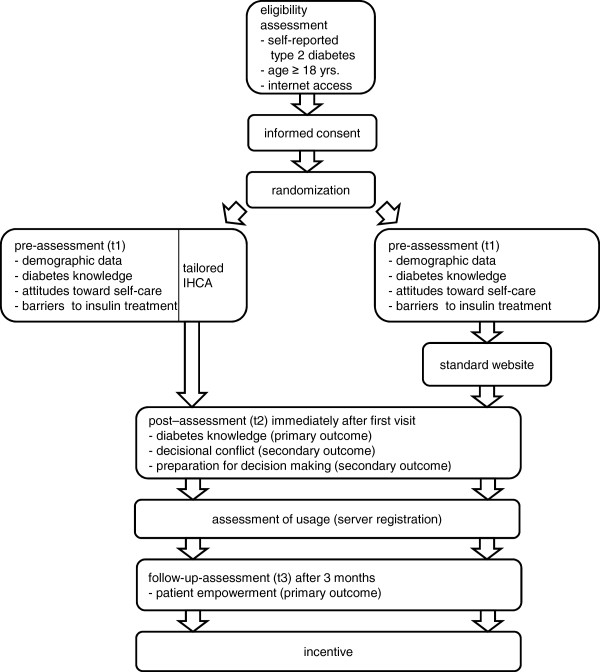
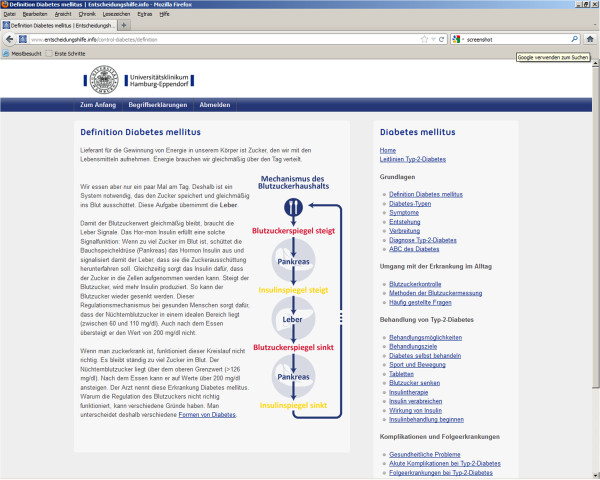
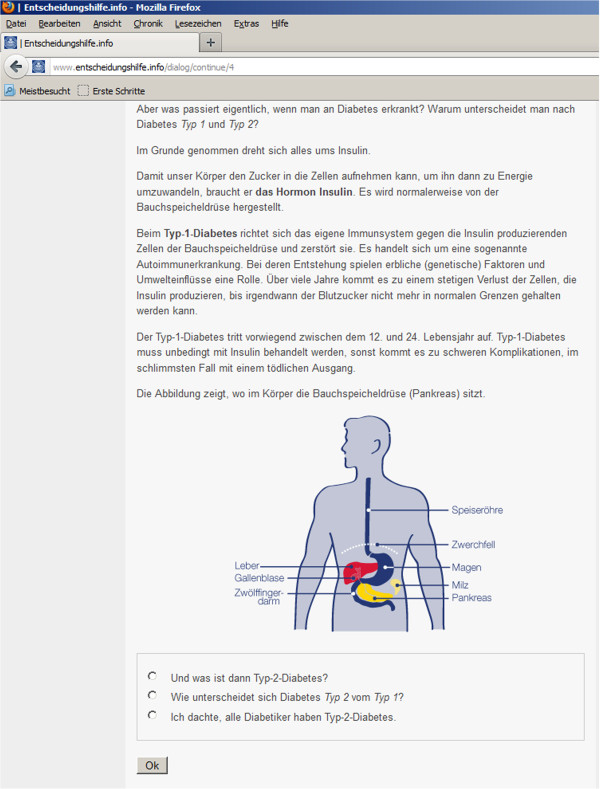
METHODS/DESIGN: The effectiveness and usage of the tailored IHCA will be tested against a standard website with identical content in a single-blinded randomized trial with a parallel design. The content covers information on type 2 diabetes, its complications and sequelae, and its treatment options including health behaviour. In the intervention group the content is delivered in dialogue form, tailored to relevant patient characteristics (health literacy, attitudes towards self-care, and barriers to insulin treatment). In the control group the different sections are presented in a content tree, without any tailoring. Participants are blinded to group assignment. Eligibility criteria are age ≥ 18 years, self-reported type 2 diabetes, and Internet access. The study aims to include 414 participants in order to detect the expected small effect (Cohen's d=0.2), with measurements at baseline, directly after the first visit, and at 3-month follow-up. The primary hypothesis is that the tailored IHCA has larger effects on diabetes knowledge and patient empowerment (primary outcomes) than the standard website. Secondary outcomes are website usage as well as decisional conflict and preparation for decision making. All measurements are online self-report questionnaires.
IHCAs are a promising way to foster diabetes knowledge and self-management competencies. The present trial tries to increase the knowledge on how to develop more effective IHCAs for patients with type 2 diabetes.
International Clinical Trials Registry DRKS00003322.
2 型糖尿病是一种日益常见的慢性疾病,通过患者参与和自我管理可以改善其预后。基于网络的互动式健康传播应用程序(IHCAs)可以将健康信息与决策支持、社会支持和/或行为改变支持相结合,从而促进患者参与。它们以低成本覆盖大量患者,并在患者偏好的时间、地点和学习速度提供高质量的信息和支持。尽管如此,在线工具往往会流失大量用户。根据患者的个体需求调整 IHCAs 的内容和语气可能会提高其效果。本研究旨在测试一种结合健康信息与决策支持和行为改变支持的个性化 IHCA 对 2 型糖尿病患者的有效性和使用情况。
方法/设计:将在一项单盲随机试验中对这种个性化 IHCA 与具有相同内容的标准网站进行比较,该试验采用平行设计。内容涵盖 2 型糖尿病及其并发症和后遗症的信息,以及包括健康行为在内的治疗选择。在干预组中,内容以对话形式呈现,根据相关患者特征(健康素养、自我保健态度和胰岛素治疗障碍)进行定制。在对照组中,不同的部分以内容树的形式呈现,没有任何定制。参与者对分组情况不知情。纳入标准为年龄≥18 岁、自述患有 2 型糖尿病且能上网。研究计划纳入 414 名参与者,以检测预期的小效应(Cohen's d=0.2),测量时间为基线、首次就诊后即刻和 3 个月随访时。主要假设是个性化 IHCA 对糖尿病知识和患者授权(主要结局)的影响大于标准网站。次要结局是网站使用情况以及决策冲突和决策准备。所有测量均为在线自我报告问卷。
IHCAs 是促进糖尿病知识和自我管理能力的一种有前途的方法。本试验旨在增加有关如何为 2 型糖尿病患者开发更有效的 IHCAs 的知识。
国际临床试验注册平台 DRKS00003322。