Department of Biology, Faculty of Sciences, University of Chile, Las Palmeras 3425, Santiago 7800024, Chile.
Mol Brain. 2013 Feb 14;6:10. doi: 10.1186/1756-6606-6-10.
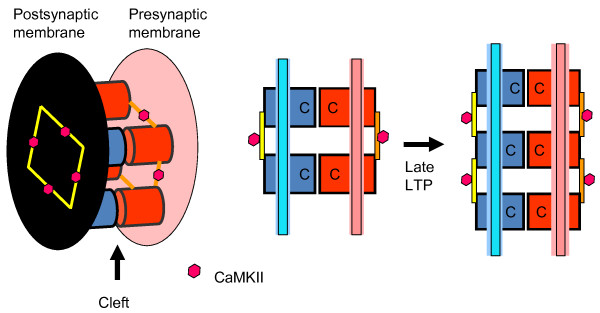
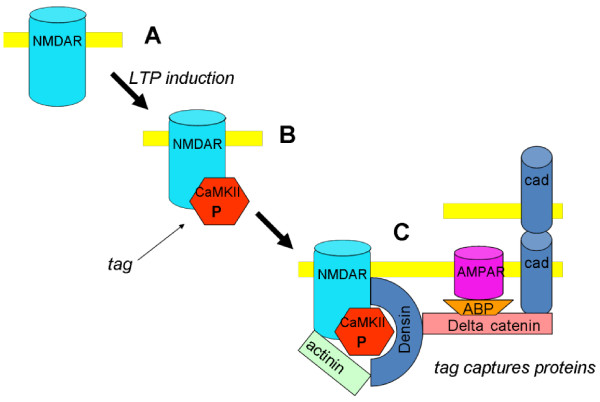
CaMKII is a major synaptic protein that is activated during the induction of long-term potentiation (LTP) by the Ca2+ influx through NMDARs. This activation is required for LTP induction, but the role of the kinase in the maintenance of LTP is less clear. Elucidating the mechanisms of maintenance may provide insights into the molecular processes that underlie the stability of stored memories. In this brief review, we will outline the criteria for evaluating an LTP maintenance mechanism. The specific hypothesis evaluated is that LTP is maintained by the complex of activated CaMKII with the NMDAR. The evidence in support of this hypothesis is substantial, but further experiments are required, notably to determine the time course and persistence of complex after LTP induction. Additional work is also required to elucidate how the CaMKII/NMDAR complex produces the structural growth of the synapse that underlies late LTP. It has been proposed by Frey and Morris that late LTP involves the setting of a molecular tag during LTP induction, which subsequently allows the activated synapse to capture the proteins responsible for late LTP. However, the molecular processes by which this leads to the structural growth that underlies late LTP are completely unclear. Based on known binding reactions, we suggest the first molecularly specific version of tag/capture hypothesis: that the CaMKII/NMDAR complex, once formed, serves as a tag, which then leads to a binding cascade involving densin, delta-catenin, and N-cadherin (some of which are newly synthesized). Delta-catenin binds AMPA-binding protein (ABP), leading to the LTP-induced increase in AMPA channel content. The addition of postsynaptic N-cadherin, and the complementary increase on the presynaptic side, leads to a trans-synaptically coordinated increase in synapse size (and more release sites). It is suggested that synaptic strength is stored stably through the combined actions of the CaMKII/NMDAR complex and N-cadherin dimers. These N-cadherin pairs have redundant storage that could provide informational stability in a manner analogous to the base-pairing in DNA.
钙调蛋白依赖性蛋白激酶 II(CaMKII)是一种主要的突触蛋白,在通过 N-甲基-D-天冬氨酸受体(NMDAR)的 Ca2+内流诱导长时程增强(LTP)期间被激活。这种激活对于 LTP 的诱导是必要的,但激酶在 LTP 的维持中的作用不太清楚。阐明维持机制可能为理解存储记忆的稳定性的分子过程提供线索。在这篇简短的综述中,我们将概述评估 LTP 维持机制的标准。评估的具体假设是,LTP 通过激活的 CaMKII 与 NMDAR 的复合物来维持。支持这一假设的证据是充分的,但还需要进一步的实验,特别是确定 LTP 诱导后复合物的时程和持久性。还需要进一步的工作来阐明 CaMKII/NMDAR 复合物如何产生支持晚期 LTP 的突触结构生长。Frey 和 Morris 提出,晚期 LTP 涉及在 LTP 诱导期间设置分子标记,随后使激活的突触能够捕获负责晚期 LTP 的蛋白质。然而,导致支持晚期 LTP 的结构生长的分子过程完全不清楚。基于已知的结合反应,我们提出了标记/捕获假说的第一个分子特异性版本:一旦形成,CaMKII/NMDAR 复合物就充当标记,然后导致包含 densin、delta-catenin 和 N-钙黏蛋白(其中一些是新合成的)的结合级联反应。Delta-catenin 结合 AMPA 结合蛋白(ABP),导致 AMPA 通道含量增加,从而导致 LTP 诱导。突触后 N-钙黏蛋白的加入,以及突触前侧的互补增加,导致突触大小的跨突触协调增加(和更多的释放位点)。有人提出,通过 CaMKII/NMDAR 复合物和 N-钙黏蛋白二聚体的联合作用,突触强度可以稳定地储存。这些 N-钙黏蛋白二聚体具有冗余的存储,这可以以类似于 DNA 中的碱基配对的方式提供信息稳定性。