• 文献检索
  • 文档翻译
  • 深度研究
  • 学术资讯
  • Suppr Zotero 插件Zotero 插件
  • 邀请有礼
  • 套餐&价格
  • 历史记录
应用&插件
Suppr Zotero 插件Zotero 插件浏览器插件Mac 客户端Windows 客户端微信小程序
定价
高级版会员购买积分包购买API积分包
服务
文献检索文档翻译深度研究API 文档MCP 服务
关于我们
关于 Suppr公司介绍联系我们用户协议隐私条款
关注我们

Suppr 超能文献

核心技术专利:CN118964589B侵权必究
粤ICP备2023148730 号-1Suppr @ 2026

文献检索

告别复杂PubMed语法,用中文像聊天一样搜索,搜遍4000万医学文献。AI智能推荐,让科研检索更轻松。

立即免费搜索

文件翻译

保留排版,准确专业,支持PDF/Word/PPT等文件格式,支持 12+语言互译。

免费翻译文档

深度研究

AI帮你快速写综述,25分钟生成高质量综述,智能提取关键信息,辅助科研写作。

立即免费体验

一种在大规模全基因组关联研究中保护隐私的新方法。

A new way to protect privacy in large-scale genome-wide association studies.

机构信息

Institute of Computer Science, University of Tartu, Liivi 2, Tartu 50409, Estonia.

出版信息

Bioinformatics. 2013 Apr 1;29(7):886-93. doi: 10.1093/bioinformatics/btt066. Epub 2013 Feb 14.

DOI:10.1093/bioinformatics/btt066
PMID:23413435
原文链接:https://pmc.ncbi.nlm.nih.gov/articles/PMC3605601/
Abstract

MOTIVATION

Increased availability of various genotyping techniques has initiated a race for finding genetic markers that can be used in diagnostics and personalized medicine. Although many genetic risk factors are known, key causes of common diseases with complex heritage patterns are still unknown. Identification of such complex traits requires a targeted study over a large collection of data. Ideally, such studies bring together data from many biobanks. However, data aggregation on such a large scale raises many privacy issues.

RESULTS

We show how to conduct such studies without violating privacy of individual donors and without leaking the data to third parties. The presented solution has provable security guarantees.

SUPPLEMENTARY INFORMATION

Supplementary data are available at Bioinformatics online.

摘要

动机

各种基因分型技术的可用性不断提高,引发了一场寻找可用于诊断和个性化医疗的遗传标记物的竞赛。尽管已经发现了许多遗传风险因素,但具有复杂遗传模式的常见疾病的关键病因仍不清楚。识别此类复杂特征需要对大量数据进行有针对性的研究。理想情况下,此类研究将汇集来自多个生物库的数据。然而,如此大规模的数据聚合引发了许多隐私问题。

结果

我们展示了如何在不侵犯个体捐赠者隐私的情况下进行此类研究,并且不会将数据泄露给第三方。所提出的解决方案具有可证明的安全保证。

补充信息

补充数据可在“Bioinformatics”在线获取。

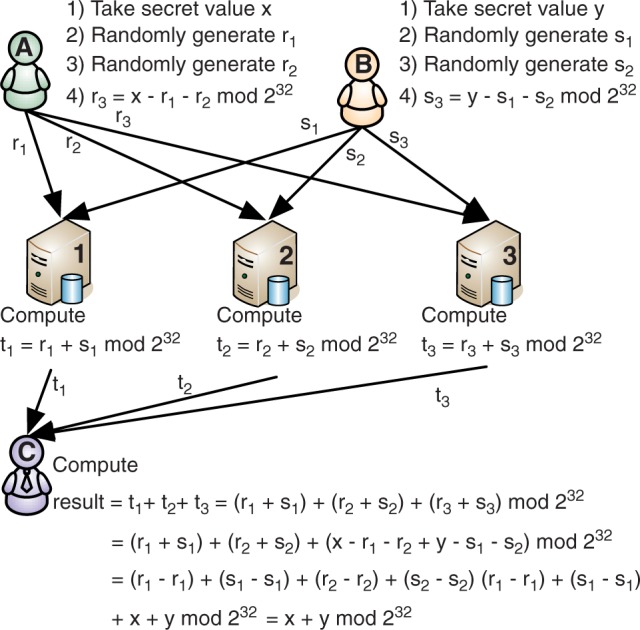
https://cdn.ncbi.nlm.nih.gov/pmc/blobs/21bc/3605601/714b9ce1610d/btt066f2p.jpg
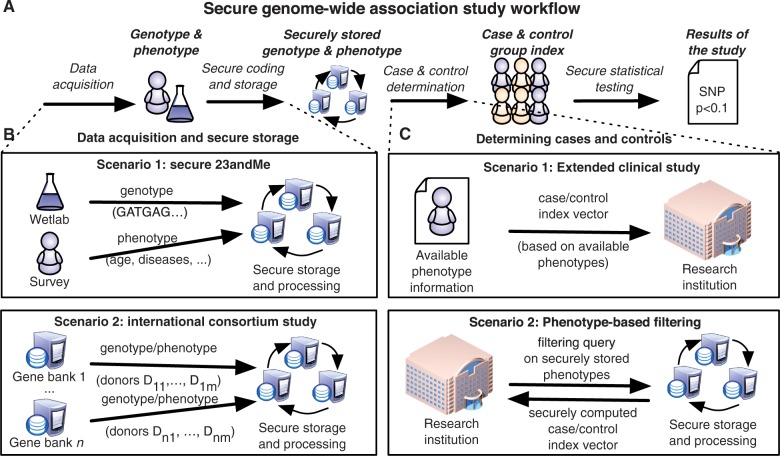
https://cdn.ncbi.nlm.nih.gov/pmc/blobs/21bc/3605601/4e4fa10c0a0f/btt066f1p.jpg
https://cdn.ncbi.nlm.nih.gov/pmc/blobs/21bc/3605601/714b9ce1610d/btt066f2p.jpg
https://cdn.ncbi.nlm.nih.gov/pmc/blobs/21bc/3605601/4e4fa10c0a0f/btt066f1p.jpg
https://cdn.ncbi.nlm.nih.gov/pmc/blobs/21bc/3605601/714b9ce1610d/btt066f2p.jpg

相似文献

1
A new way to protect privacy in large-scale genome-wide association studies.一种在大规模全基因组关联研究中保护隐私的新方法。
Bioinformatics. 2013 Apr 1;29(7):886-93. doi: 10.1093/bioinformatics/btt066. Epub 2013 Feb 14.
2
Differential privacy under dependent tuples-the case of genomic privacy.相依元组下的差分隐私-基因组隐私案例。
Bioinformatics. 2020 Mar 1;36(6):1696-1703. doi: 10.1093/bioinformatics/btz837.
3
Mechanisms to protect the privacy of families when using the transmission disequilibrium test in genome-wide association studies.在全基因组关联研究中使用传递不平衡检验时保护家庭隐私的机制。
Bioinformatics. 2017 Dec 1;33(23):3716-3725. doi: 10.1093/bioinformatics/btx470.
4
Realizing privacy preserving genome-wide association studies.实现隐私保护的全基因组关联研究。
Bioinformatics. 2016 May 1;32(9):1293-300. doi: 10.1093/bioinformatics/btw009. Epub 2016 Jan 14.
5
Security controls in an integrated Biobank to protect privacy in data sharing: rationale and study design.综合生物样本库中保护数据共享隐私的安全控制措施:基本原理与研究设计。
BMC Med Inform Decis Mak. 2017 Jul 6;17(1):100. doi: 10.1186/s12911-017-0494-5.
6
Ensuring privacy and security of genomic data and functionalities.确保基因组数据和功能的隐私和安全。
Brief Bioinform. 2020 Mar 23;21(2):511-526. doi: 10.1093/bib/bbz013.
7
Privacy-preserving construction of generalized linear mixed model for biomedical computation.用于生物医学计算的广义线性混合模型的隐私保护构建。
Bioinformatics. 2020 Jul 1;36(Suppl_1):i128-i135. doi: 10.1093/bioinformatics/btaa478.
8
Scalable privacy-preserving data sharing methodology for genome-wide association studies.用于全基因组关联研究的可扩展隐私保护数据共享方法
J Biomed Inform. 2014 Aug;50:133-41. doi: 10.1016/j.jbi.2014.01.008. Epub 2014 Feb 6.
9
SQC: secure quality control for meta-analysis of genome-wide association studies.SQC:全基因组关联研究荟萃分析的安全质量控制
Bioinformatics. 2017 Aug 1;33(15):2273-2280. doi: 10.1093/bioinformatics/btx193.
10
Achieving GWAS with homomorphic encryption.利用同态加密实现 GWAS。
BMC Med Genomics. 2020 Jul 21;13(Suppl 7):90. doi: 10.1186/s12920-020-0717-y.

引用本文的文献

1
Learning-augmented sketching offers improved performance for privacy preserving and secure GWAS.学习增强的草图绘制为隐私保护和安全的全基因组关联研究提供了更好的性能。
iScience. 2025 Feb 13;28(3):112011. doi: 10.1016/j.isci.2025.112011. eCollection 2025 Mar 21.
2
Learning-Augmented Sketching Offers Improved Performance for Privacy Preserving and Secure GWAS.学习增强的草图绘制为隐私保护和安全的全基因组关联研究提供了更好的性能。
bioRxiv. 2024 Sep 24:2024.09.19.613975. doi: 10.1101/2024.09.19.613975.
3
Privacy-Enhancing Technologies in Biomedical Data Science.

本文引用的文献

1
Identifying personal genomes by surname inference.姓氏推断识别个人基因组。
Science. 2013 Jan 18;339(6117):321-4. doi: 10.1126/science.1229566.
2
DataSHIELD: resolving a conflict in contemporary bioscience--performing a pooled analysis of individual-level data without sharing the data.DataSHIELD:解决当代生物科学中的冲突——在不共享数据的情况下对个体水平数据进行汇总分析。
Int J Epidemiol. 2010 Oct;39(5):1372-82. doi: 10.1093/ije/dyq111. Epub 2010 Jul 14.
3
Genome-wide association studies in common cancers--what have we learnt?全基因组关联研究在常见癌症中的应用——我们学到了什么?
生物医学数据科学中的隐私增强技术。
Annu Rev Biomed Data Sci. 2024 Aug;7(1):317-343. doi: 10.1146/annurev-biodatasci-120423-120107.
4
Genomic privacy preservation in genome-wide association studies: taxonomy, limitations, challenges, and vision.全基因组关联研究中的基因组隐私保护:分类法、局限性、挑战和展望。
Brief Bioinform. 2024 Jul 25;25(5). doi: 10.1093/bib/bbae356.
5
Sequre: a high-performance framework for secure multiparty computation enables biomedical data sharing.Sequre:一个高性能的安全多方计算框架,可实现生物医学数据共享。
Genome Biol. 2023 Jan 11;24(1):5. doi: 10.1186/s13059-022-02841-5.
6
EasySMPC: a simple but powerful no-code tool for practical secure multiparty computation.EasySMPC:一个简单而强大的实用安全多方计算无代码工具。
BMC Bioinformatics. 2022 Dec 9;23(1):531. doi: 10.1186/s12859-022-05044-8.
7
Sequre: a high-performance framework for rapid development of secure bioinformatics pipelines.Sequre:一个用于快速开发安全生物信息学管道的高性能框架。
IEEE Int Symp Parallel Distrib Process Workshops Phd Forum. 2022 May-Jun;2022:164-165. Epub 2022 Aug 1.
8
Privacy-preserving federated neural network learning for disease-associated cell classification.用于疾病相关细胞分类的隐私保护联邦神经网络学习
Patterns (N Y). 2022 Apr 18;3(5):100487. doi: 10.1016/j.patter.2022.100487. eCollection 2022 May 13.
9
sPLINK: a hybrid federated tool as a robust alternative to meta-analysis in genome-wide association studies.sPLINK:一种混合联邦工具,是全基因组关联研究中替代荟萃分析的强大选择。
Genome Biol. 2022 Jan 24;23(1):32. doi: 10.1186/s13059-021-02562-1.
10
Privacy-Preserving Artificial Intelligence Techniques in Biomedicine.生物医学中的隐私保护人工智能技术。
Methods Inf Med. 2022 Jun;61(S 01):e12-e27. doi: 10.1055/s-0041-1740630. Epub 2022 Jan 21.
Curr Opin Genet Dev. 2010 Jun;20(3):201-9. doi: 10.1016/j.gde.2010.03.012. Epub 2010 Apr 24.
4
A European survey on biobanks: trends and issues.一项关于生物样本库的欧洲调查:趋势与问题。
Public Health Genomics. 2011;14(2):96-103. doi: 10.1159/000296278. Epub 2010 Apr 15.
5
Genomics firms turn to other markets.基因公司转向其他市场。
Nature. 2010 Feb 18;463(7283):859. doi: 10.1038/463859a.
6
Bioinformatics challenges for genome-wide association studies.全基因组关联研究中的生物信息学挑战。
Bioinformatics. 2010 Feb 15;26(4):445-55. doi: 10.1093/bioinformatics/btp713. Epub 2010 Jan 6.
7
Machine learning in genome-wide association studies.全基因组关联研究中的机器学习。
Genet Epidemiol. 2009;33 Suppl 1:S51-7. doi: 10.1002/gepi.20473.
8
Public access to genome-wide data: five views on balancing research with privacy and protection.公众对全基因组数据的访问:关于平衡研究与隐私及保护的五种观点。
PLoS Genet. 2009 Oct;5(10):e1000665. doi: 10.1371/journal.pgen.1000665. Epub 2009 Oct 2.
9
The limits of individual identification from sample allele frequencies: theory and statistical analysis.根据样本等位基因频率进行个体识别的局限性:理论与统计分析
PLoS Genet. 2009 Oct;5(10):e1000628. doi: 10.1371/journal.pgen.1000628. Epub 2009 Oct 2.
10
Potential etiologic and functional implications of genome-wide association loci for human diseases and traits.全基因组关联位点对人类疾病和性状的潜在病因学及功能影响。
Proc Natl Acad Sci U S A. 2009 Jun 9;106(23):9362-7. doi: 10.1073/pnas.0903103106. Epub 2009 May 27.