Department of Public Health, Dokkyo Medical University School of Medicine, Shimotsugagun-Mibu, Tochigi, Japan.
PLoS One. 2013;8(2):e56319. doi: 10.1371/journal.pone.0056319. Epub 2013 Feb 12.
The proportion of Japanese workers experiencing intense worry or stress during working life is in excess of 60%, and the incidence of psychiatric disorders and suicide due to psychological burden from work duties is increasing. To confirm whether the stress response measured by the Brief Job Stress Questionnaire (BJSQ) can identify risk for depression, a cohort study was conducted to evaluate whether the stress response measured by BJSQ was associated with the onset of depression.
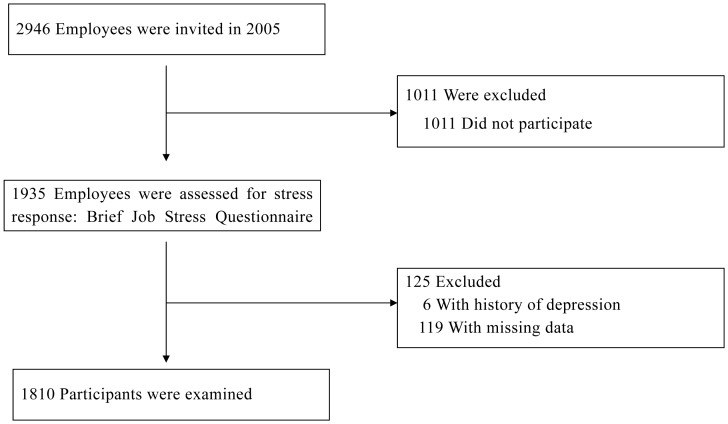
A total of 1,810 participants aged 20-70 years in 2005 completed the stress response of the BJSQ and were followed-up until August, 2007 by examining sick pay records. Depression was defined by a description in sick pay records that included "depression" or "depressive symptoms" as a reason for sick leave according to a physician's medical certificate. The participants were divided into quartiles (Ql, Q2, Q3, and Q4) according to the total stress response score of BJSQ at baseline. Furthermore, the participants were divided into a higher score category (Q4) and a lower score category (Q1-Q3). Risk ratios of the stress response of the BJSQ for onset of depression were calculated using a multivariable Cox proportional hazard model.
Among 1,810 participants, 14 developed depression during a mean of 1.8 years of follow-up. The risk ratio was 2.96 (95% confidence interval [CI], 1.04-8.42, p for trend = 0.002) when the higher stress response score category of BJSQ was compared with the low stress response score category for sick leave due to depression. After adjusting for gender, age, marital status, and having children, the risk ratios were similar to no adjustment.
These findings suggest that the stress response measured by the BJSQ can demonstrate risk for the onset of depression.
在工作生涯中,经历强烈担忧或压力的日本工人比例超过 60%,由于工作责任带来的心理负担而导致的精神障碍和自杀发病率正在上升。为了确认通过《简要工作压力问卷》(BJSQ)测量的压力反应是否能识别抑郁风险,进行了一项队列研究,以评估 BJSQ 测量的压力反应是否与抑郁发作有关。
2005 年,共有 1810 名 20-70 岁的参与者完成了 BJSQ 的压力反应测试,并通过检查病假记录,随访至 2007 年 8 月。根据医生的医疗证明,病假记录中包含“抑郁”或“抑郁症状”作为病假原因的描述来定义抑郁。根据基线时 BJSQ 的总压力反应评分,参与者被分为四组(Q1、Q2、Q3 和 Q4)。此外,参与者被分为高分组(Q4)和低分组(Q1-Q3)。使用多变量 Cox 比例风险模型计算 BJSQ 压力反应对抑郁发作的风险比。
在 1810 名参与者中,14 名在平均 1.8 年的随访期间患上了抑郁症。与低压力反应评分组相比,BJSQ 的高压力反应评分组的病假因抑郁而发病的风险比为 2.96(95%置信区间[CI],1.04-8.42,趋势检验 p=0.002)。在调整了性别、年龄、婚姻状况和子女状况后,风险比与未调整时相似。
这些发现表明,BJSQ 测量的压力反应可以显示出抑郁发作的风险。