Hirokawa Kumi, Ohira Tetsuya, Kajiura Mitsugu, Imano Hironori, Kitamura Akihiko, Kiyama Masahiko, Okada Takeo, Iso Hiroyasu
Department of Nursing, Baika Women's University.
Public Health, Department of Social Medicine, Osaka University Graduate School of Medicine.
Fukushima J Med Sci. 2020 Aug 4;66(2):88-96. doi: 10.5387/fms.2019-15. Epub 2020 Jun 27.
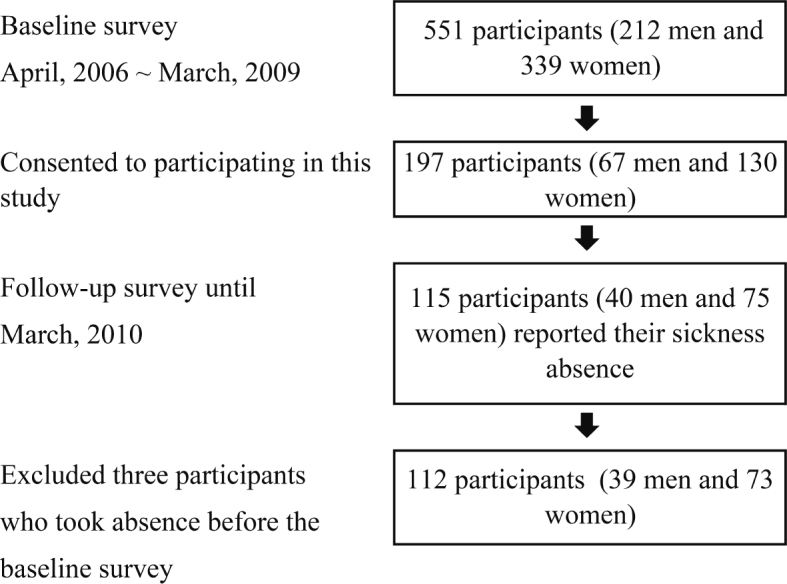
This study aimed to investigate associations between Brief Job Stress Questionnaire (BJSQ)-measured job stress factors and sickness absence in Japanese workers. Among 551 healthy, employed Japanese men and women (age range: 21-73 years) who underwent mental health examinations at the Osaka Medical Center for Health Science and Promotion between 2006 and 2009, 197 (67 men, 130 women) consented to participate in this study. Their sickness absences until the end of March 2010 were then followed-up via postal mail survey, with 112 participants effectively responding to the question on sickness absence (56.9%). The hazard ratio (HR) and 95% confidence interval (CI) were calculated using the Cox proportional hazards model, adjusting for age, sex, and lifestyle factors. Among the 112 respondents, 12 took sickness absence after their study entry, as found during the mean 2.3 years of follow-up (258.8 person-years). Among all sickness absences, those of eight participants were because of mental illness. Physical demands were positively associated with increased risks of all sickness absence (adjusted HR: 2.78, 95% CI: 1.01-7.64). Physical demands were predictive for all sickness absence, and should be alleviated at workplaces to prevent such absence.
本研究旨在调查通过简短工作压力问卷(BJSQ)测量的工作压力因素与日本员工病假之间的关联。在2006年至2009年期间于大阪健康科学与促进医学中心接受心理健康检查的551名健康在职日本男性和女性(年龄范围:21 - 73岁)中,197人(67名男性,130名女性)同意参与本研究。随后通过邮政邮件调查对他们截至2010年3月底的病假情况进行随访,112名参与者有效回答了关于病假的问题(56.9%)。使用Cox比例风险模型计算风险比(HR)和95%置信区间(CI),并对年龄、性别和生活方式因素进行了调整。在112名受访者中,有12人在进入研究后请了病假,这是在平均2.3年的随访期间(258.8人年)发现的。在所有病假中,8名参与者的病假是因为精神疾病。体力需求与所有病假风险增加呈正相关(调整后HR:2.78,95%CI:1.01 - 7.64)。体力需求可预测所有病假情况,工作场所应减轻此类需求以防止病假。