Department of Pharmacy Practice, School of Pharmacy, South College, Knoxville, TN, USA.
Respir Res. 2013 Feb 23;14(1):26. doi: 10.1186/1465-9921-14-26.
Little is known about factors contributing to children's asthma control status and health-related quality of life (HRQoL). The study objectives were to assess the relationship between asthma control and asthma-specific HRQoL in asthmatic children, and to examine the extent to which parental health literacy, perceived self-efficacy with patient-physician interaction, and satisfaction with shared decision-making (SDM) contribute to children's asthma control and asthma-specific HRQoL.
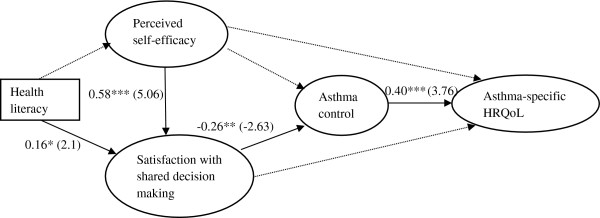
This cross-sectional study utilized data collected from a sample of asthmatic children (n = 160) aged 8-17 years and their parents (n = 160) who visited a university medical center. Asthma-specific HRQoL was self-reported by children using the National Institutes of Health's Patient-Reported Outcomes Measurement Information System (PROMIS) Pediatric Asthma Impact Scale. Satisfaction with SDM, perceived self-efficacy with patient-physician interaction, parental health literacy, and asthma control were reported by parents using standardized measures. Structural equation modeling (SEM) was performed to test the hypothesized pathways.
Path analysis revealed that children with better asthma control reported higher asthma-specific HRQoL (β = 0.4, P < 0.001). Parents with higher health literacy and greater perceived self-efficacy with patient-physician interactions were associated with higher satisfaction with SDM (β = 0.38, P < 0.05; β = 0.58, P < 0.001, respectively). Greater satisfaction with SDM was in turn associated with better asthma control (β = -0.26, P < 0.01).
Children's asthma control status influenced their asthma-specific HRQoL. However, parental factors such as perceived self-efficacy with patient-physician interaction and satisfaction with shared decision-making indirectly influenced children's asthma control status and asthma-specific HRQoL.
对于导致儿童哮喘控制状况和健康相关生活质量(HRQoL)的因素知之甚少。本研究旨在评估哮喘儿童哮喘控制与哮喘特异性 HRQoL 之间的关系,并研究父母健康素养、医患互动感知自我效能和对共享决策(SDM)的满意度在多大程度上影响儿童哮喘控制和哮喘特异性 HRQoL。
本横断面研究利用了从大学医疗中心就诊的哮喘儿童(n=160)及其父母(n=160)的样本数据。儿童使用 NIH 患者报告的结果测量信息系统(PROMIS)儿科哮喘影响量表自我报告哮喘特异性 HRQoL。父母使用标准化量表报告对 SDM 的满意度、医患互动感知自我效能、父母健康素养和哮喘控制情况。采用结构方程模型(SEM)检验假设路径。
路径分析显示,哮喘控制较好的儿童报告哮喘特异性 HRQoL 较高(β=0.4,P<0.001)。父母健康素养和医患互动感知自我效能较高与对 SDM 的满意度较高相关(β=0.38,P<0.05;β=0.58,P<0.001)。对 SDM 的满意度较高与哮喘控制较好相关(β=-0.26,P<0.01)。
儿童哮喘控制状况影响其哮喘特异性 HRQoL。然而,父母的因素,如医患互动感知自我效能和对共享决策的满意度,间接地影响儿童的哮喘控制状况和哮喘特异性 HRQoL。