Caorsi Roberta, Lepore Loredana, Zulian Francesco, Alessio Maria, Stabile Achille, Insalaco Antonella, Finetti Martina, Battagliese Antonella, Martini Giorgia, Bibalo Chiara, Martini Alberto, Gattorno Marco
Arthritis Res Ther. 2013 Feb 26;15(1):R33. doi: 10.1186/ar4184.
Interleukin-1 (IL-1) blockade is the treatment of choice of cryopyrin associated periodic syndromes (CAPS). Anti-IL-1 monoclonal antibody (canakinumab) was recently registered. However no clear data are available on the optimal schedule of administration of this drug. The aim of the present study was to analyse the impact of canakinumab on CAPS patients in daily clinical practice and to identify the best schedule of administration according to age and phenotype.
13 CAPS patients (10 children and 3 young adults) treated with canakinumab were followed for 12 months. Clinical and laboratory parameters were collected at each visit. Health-related quality of life (HRQoL) was recorded at month 12. Complete response was defined as absence of clinical manifestations and normal examinations. Clinical and laboratory variables at last follow-up were compared with those registered at the moment of anakinra discontinuation.
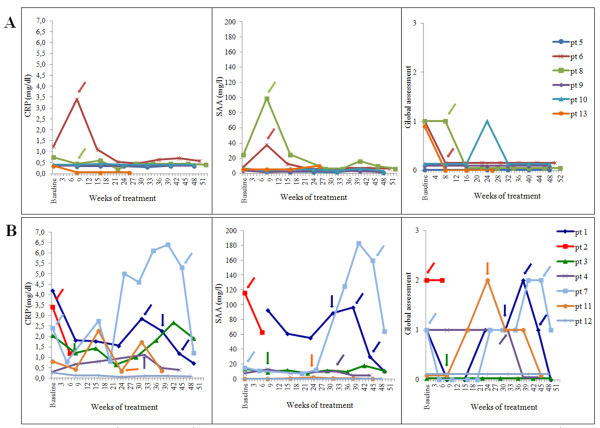
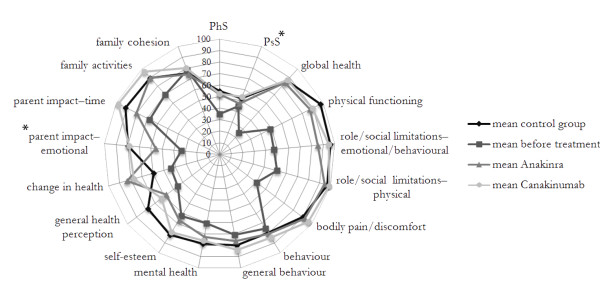
seven patients with chronic infantile neurological cutaneous articular (CINCA) syndrome, four patients with Muckle-Wells syndrome (MWS) and two patients with an overlapping MWS/CINCA phenotype were analysed. CINCA patients experienced a higher number of modifications of the treatment (increased dosage or decreased dosing interval) in respect to MWS patients. At the end of the follow-up CINCA patients displayed a higher frequency of administration with a median dose of 3.7 mg/kg (2.1 mg/kg for MWS patients). Canakinumab was withdrawn in a patient with CINCA for incomplete response and poor compliance. The effect of canakinumab on HRQoL was similar to that observed during treatment with anakinra, with the exception of an improvement of the psychosocial concepts after the introduction of canakinumab.
The use of canakinumab in daily practice is associated with persistent satisfactory control of disease activity but needs progressive dose adjustments in more severe patients. The clinical phenotype, rather than the age, represents the main variable able to determine the need of more frequent administrations of the drug at higher dosage.
白细胞介素-1(IL-1)阻断疗法是治疗冷吡啉相关周期性综合征(CAPS)的首选方法。抗IL-1单克隆抗体(卡那单抗)最近已获批上市。然而,关于该药物的最佳给药方案尚无明确数据。本研究的目的是分析卡那单抗在日常临床实践中对CAPS患者的影响,并根据年龄和表型确定最佳给药方案。
对13例接受卡那单抗治疗的CAPS患者(10例儿童和3例青年成人)进行了为期12个月的随访。每次随访时收集临床和实验室参数。在第12个月记录健康相关生活质量(HRQoL)。完全缓解定义为无临床表现且检查结果正常。将最后一次随访时的临床和实验室变量与阿那白滞素停药时记录的变量进行比较。
分析了7例慢性婴儿神经皮肤关节综合征(CINCA)患者、4例穆克-韦尔斯综合征(MWS)患者和2例MWS/CINCA重叠表型患者。与MWS患者相比,CINCA患者的治疗调整次数更多(剂量增加或给药间隔缩短)。随访结束时,CINCA患者的给药频率更高,中位剂量为3.7 mg/kg(MWS患者为2.1 mg/kg)。1例CINCA患者因反应不完全和依从性差而停用卡那单抗。卡那单抗对HRQoL的影响与阿那白滞素治疗期间观察到的相似,但引入卡那单抗后心理社会概念有所改善。
在日常实践中使用卡那单抗可使疾病活动得到持续满意的控制,但在病情较重的患者中需要逐步调整剂量。临床表型而非年龄是决定是否需要更频繁地给予更高剂量药物的主要变量。