Medical University of Vienna, Vienna, Austria.
BMC Womens Health. 2013 Feb 28;13:9. doi: 10.1186/1472-6874-13-9.
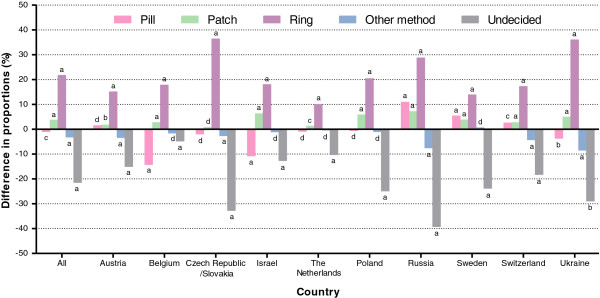
The European CHOICE study was a cross-sectional survey that evaluated women's combined hormonal contraceptive choices before and after contraceptive counseling in Austria, Belgium, Czech Republic and Slovakia, the Netherlands, Poland, Sweden, Switzerland, Israel, Russia, and Ukraine. The changes in method selection before and after counseling were reported previously. In this paper we present the reasons given by the 18,787 participating women for selecting their contraceptive method of choice, as well as their perceptions about the contraceptive pill, patch, and ring after counseling.
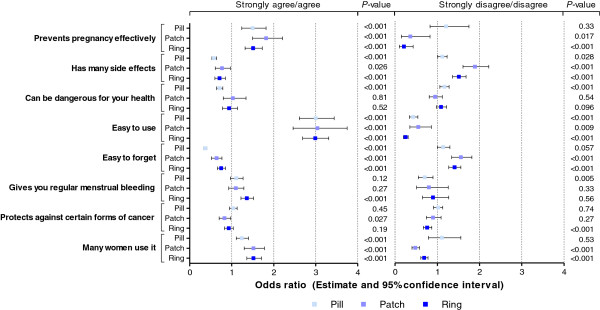
Women with an interest in a combined hormonal contraceptive method (pill, patch, or ring) were counseled using a standardized counseling leaflet. The women completed questionnaires, which included questions on why they had selected a particular method of contraception, and the extent to which they agreed with statements about the attributes of the pill, patch, and ring. The results for each country were compared with the percentages for all countries combined by using a binomial regression model. Multiple logistic regression models were used to investigate the extent to which the probability of choosing a method was related to prespecified aspects (i.e. perceptions) of each contraceptive method.
'Easy to use', 'convenience', and 'regular menstrual bleeding' were important selection criteria. 'Nondaily administration' was one of the main reasons women selected the patch or ring. 'Daily use' and 'will forget to take it' were the primary reasons for not selecting the pill, while the main reasons for not choosing the patch included 'not discrete, visible' and 'can fall off'. In a small number of instances, the ring was rejected because some women don't like to use a 'foreign body'. Women's perceptions influenced their contraceptive decisions: positive perceptions about a method increased the likelihood that a woman would select it. After counseling, many women associated the pill with forgetfulness, and many still did not know about the patch or ring's key attributes. Women's knowledge about a particular method was generally greater if they had chosen it.
To support informed contraceptive decision-making, healthcare professionals should realize that a woman's view of a method's ease of use is more important than perceived efficacy, tolerability, health benefits, or risks.
CHOICE 研究是一项横断面调查,评估了奥地利、比利时、捷克共和国、斯洛伐克、荷兰、波兰、瑞典、瑞士、以色列、俄罗斯和乌克兰的妇女在接受避孕咨询前后的复方激素避孕选择变化。此前已经报道了咨询前后方法选择的变化。在本文中,我们介绍了 18787 名参与研究的妇女选择避孕方法的原因,以及她们在咨询后对避孕丸、贴剂和环的看法。
对有兴趣使用复方激素避孕方法(丸剂、贴剂或环)的妇女进行标准化咨询单页咨询。妇女填写调查问卷,包括选择特定避孕方法的原因,以及对避孕丸、贴剂和环的属性的同意程度。每个国家的结果与所有国家的百分比进行比较,使用二项回归模型。多因素逻辑回归模型用于调查选择某种方法的概率与每个避孕方法的特定方面(即看法)之间的关系。
“易于使用”、“方便”和“规律的月经出血”是重要的选择标准。“无需每日给药”是妇女选择贴剂或环的主要原因之一。“每日用药”和“会忘记服用”是不选择避孕药的主要原因,而不选择贴剂的主要原因包括“不隐蔽,可见”和“可能脱落”。在少数情况下,环被拒绝是因为一些妇女不喜欢使用“异物”。妇女的看法影响她们的避孕决定:对一种方法的积极看法增加了妇女选择它的可能性。咨询后,许多妇女认为避孕药会导致健忘,而且许多妇女仍然不了解贴剂或环的关键属性。如果妇女选择了某种方法,她们对该方法的了解通常会更多。
为了支持知情的避孕决策,医疗保健专业人员应认识到,妇女对方法易用性的看法比感知的疗效、耐受性、健康益处或风险更为重要。