Ternesten-Hasséus Ewa, Larsson Christel, Larsson Sven, Millqvist Eva
Department of Allergology, Institution of Internal Medicine, the Sahlgrenska Academy at University of Gothenburg, Gothenburg, Sweden.
Cough. 2013 Feb 28;9(1):5. doi: 10.1186/1745-9974-9-5.
A subgroup of patients with chronic cough is recognised as having airway symptoms resulting exposure to chemicals and scents related to enhanced cough sensitivity to inhaled capsaicin. Sensory hyperreactivity, which has an estimated prevalence of more than 6%, is one possible explanation for the symptoms experienced by these patients. We hypothesized that a number of patients diagnosed with chronic unexplained cough also have coughing provoked by chemical irritants associated with augmented capsaicin cough reaction, but the extent of such a relation is not known. One aim of the present study was to analyse cough sensitivity to inhaled capsaicin in patients with chronic unexplained cough. Another aim was to compare capsaicin sensitivity in individuals with chemically induced coughing (the chemical-sensitive group) to capsaicin sensitivity in those without such chemical sensitivity (non-sensitive group).
Fifty-six participants from an earlier cross-sectional study of 62 patients with chronic unexplained cough were asked to participate in this study: 33 were chemical-sensitive and 23 were non-sensitive. Each participant visited the clinic once and performed a capsaicin inhalation test with one of two inhalation devices. The number of coughs, induced airway symptoms, and spirometry results were recorded.
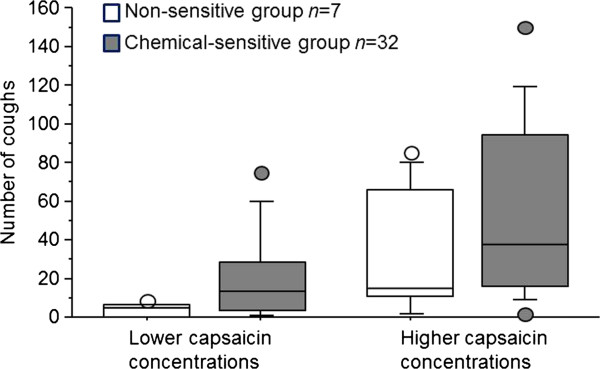
Thirty-nine of the invited patients participated in the study, with 32 in the chemical-sensitive group (21 women, 11 men), and 7 in the non-sensitive group (4 women, 3 men). The chemical-sensitive patients coughed significantly more on inhaling capsaicin, and had significantly more other airway symptoms compared to those in the non-sensitive group. Women coughed significantly more than men after receiving the higher concentration of capsaicin.
Environmental irritants often trigger chronic unexplained cough. The current findings confirm that this sensitivity is related to enhanced capsaicin cough sensitivity and indicates more involvement of airway sensory nerves in the pathophysiology of the disease than in cough without evident trigger factors.
慢性咳嗽患者的一个亚组被认为存在气道症状,这是由于接触与吸入辣椒素咳嗽敏感性增强相关的化学物质和气味所致。感觉超敏反应估计患病率超过6%,是这些患者所经历症状的一种可能解释。我们推测,许多被诊断为慢性不明原因咳嗽的患者也会因与辣椒素咳嗽反应增强相关的化学刺激物而引发咳嗽,但这种关系的程度尚不清楚。本研究的一个目的是分析慢性不明原因咳嗽患者对吸入辣椒素的咳嗽敏感性。另一个目的是比较化学诱导咳嗽患者(化学敏感组)与无此类化学敏感性患者(非敏感组)对辣椒素的敏感性。
在之前一项对62例慢性不明原因咳嗽患者进行的横断面研究中的56名参与者被邀请参加本研究:33名是化学敏感者,23名是非敏感者。每位参与者到诊所就诊一次,使用两种吸入装置之一进行辣椒素吸入试验。记录咳嗽次数、诱发的气道症状和肺功能检查结果。
39名受邀患者参加了研究,其中化学敏感组32名(21名女性,11名男性),非敏感组7名(4名女性,3名男性)。与非敏感组相比,化学敏感患者吸入辣椒素时咳嗽明显更多,且有明显更多的其他气道症状。接受较高浓度辣椒素后,女性咳嗽明显多于男性。
环境刺激物常引发慢性不明原因咳嗽。目前的研究结果证实,这种敏感性与辣椒素咳嗽敏感性增强有关,表明气道感觉神经在该疾病的病理生理学中比在无明显触发因素的咳嗽中参与更多。