Department of Chemical Engineering, University of California, Santa Barbara, California 93106, USA.
Biomacromolecules. 2013 Apr 8;14(4):1072-7. doi: 10.1021/bm301908y. Epub 2013 Mar 14.
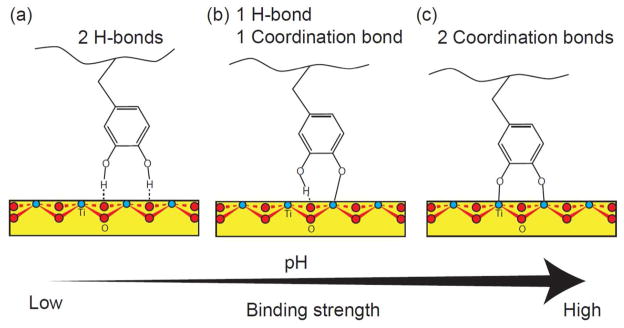
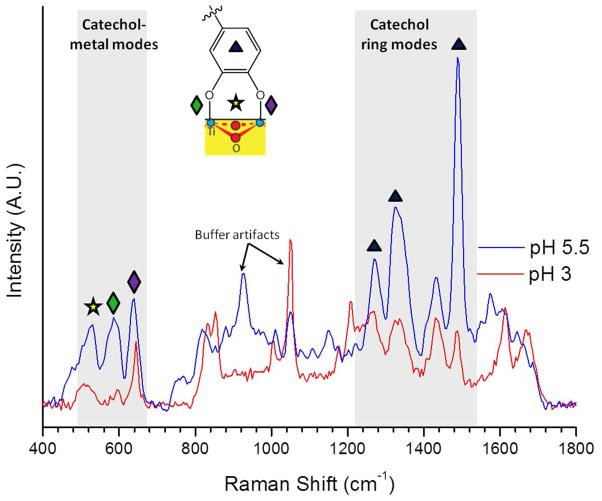
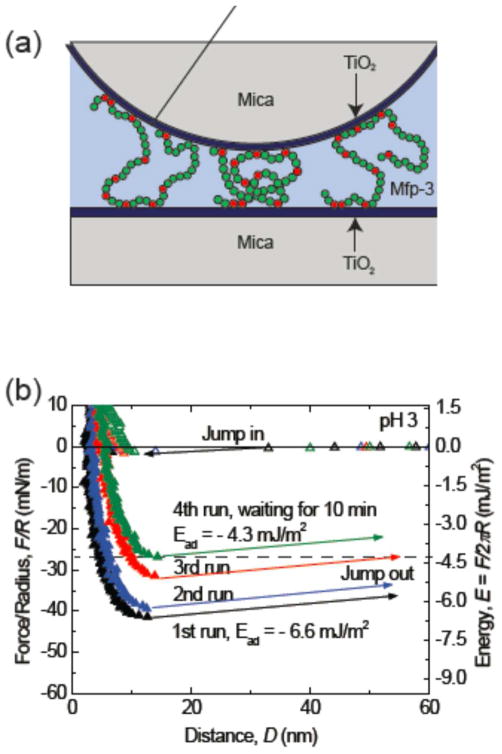
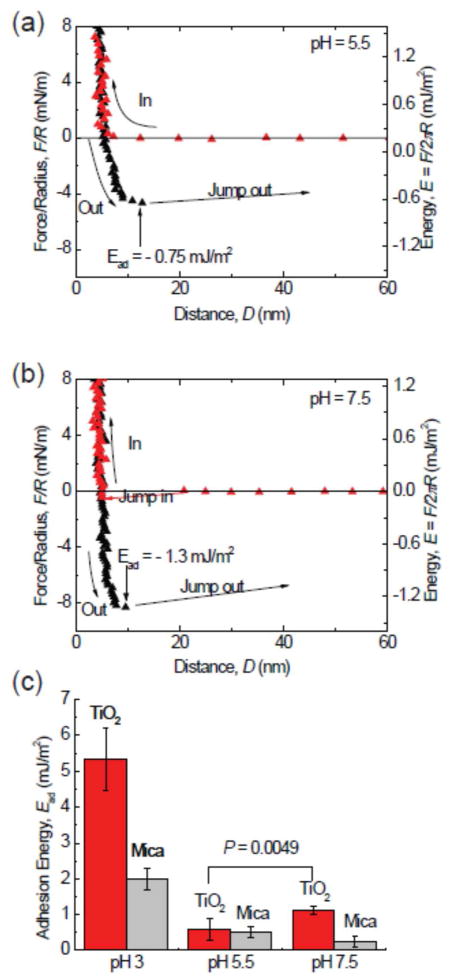
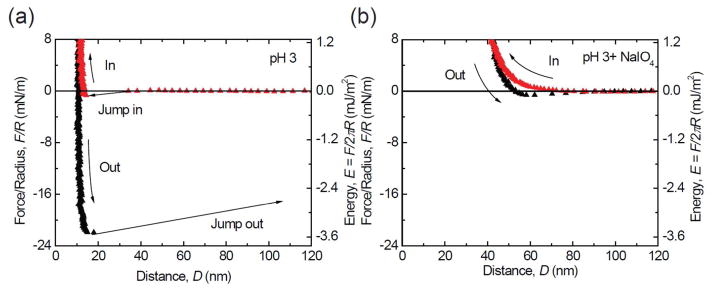
The underwater adhesion of marine mussels relies on mussel foot proteins (mfps) rich in the catecholic amino acid 3,4-dihydroxyphenylalanine (Dopa). As a side chain, Dopa is capable of strong bidentate interactions with a variety of surfaces, including many minerals and metal oxides. Titanium is among the most widely used medical implant material and quickly forms a TiO2 passivation layer under physiological conditions. Understanding the binding mechanism of Dopa to TiO2 surfaces is therefore of considerable theoretical and practical interest. Using a surface forces apparatus, we explored the force-distance profiles and adhesion energies of mussel foot protein 3 (mfp-3) to TiO2 surfaces at three different pHs (pH 3, 5.5 and 7.5). At pH 3, mfp-3 showed the strongest adhesion force on TiO2, with an adhesion energy of ∼-7.0 mJ/m(2). Increasing the pH gives rise to two opposing effects: (1) increased oxidation of Dopa, thus, decreasing availability for the Dopa-mediated adhesion, and (2) increased bidentate Dopa-Ti coordination, leading to the further stabilization of the Dopa group and, thus, an increase in adhesion force. Both effects were reflected in the resonance-enhanced Raman spectra obtained at the three deposition pHs. The two competing effects give rise to a higher adhesion force of mfp-3 on the TiO2 surface at pH 7.5 than at pH 5.5. Our results suggest that Dopa-containing proteins and synthetic polymers have great potential as coating materials for medical implant materials, particularly if redox activity can be controlled.
海洋贻贝的水下附着依赖于富含儿茶酚氨基酸 3,4-二羟基苯丙氨酸(Dopa)的贻贝脚蛋白(mfps)。作为侧链,Dopa 能够与多种表面(包括许多矿物质和金属氧化物)进行强双齿相互作用。钛是最广泛使用的医用植入材料之一,在生理条件下迅速形成 TiO2 钝化层。因此,了解 Dopa 与 TiO2 表面的结合机制具有相当大的理论和实际意义。我们使用表面力仪研究了在三个不同 pH 值(pH 3、5.5 和 7.5)下贻贝脚蛋白 3(mfp-3)与 TiO2 表面的力-距离曲线和粘附能。在 pH 3 时,mfp-3 在 TiO2 上表现出最强的粘附力,粘附能约为-7.0 mJ/m2。增加 pH 值会产生两种相反的影响:(1)Dopa 的氧化增加,从而降低了 Dopa 介导的粘附的可用性,(2)增加了双齿 Dopa-Ti 配位,导致 Dopa 基团进一步稳定,从而增加了粘附力。这两种效应都反映在在三个沉积 pH 值下获得的共振增强拉曼光谱中。两种竞争效应导致 mfp-3 在 pH 7.5 下的 TiO2 表面的粘附力高于在 pH 5.5 下的粘附力。我们的结果表明,含 Dopa 的蛋白质和合成聚合物具有作为医用植入材料涂层材料的巨大潜力,特别是如果可以控制氧化还原活性的话。