• 文献检索
  • 文档翻译
  • 深度研究
  • 学术资讯
  • Suppr Zotero 插件Zotero 插件
  • 邀请有礼
  • 套餐&价格
  • 历史记录
应用&插件
Suppr Zotero 插件Zotero 插件浏览器插件Mac 客户端Windows 客户端微信小程序
定价
高级版会员购买积分包购买API积分包
服务
文献检索文档翻译深度研究API 文档MCP 服务
关于我们
关于 Suppr公司介绍联系我们用户协议隐私条款
关注我们

Suppr 超能文献

核心技术专利:CN118964589B侵权必究
粤ICP备2023148730 号-1Suppr @ 2026

文献检索

告别复杂PubMed语法,用中文像聊天一样搜索,搜遍4000万医学文献。AI智能推荐,让科研检索更轻松。

立即免费搜索

文件翻译

保留排版,准确专业,支持PDF/Word/PPT等文件格式,支持 12+语言互译。

免费翻译文档

深度研究

AI帮你快速写综述,25分钟生成高质量综述,智能提取关键信息,辅助科研写作。

立即免费体验

用户特征如何影响针对乳腺癌和前列腺癌患者的基于网络的疾病管理支持中的使用模式。

How user characteristics affect use patterns in web-based illness management support for patients with breast and prostate cancer.

作者信息

Børøsund Elin, Cvancarova Milada, Ekstedt Mirjam, Moore Shirley M, Ruland Cornelia M

机构信息

Centre for Shared Decision Making and Collaborative Care Research, Oslo University Hospital, Oslo 0424, Norway.

出版信息

J Med Internet Res. 2013 Mar 1;15(3):e34. doi: 10.2196/jmir.2285.

DOI:10.2196/jmir.2285
PMID:23454601
原文链接:https://pmc.ncbi.nlm.nih.gov/articles/PMC3636230/
Abstract

BACKGROUND

Frequently eHealth applications are not used as intended and they have high attrition rates; therefore, a better understanding of patients' need for support is warranted. Specifically, more research is needed to identify which system components target different patient groups and under what conditions.

OBJECTIVE

To explore user characteristics associated with the use of different system components of a Web-based illness management support system for cancer patients (WebChoice).

METHODS

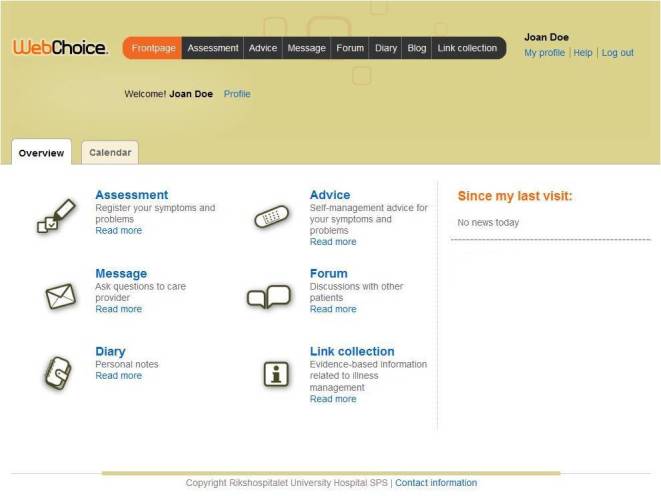
For this secondary post hoc analysis of a large randomized controlled trial (RCT), in which WebChoice was tested among 325 breast cancer and prostate cancer patients who were followed with repeated measures for 1 year, usage patterns of 162 cancer patients in the intervention arm with access to WebChoice were extracted from the user log. Logistic regression was performed to identify patterns of associations between system use and patient characteristics. Latent class analyses (LCA) were performed to identify associations among the use of different system components and levels of social support, symptom distress, depression, self-efficacy, and health-related quality of life.

RESULTS

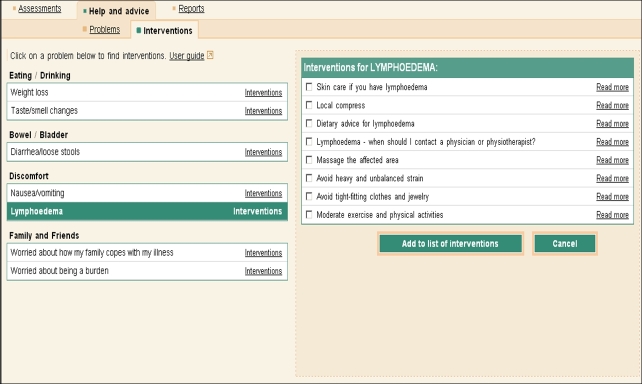
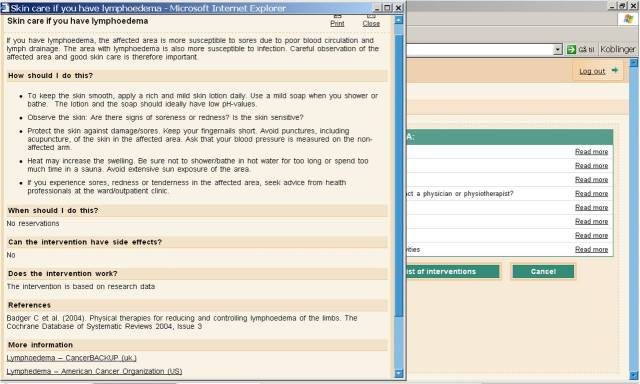
Approximately two-thirds (103/162, 63.6%) of the patients logged on to WebChoice more than once, and were defined as users. A high level of computer experience (odds ratio [OR] 3.77, 95% CI 1.20-11.91) and not having other illnesses in addition to cancer (OR 2.10, 95% CI 1.02-4.34) increased the overall probability of using WebChoice. LCA showed that both men with prostate cancer and women with breast cancer who had low scores on social support accompanied with high levels of symptom distress and high levels of depression were more likely to use the e-message component. For men with prostate cancer, these variables were also associated with high use of the self-management advice component. We found important differences between men with prostate cancer and women with breast cancer when associations between WebChoice use and each user characteristic were analyzed separately. High use of all components was associated with low levels of social support among women with breast cancer, but not among men with prostate cancer. High use of e-messages, advice, and the discussion forum were associated with high levels of depression among women with breast cancer, but not among men with prostate cancer. For men with prostate cancer (but not women with breast cancer), high use of symptom assessments, advice, and the discussion forum were associated with high levels of symptom distress. However, it is unclear whether these findings can be attributed to differences related to diagnosis, gender, or both.

CONCLUSIONS

This study provides evidence that different user characteristics are associated with different use patterns. Such information is crucial to target Web-based support systems to different patient groups. LCA is a useful technique to identify subgroups of users. In our study, e-messages and self-management advice were highly used components for patients who had low levels of social support and high illness burden, suggesting that patients with these characteristics may find such tools particularly useful.

TRIAL REGISTRATION

ClinicalTrials.gov NCT00710658; http://clinicaltrials.gov/ct2/show/NCT00710658 (Archived by WebCite at http://www.webcitation.org/6EmEWZiwz).
https://cdn.ncbi.nlm.nih.gov/pmc/blobs/78d2/3636230/fa485e7edbda/jmir_v15i3e34_fig3.jpg
https://cdn.ncbi.nlm.nih.gov/pmc/blobs/78d2/3636230/9271a20793c1/jmir_v15i3e34_fig1.jpg
https://cdn.ncbi.nlm.nih.gov/pmc/blobs/78d2/3636230/09b9fcec3c12/jmir_v15i3e34_fig2.jpg
https://cdn.ncbi.nlm.nih.gov/pmc/blobs/78d2/3636230/fa485e7edbda/jmir_v15i3e34_fig3.jpg
https://cdn.ncbi.nlm.nih.gov/pmc/blobs/78d2/3636230/9271a20793c1/jmir_v15i3e34_fig1.jpg
https://cdn.ncbi.nlm.nih.gov/pmc/blobs/78d2/3636230/09b9fcec3c12/jmir_v15i3e34_fig2.jpg
https://cdn.ncbi.nlm.nih.gov/pmc/blobs/78d2/3636230/fa485e7edbda/jmir_v15i3e34_fig3.jpg
摘要

背景

电子健康应用程序常常未按预期使用,且流失率很高;因此,有必要更好地了解患者对支持的需求。具体而言,需要更多研究来确定哪些系统组件针对不同患者群体以及在何种条件下适用。

目的

探讨与基于网络的癌症患者疾病管理支持系统(WebChoice)不同系统组件使用相关的用户特征。

方法

对于这项大型随机对照试验(RCT)的二次事后分析,在325名乳腺癌和前列腺癌患者中对WebChoice进行了测试,并对其进行了为期1年的重复测量跟踪,从用户日志中提取了干预组中162名有权使用WebChoice的癌症患者的使用模式。进行逻辑回归以确定系统使用与患者特征之间的关联模式。进行潜在类别分析(LCA)以确定不同系统组件的使用与社会支持水平、症状困扰、抑郁、自我效能感以及健康相关生活质量之间的关联。

结果

约三分之二(103/162,63.6%)的患者多次登录WebChoice,被定义为用户。高水平的计算机经验(优势比[OR] 3.77,95%置信区间1.20 - 11.91)以及除癌症外没有其他疾病(OR 2.10,95%置信区间1.02 - 4.34)增加了使用WebChoice的总体概率。LCA显示,社会支持得分低、症状困扰水平高且抑郁水平高的前列腺癌男性和乳腺癌女性更有可能使用电子信息组件。对于前列腺癌男性,这些变量也与自我管理建议组件的高使用率相关。当分别分析WebChoice使用与每个用户特征之间的关联时,我们发现前列腺癌男性和乳腺癌女性之间存在重要差异。乳腺癌女性中所有组件的高使用率与低社会支持水平相关,但前列腺癌男性并非如此。乳腺癌女性中电子信息、建议和讨论论坛的高使用率与高抑郁水平相关,但前列腺癌男性并非如此。对于前列腺癌男性(而非乳腺癌女性),症状评估、建议和讨论论坛的高使用率与高症状困扰水平相关。然而,尚不清楚这些发现是否可归因于与诊断、性别或两者相关的差异。

结论

本研究提供了证据表明不同的用户特征与不同的使用模式相关。此类信息对于将基于网络的支持系统针对不同患者群体至关重要。LCA是识别用户亚组的有用技术。在我们的研究中,电子信息和自我管理建议是社会支持水平低且疾病负担高的患者高度使用的组件,这表明具有这些特征的患者可能会发现此类工具特别有用。

试验注册

ClinicalTrials.gov NCT00710658;http://clinicaltrials.gov/ct2/show/NCT00710658(由WebCite存档于http://www.webcitation.org/6EmEWZiwz)。

相似文献

1
How user characteristics affect use patterns in web-based illness management support for patients with breast and prostate cancer.用户特征如何影响针对乳腺癌和前列腺癌患者的基于网络的疾病管理支持中的使用模式。
J Med Internet Res. 2013 Mar 1;15(3):e34. doi: 10.2196/jmir.2285.
2
Comparing effects in regular practice of e-communication and Web-based self-management support among breast cancer patients: preliminary results from a randomized controlled trial.比较电子通信和基于网络的自我管理支持在乳腺癌患者常规治疗中的效果:一项随机对照试验的初步结果。
J Med Internet Res. 2014 Dec 18;16(12):e295. doi: 10.2196/jmir.3348.
3
Evaluation of different features of an eHealth application for personalized illness management support: cancer patients' use and appraisal of usefulness.评估电子健康应用程序在个性化疾病管理支持方面的不同特征:癌症患者的使用情况及其对有用性的评价。
Int J Med Inform. 2013 Jul;82(7):593-603. doi: 10.1016/j.ijmedinf.2013.02.007. Epub 2013 Mar 16.
4
Effects of an internet support system to assist cancer patients in reducing symptom distress: a randomized controlled trial.互联网支持系统对减轻癌症患者症状困扰的效果:一项随机对照试验。
Cancer Nurs. 2013 Jan-Feb;36(1):6-17. doi: 10.1097/NCC.0b013e31824d90d4.
5
Usage of a generic web-based self-management intervention for breast cancer survivors: substudy analysis of the BREATH trial.一种基于网络的通用自我管理干预措施在乳腺癌幸存者中的应用:BREATH试验的子研究分析
J Med Internet Res. 2013 Aug 19;15(8):e170. doi: 10.2196/jmir.2566.
6
Engagement in an Interactive App for Symptom Self-Management during Treatment in Patients With Breast or Prostate Cancer: Mixed Methods Study.参与交互式应用程序进行症状自我管理在患有乳腺癌或前列腺癌的患者治疗中:混合方法研究。
J Med Internet Res. 2020 Aug 10;22(8):e17058. doi: 10.2196/17058.
7
Exposure to a patient-centered, Web-based intervention for managing cancer symptom and quality of life issues: impact on symptom distress.接触以患者为中心的基于网络的干预措施以管理癌症症状和生活质量问题:对症状困扰的影响。
J Med Internet Res. 2015 Jun 3;17(6):e136. doi: 10.2196/jmir.4190.
8
Designing tailored Internet support to assist cancer patients in illness management.设计量身定制的互联网支持服务以协助癌症患者进行疾病管理。
AMIA Annu Symp Proc. 2007 Oct 11;2007:635-9.
9
Mobile Breast Cancer e-Support Program for Chinese Women With Breast Cancer Undergoing Chemotherapy (Part 2): Multicenter Randomized Controlled Trial.针对接受化疗的中国乳腺癌女性的移动乳腺癌电子支持项目(第2部分):多中心随机对照试验
JMIR Mhealth Uhealth. 2018 Apr 30;6(4):e104. doi: 10.2196/mhealth.9438.
10
A mobile application of breast cancer e-support program versus routine Care in the treatment of Chinese women with breast cancer undergoing chemotherapy: study protocol for a randomized controlled trial.乳腺癌电子支持项目移动应用程序与常规护理用于中国乳腺癌化疗女性治疗的比较:一项随机对照试验的研究方案
BMC Cancer. 2017 Apr 26;17(1):291. doi: 10.1186/s12885-017-3276-7.

引用本文的文献

1
Web-Based Cancer Symptom Self-Management System: A Randomized Clinical Trial.基于网络的癌症症状自我管理系统:一项随机临床试验。
JAMA Netw Open. 2025 May 1;8(5):e258353. doi: 10.1001/jamanetworkopen.2025.8353.
2
Connected health in cancer survivorship: Evaluating the usability and utility of the cancer thriving and surviving programme in Ireland.癌症幸存者的互联健康:评估爱尔兰“癌症蓬勃生存计划”的可用性和效用。
Ir J Med Sci. 2025 Mar 21. doi: 10.1007/s11845-025-03931-6.
3
Factors Associated With Digital Intervention Engagement and Adherence in Patients With Cancer: Systematic Review.

本文引用的文献

1
Cancer patients' experiences of using an Interactive Health Communication Application (IHCA).癌症患者使用交互式健康传播应用程序(IHCA)的体验。
Int J Qual Stud Health Well-being. 2012;7. doi: 10.3402/qhw.v7i0.15511. Epub 2012 May 9.
2
Effects of an internet support system to assist cancer patients in reducing symptom distress: a randomized controlled trial.互联网支持系统对减轻癌症患者症状困扰的效果:一项随机对照试验。
Cancer Nurs. 2013 Jan-Feb;36(1):6-17. doi: 10.1097/NCC.0b013e31824d90d4.
3
A national interactive web-based physical activity intervention in women, evaluation of the american heart association choose to move program 2006-2007.
癌症患者数字干预参与度和依从性的相关因素:系统评价
J Med Internet Res. 2024 Dec 11;26:e52542. doi: 10.2196/52542.
4
Supportive Digital Health Service During Cancer Chemotherapy: Single-Arm Before-and-After Feasibility Study.癌症化疗期间的支持性数字健康服务:单臂前后可行性研究
JMIR Form Res. 2023 Dec 22;7:e50550. doi: 10.2196/50550.
5
Predictors of the Use of a Mental Health-Focused eHealth System in Patients With Breast and Prostate Cancer: Bayesian Structural Equation Modeling Analysis of a Prospective Study.乳腺癌和前列腺癌患者使用以心理健康为重点的电子健康系统的预测因素:一项前瞻性研究的贝叶斯结构方程模型分析
JMIR Cancer. 2023 Sep 12;9:e49775. doi: 10.2196/49775.
6
Effects of Web-Based and Mobile Self-Care Support in Addition to Standard Care in Patients After Radical Prostatectomy: Randomized Controlled Trial.根治性前列腺切除术后患者在标准护理基础上增加基于网络和移动设备的自我护理支持的效果:随机对照试验
JMIR Cancer. 2023 Sep 6;9:e44320. doi: 10.2196/44320.
7
Artificial intelligence empowered digital health technologies in cancer survivorship care: A scoping review.人工智能赋能的数字健康技术在癌症生存护理中的应用:一项范围综述。
Asia Pac J Oncol Nurs. 2022 Aug 23;9(12):100127. doi: 10.1016/j.apjon.2022.100127. eCollection 2022 Dec.
8
Feasibility and preliminary efficacy of iConquerFear: a self-guided digital intervention for fear of cancer recurrence.iConquerFear 的可行性和初步疗效:一种针对癌症复发恐惧的自我引导型数字干预措施。
J Cancer Surviv. 2024 Apr;18(2):425-438. doi: 10.1007/s11764-022-01233-9. Epub 2022 Jul 25.
9
Validity Evidence Based on Relations to Other Variables of the eHealth Literacy Questionnaire (eHLQ): Bayesian Approach to Test for Known-Groups Validity.基于与其他变量关系的电子健康素养问卷 (eHLQ) 的有效性证据:用于检验已知组有效性的贝叶斯方法。
J Med Internet Res. 2021 Oct 14;23(10):e30243. doi: 10.2196/30243.
10
Digital Self-Management Support Tools in the Care Plan of Patients With Cancer: Review of Randomized Controlled Trials.癌症患者护理计划中的数字自我管理支持工具:随机对照试验综述。
J Med Internet Res. 2021 Jun 29;23(6):e20861. doi: 10.2196/20861.
一项针对女性的全国性互动网络体育活动干预,评估美国心脏协会 2006-2007 年选择行动方案。
Am J Cardiol. 2012 Jun 15;109(12):1754-60. doi: 10.1016/j.amjcard.2012.02.017. Epub 2012 Apr 9.
4
Web-based tailored education program for disease-free cancer survivors with cancer-related fatigue: a randomized controlled trial.基于网络的针对无疾病癌症幸存者的癌症相关疲劳的个体化教育计划:一项随机对照试验。
J Clin Oncol. 2012 Apr 20;30(12):1296-303. doi: 10.1200/JCO.2011.37.2979. Epub 2012 Mar 12.
5
eHealth literacy: extending the digital divide to the realm of health information.电子健康素养:将数字鸿沟扩展至健康信息领域。
J Med Internet Res. 2012 Jan 27;14(1):e19. doi: 10.2196/jmir.1619.
6
Effects of a Web-based intervention for adults with chronic conditions on patient activation: online randomized controlled trial.基于网络的慢性病成人干预对患者激活的影响:在线随机对照试验。
J Med Internet Res. 2012 Feb 21;14(1):e32. doi: 10.2196/jmir.1924.
7
Social and psychological determinants of levels of engagement with an online breast cancer support group: posters, lurkers, and nonusers.社会和心理因素对参与在线乳腺癌支持小组的程度的影响:发帖者、潜水者和非使用者。
J Health Commun. 2012;17(3):356-71. doi: 10.1080/10810730.2011.585696. Epub 2011 Nov 15.
8
Factors influencing the use of a Web-based application for supporting the self-care of patients with type 2 diabetes: a longitudinal study.影响使用基于网络的应用程序支持2型糖尿病患者自我护理的因素:一项纵向研究。
J Med Internet Res. 2011 Sep 30;13(3):e71. doi: 10.2196/jmir.1603.
9
Internet-Based Interactive Support for Cancer Patients: Are Integrated Systems Better?基于互联网的癌症患者互动支持:综合系统是否更佳?
J Commun. 2008 Jun;58(2):238-257. doi: 10.1111/j.1460-2466.2008.00383.x.
10
Factors Associated with Use of Interactive Cancer Communication System: An Application of the Comprehensive Model of Information Seeking.与交互式癌症沟通系统使用相关的因素:信息寻求综合模型的应用
J Comput Mediat Commun. 2010 Apr;15(3):367-388. doi: 10.1111/j.1083-6101.2010.01508.x.