Centre for Global Health and Equity, School of Health Sciences, Swinburne University of Technology, Hawthorn, Australia.
School of Health and Social Development, Faculty of Health, Deakin University, Burwood, Australia.
J Med Internet Res. 2021 Oct 14;23(10):e30243. doi: 10.2196/30243.
As health resources and services are increasingly delivered through digital platforms, eHealth literacy is becoming a set of essential capabilities to improve consumer health in the digital era. To understand eHealth literacy needs, a meaningful measure is required. Strong initial evidence for the reliability and construct validity of inferences drawn from the eHealth Literacy Questionnaire (eHLQ) was obtained during its development in Denmark, but validity testing for varying purposes is an ongoing and cumulative process.
This study aims to examine validity evidence based on relations to other variables-using data collected with the known-groups approach-to further explore if the eHLQ is a robust tool to understand eHealth literacy needs in different contexts. A priori hypotheses are set for the expected score differences among age, sex, education, and information and communication technology (ICT) use for each of the 7 eHealth literacy constructs represented by the 7 eHLQ scales.
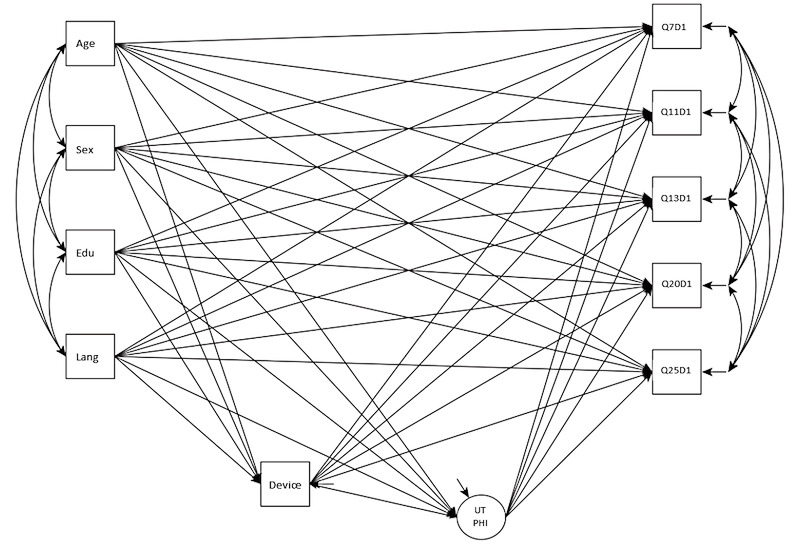
A Bayesian mediated multiple indicators multiple causes model approach was used to simultaneously identify group differences and test measurement invariance through differential item functioning across the groups, with ICT use as a mediator. A sample size of 500 participants was estimated. Data were collected at 3 diverse health sites in Australia.
Responses from 525 participants were included for analysis. Being older was significantly related to lower scores in 4 eHLQ scales, with 3. Ability to actively engage with digital services having the strongest effect (total effect -0.37; P<.001), followed by 1. Using technology to process health information (total effect -0.32; P<.001), 5. Motivated to engage with digital services (total effect -0.21; P=.01), and 7. Digital services that suit individual needs (total effect -0.21; P=.02). However, the effects were only partially mediated by ICT use. Higher education was associated with higher scores in 1. Using technology to process health information (total effect 0.22; P=.01) and 3. Ability to actively engage with digital services (total effect 0.25; P<.001), with the effects mostly mediated by ICT use. Higher ICT use was related to higher scores in all scales except 2. Understanding health concepts and language and 4. Feel safe and in control. Either no or ignorable cases of differential item functioning were found across the 4 groups.
By using a Bayesian mediated multiple indicators multiple causes model, this study provides supportive validity evidence for the eHLQ based on relations to other variables as well as established evidence regarding internal structure related to measurement invariance across the groups for the 7 scales in the Australian community health context. This study also demonstrates that the eHLQ can be used to gain valuable insights into people's eHealth literacy needs to help optimize access and use of digital health and promote health equity.
随着健康资源和服务越来越多地通过数字平台提供,电子健康素养正成为提高数字时代消费者健康的一系列基本能力。为了了解电子健康素养需求,需要一个有意义的衡量标准。在丹麦开发电子健康素养问卷(eHLQ)期间,已经获得了该问卷在可靠性和结构有效性推论方面的强有力初始证据,但针对不同目的的有效性测试是一个持续和累积的过程。
本研究旨在通过使用已知群体方法收集的数据,基于与其他变量的关系来检验有效性证据,以进一步探讨 eHLQ 是否是一种了解不同背景下电子健康素养需求的可靠工具。根据 7 个 eHLQ 量表所代表的 7 个电子健康素养结构,针对每个结构的年龄、性别、教育和信息通信技术(ICT)使用之间的预期评分差异提出了先验假设。
使用贝叶斯中介多指标多原因模型方法,同时通过跨组差异项目功能来识别组间差异并测试测量不变性,以 ICT 使用为中介。估计样本量为 500 名参与者。数据是在澳大利亚 3 个不同的健康场所收集的。
对 525 名参与者的响应进行了分析。年龄较大与 4 个 eHLQ 量表的得分较低显著相关,其中 3. 积极参与数字服务的能力(总效应 -0.37;P<.001)的影响最强,其次是 1. 使用技术处理健康信息(总效应 -0.32;P<.001),5. 有动力参与数字服务(总效应 -0.21;P=.01),以及 7. 适合个人需求的数字服务(总效应 -0.21;P=.02)。然而,这些影响仅部分由 ICT 使用中介。较高的教育水平与 1. 使用技术处理健康信息(总效应 0.22;P=.01)和 3. 积极参与数字服务的能力(总效应 0.25;P<.001)的得分较高有关,这些影响主要由 ICT 使用中介。较高的 ICT 使用与除 2. 理解健康概念和语言以及 4. 感到安全和掌控之外的所有量表的得分较高有关。在 4 个组中,没有发现或忽略了差异项目功能的情况。
通过使用贝叶斯中介多指标多原因模型,本研究提供了基于与其他变量的关系以及与群体内测量不变性相关的内部结构的支持性有效性证据,这是在澳大利亚社区健康背景下对 7 个量表进行的。本研究还表明,eHLQ 可用于深入了解人们的电子健康素养需求,以帮助优化数字健康的获取和使用,并促进健康公平。
