Division of Rheumatology, Department of Internal Medicine, College of Medicine, Mayo Clinic, Rochester, MN, USA.
J Bone Miner Res. 2013 Aug;28(8):1751-9. doi: 10.1002/jbmr.1914.
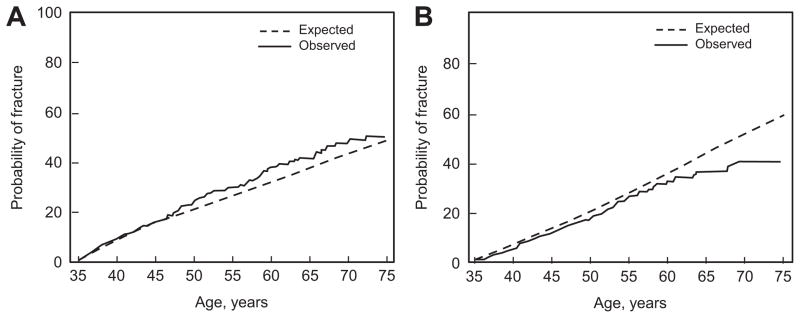
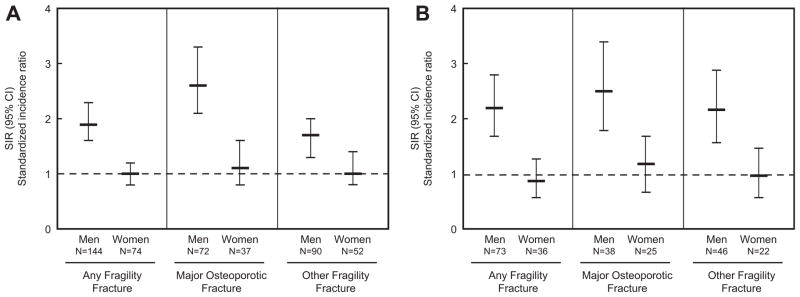
Distal forearm fractures are among the most common fractures during childhood, but it remains unclear whether they predict an increased fracture risk later in life. We studied a population-based cohort of 1776 children ≤18 years of age, from Olmsted County, MN, USA, who had a distal forearm fracture in 1935-1992. Incident fractures occurring at age ≥35 years were identified through review of complete medical records using the linkage system of the Rochester Epidemiology Project. Observed nonpathologic fractures resulting from no more than moderate trauma (fragility fractures) were compared with expected numbers estimated from fracture site-specific incidence rates, based on age, sex, and calendar year, for Olmsted County (standardized incidence ratios [SIR]). In 1086 boys (mean ± SD age; 11 ± 4 years) and 690 girls (10 ± 4 years) followed for 27,292 person-years after the age of 35 years, subsequent fragility fractures were observed in 144 (13%) men and 74 (11%) women. There was an increased risk for future fragility fractures in boys who had a distal forearm fracture (SIR, 1.9; 95% CI, 1.6-2.3) but not girls (SIR, 1.0; 95% CI, 0.8-1.2). Fragility fractures at both major osteoporotic (hip, spine, wrist, and shoulder) sites (SIR, 2.6; 95% CI, 2.1-3.3) and remaining sites (SIR, 1.7; 95% CI, 1.3-2.0) were increased in men, irrespective of age at distal forearm fracture as boys. A distal forearm fracture in boys, but not girls, is associated with an increased risk for fragility fractures as older adults. It is necessary to determine whether the increased fractures observed in men is due to persistent deficits of bone strength, continued high fracture risk activity, or both. Until then, men should be asked about a childhood distal forearm fracture and, if so, warrant further screening and counseling on measures to optimize bone health and prevent fractures.
前臂远端骨折是儿童时期最常见的骨折之一,但目前尚不清楚它们是否会增加日后骨折的风险。我们研究了一个基于人群的队列,共纳入了 1935 年至 1992 年间在美国明尼苏达州奥姆斯特德县年龄≤18 岁的 1776 名儿童,这些儿童都发生过前臂远端骨折。通过罗切斯特流行病学项目的链接系统,查阅完整的医疗记录,确定了年龄≥35 岁时发生的骨折事件。将由不超过中度创伤引起的非病理性骨折(脆性骨折)与根据奥姆斯特德县年龄、性别和日历年份的骨折部位特异性发生率估计的预期数量进行比较(标准化发病率比[SIR])。在 1086 名男孩(平均年龄±标准差;11±4 岁)和 690 名女孩(10±4 岁)中,在年龄>35 岁后随访了 27292 人年,其中 144 名男性(13%)和 74 名女性(11%)发生了脆性骨折。前臂远端骨折的男性发生脆性骨折的风险增加(SIR,1.9;95%CI,1.6-2.3),但女性没有(SIR,1.0;95%CI,0.8-1.2)。男性在主要骨质疏松性(髋部、脊柱、腕部和肩部)骨折部位(SIR,2.6;95%CI,2.1-3.3)和其余部位(SIR,1.7;95%CI,1.3-2.0)发生脆性骨折的风险增加,与发生前臂远端骨折时的年龄无关。前臂远端骨折的男孩,而不是女孩,与成年后脆性骨折风险增加有关。有必要确定男性中观察到的骨折增加是由于骨强度持续下降、持续高骨折风险活动还是两者兼有。在此之前,应询问男性儿童时期是否发生过前臂远端骨折,如果发生过,应进一步筛查,并提供优化骨骼健康和预防骨折的措施咨询。