German Center for Vertigo and Balance Disorders, University Hospital of Munich, Munich, Germany.
PLoS One. 2013;8(2):e56862. doi: 10.1371/journal.pone.0056862. Epub 2013 Feb 15.
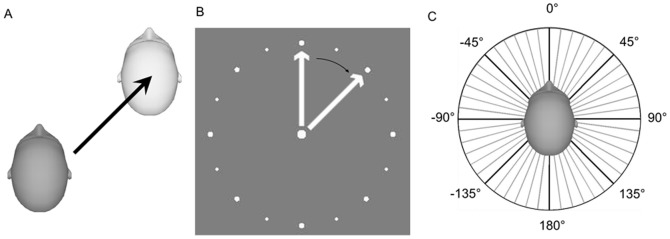
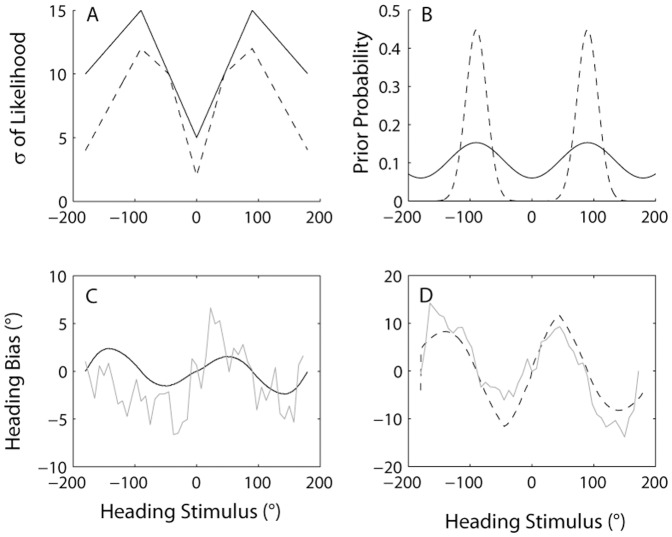
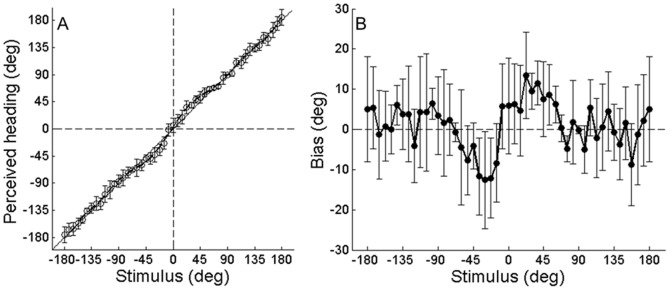
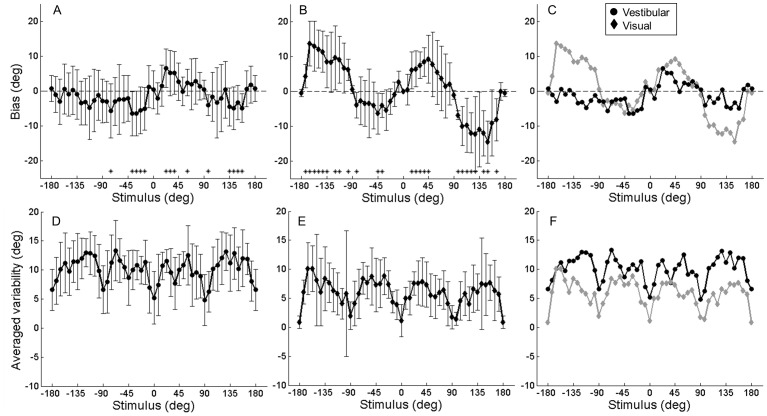
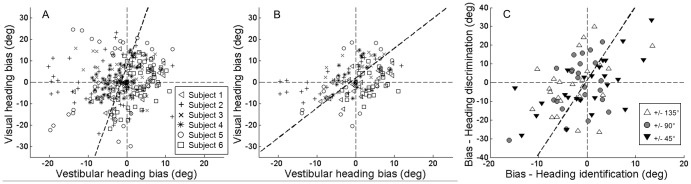
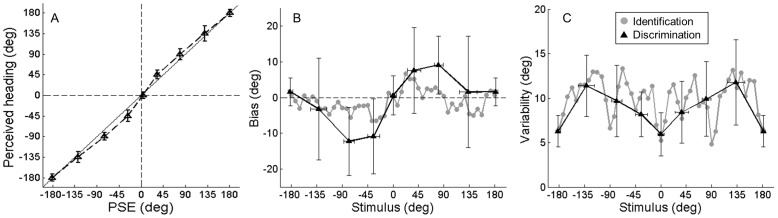
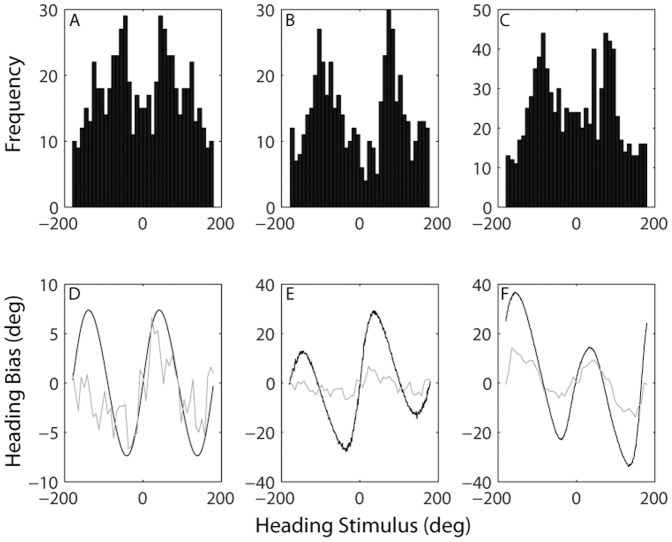
Heading estimation is vital to everyday navigation and locomotion. Despite extensive behavioral and physiological research on both visual and vestibular heading estimation over more than two decades, the accuracy of heading estimation has not yet been systematically evaluated. Therefore human visual and vestibular heading estimation was assessed in the horizontal plane using a motion platform and stereo visual display. Heading angle was overestimated during forward movements and underestimated during backward movements in response to both visual and vestibular stimuli, indicating an overall multimodal bias toward lateral directions. Lateral biases are consistent with the overrepresentation of lateral preferred directions observed in neural populations that carry visual and vestibular heading information, including MSTd and otolith afferent populations. Due to this overrepresentation, population vector decoding yields patterns of bias remarkably similar to those observed behaviorally. Lateral biases are inconsistent with standard bayesian accounts which predict that estimates should be biased toward the most common straight forward heading direction. Nevertheless, lateral biases may be functionally relevant. They effectively constitute a perceptual scale expansion around straight ahead which could allow for more precise estimation and provide a high gain feedback signal to facilitate maintenance of straight-forward heading during everyday navigation and locomotion.
朝向估计对于日常导航和运动至关重要。尽管在过去二十多年里对视觉和前庭朝向估计进行了广泛的行为和生理学研究,但朝向估计的准确性尚未得到系统评估。因此,使用运动平台和立体视觉显示器在水平面上评估了人类的视觉和前庭朝向估计。在视觉和前庭刺激下,向前运动时朝向被高估,向后运动时朝向被低估,这表明整体上存在朝向侧面的多模式偏差。这种侧向偏差与携带视觉和前庭朝向信息的神经群体中观察到的侧向优势方向的过度表示一致,包括 MSTd 和耳石传入群体。由于这种过度表示,群体矢量解码产生的偏差模式与观察到的行为模式非常相似。侧向偏差与标准贝叶斯解释不一致,后者预测估计应该偏向最常见的直线前进方向。然而,侧向偏差可能具有功能相关性。它们有效地在直线前进周围构成了一个感知尺度扩展,可以实现更精确的估计,并提供高增益反馈信号,以在日常导航和运动中促进直线前进的维持。