Department of Biomedical Engineering, The City College of the City University of New York, New York, New York, USA.
PLoS Comput Biol. 2013;9(2):e1002898. doi: 10.1371/journal.pcbi.1002898. Epub 2013 Feb 14.
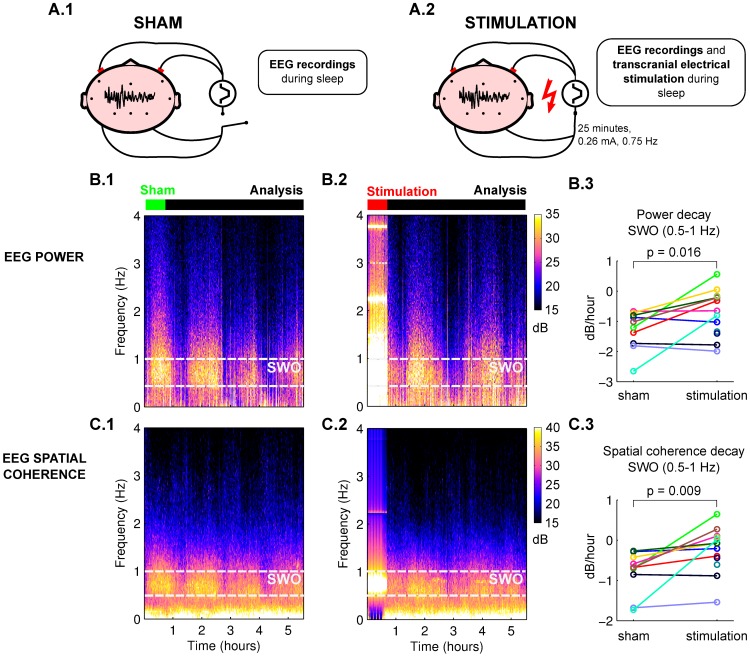
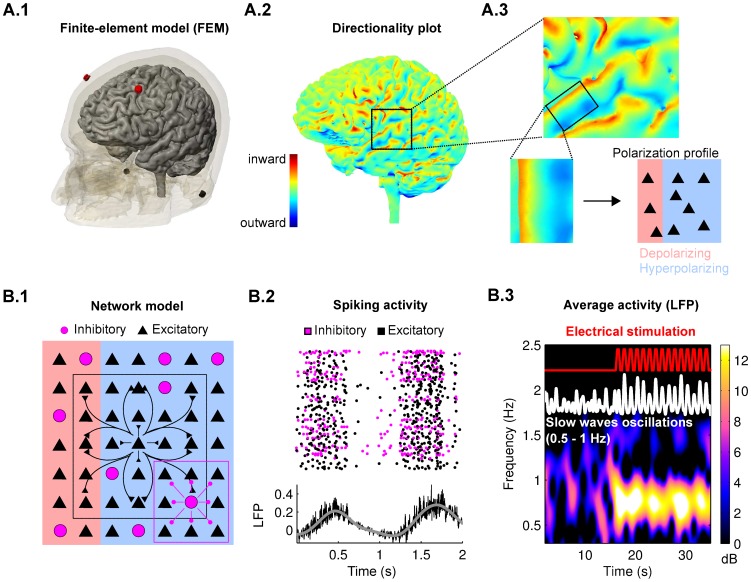
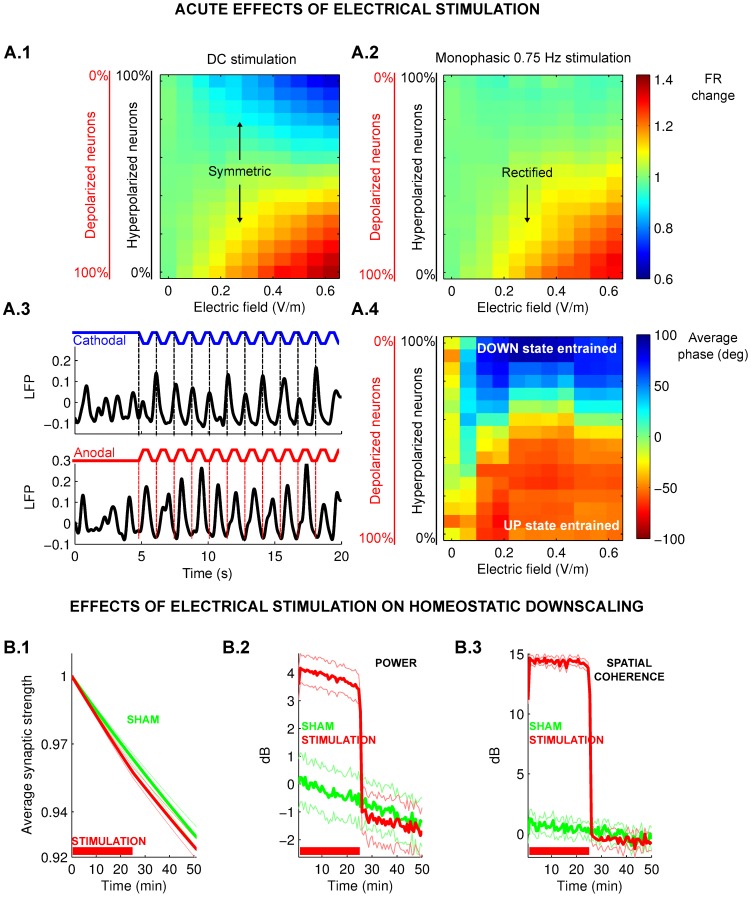
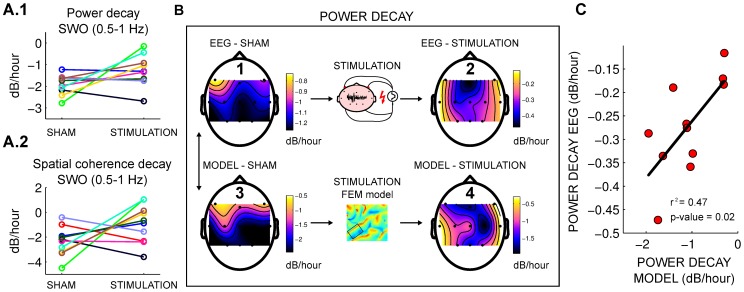
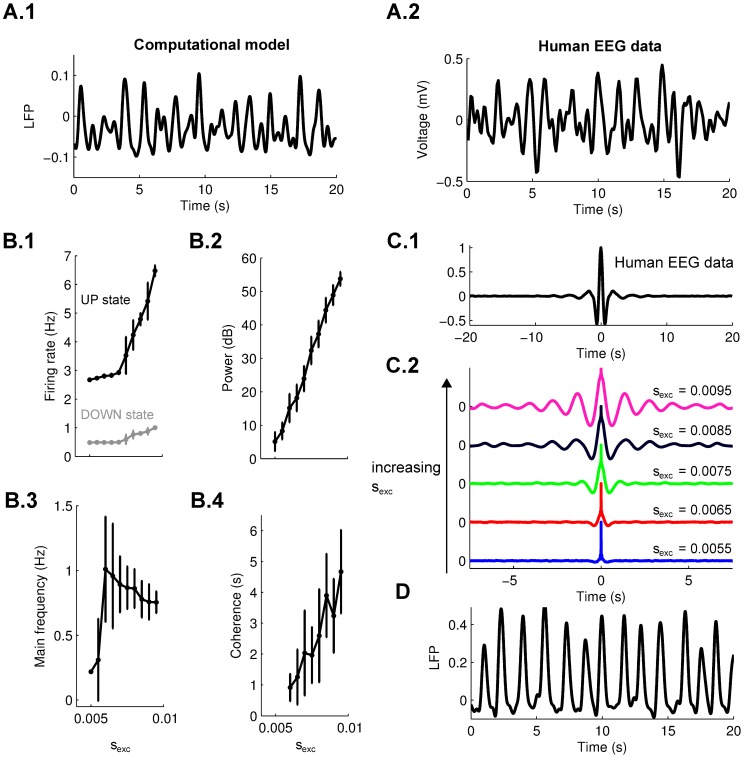
The sleeping brain exhibits characteristic slow-wave activity which decays over the course of the night. This decay is thought to result from homeostatic synaptic downscaling. Transcranial electrical stimulation can entrain slow-wave oscillations (SWO) in the human electro-encephalogram (EEG). A computational model of the underlying mechanism predicts that firing rates are predominantly increased during stimulation. Assuming that synaptic homeostasis is driven by average firing rates, we expected an acceleration of synaptic downscaling during stimulation, which is compensated by a reduced drive after stimulation. We show that 25 minutes of transcranial electrical stimulation, as predicted, reduced the decay of SWO in the remainder of the night. Anatomically accurate simulations of the field intensities on human cortex precisely matched the effect size in different EEG electrodes. Together these results suggest a mechanistic link between electrical stimulation and accelerated synaptic homeostasis in human sleep.
睡眠中的大脑会呈现出特征性的慢波活动,这种活动会在整个夜间逐渐减弱。这种衰减被认为是由同型相食突触缩小引起的。经颅电刺激可以使人类脑电图(EEG)中的慢波振荡(SWO)同步。一个潜在机制的计算模型预测,在刺激期间,神经元的发放频率会显著增加。假设突触同型相食是由平均发放频率驱动的,我们预计在刺激期间,突触同型相食会加速,而在刺激后,驱动会减少。我们发现,正如预测的那样,25 分钟的经颅电刺激确实减少了夜间剩余时间 SWO 的衰减。对人类皮层上的场强进行精确的解剖学模拟,在不同的 EEG 电极中精确匹配了效应大小。这些结果共同表明,在人类睡眠中,电刺激和加速的突触同型相食之间存在一种机制联系。