Department of Clinical and Molecular Biomedicine, Pharmacology Section, Medical School, University of Catania, Catania, Italy.
Eur J Neurosci. 2013 May;37(10):1550-63. doi: 10.1111/ejn.12166. Epub 2013 Mar 5.
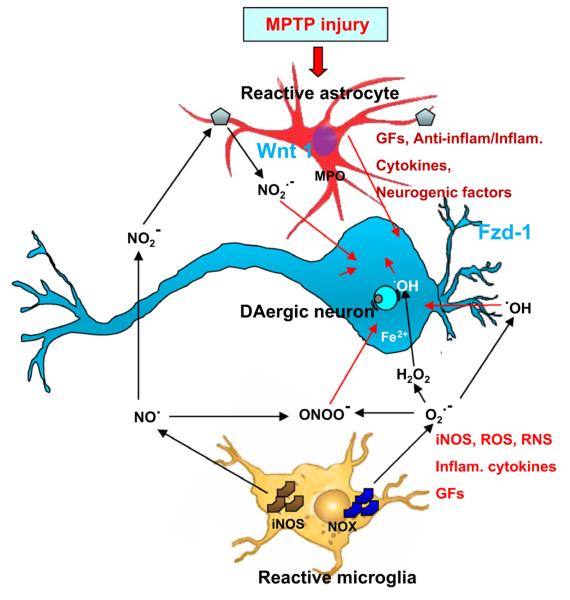
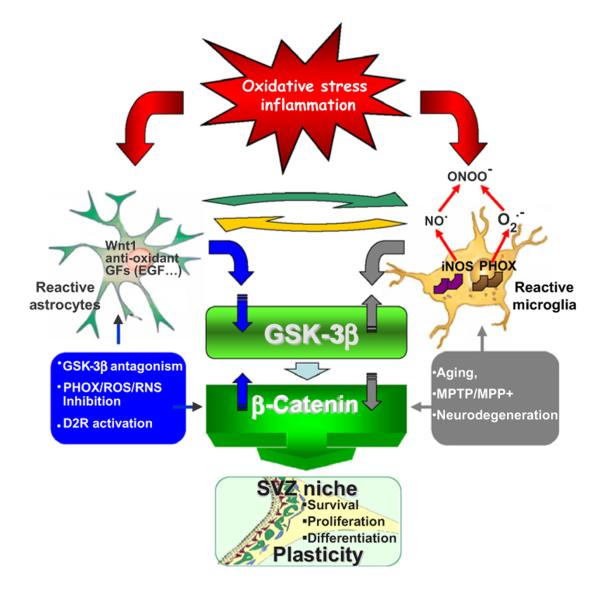
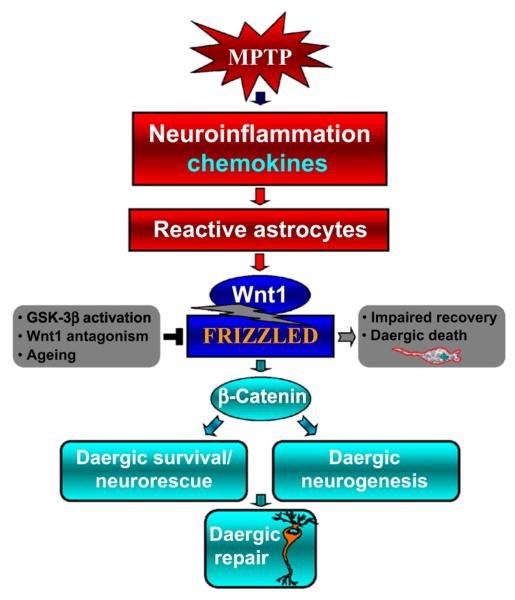
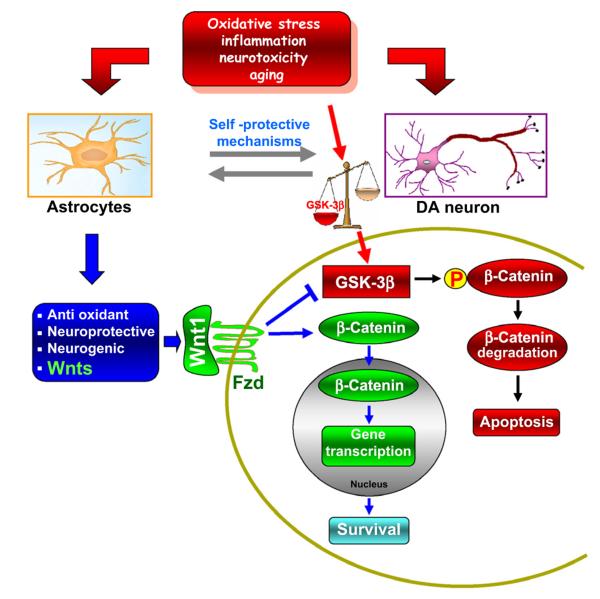
Parkinson's disease (PD) is a common neurodegenerative disorder characterized by progressive loss of dopaminergic (DAergic) neuronal cell bodies in the substantia nigra pars compacta and gliosis. The cause and mechanisms underlying the demise of nigrostriatal DAergic neurons are ill-defined, but interactions between genes and environmental factors are recognized to play a critical role in modulating the vulnerability to PD. Current evidence points to reactive glia as a pivotal factor in PD pathophysiology, playing both protective and destructive roles. Here, the contribution of reactive astrocytes and their ability to modulate DAergic neurodegeneration, neuroprotection and neurorepair in the 1-methyl-4-phenyl-1,2,3,6-tetrahydropyridine (MPTP) rodent model of PD will be discussed in the light of novel emerging evidence implicating wingless-type mouse mammary tumor virus integration site (Wnt)/β-catenin signaling as a strong candidate in MPTP-induced nigrostriatal DAergic plasticity. In this work, we highlight an intrinsic Wnt1/frizzled-1/β-catenin tone that critically contributes to the survival and protection of adult midbrain DAergic neurons, with potential implications for drug design or drug action in PD. The dynamic interplay between astrocyte-derived factors and neurogenic signals in MPTP-induced nigrostriatal DAergic neurotoxicity and repair will be summarized, together with recent findings showing a critical role of glia-neural stem/progenitor cell (NPC) interactions aimed at overcoming neurodegeneration and inducing neurorestoration. Understanding the intrinsic plasticity of nigrostriatal DAergic neurons and deciphering the signals facilitating the crosstalk between astrocytes, microglia, DAergic neurons and NPCs may have major implications for the role of stem cell technology in PD, and for identifying potential therapeutic targets to induce endogenous neurorepair.
帕金森病(PD)是一种常见的神经退行性疾病,其特征是黑质致密部多巴胺能(DAergic)神经元细胞体进行性丧失和神经胶质增生。导致黑质纹状体 DAergic 神经元死亡的原因和机制尚不清楚,但已认识到基因和环境因素的相互作用在调节 PD 的易感性方面起着关键作用。目前的证据表明,反应性神经胶质是 PD 病理生理学的关键因素,发挥着保护和破坏作用。在这里,将根据新出现的证据,讨论反应性星形胶质细胞在 1-甲基-4-苯基-1,2,3,6-四氢吡啶(MPTP)诱导的 PD 啮齿动物模型中的作用及其调节 DAergic 神经退行性变、神经保护和神经修复的能力,这些证据表明 Wnt/β-catenin 信号通路作为 MPTP 诱导的黑质纹状体 DAergic 可塑性的一个强有力候选因子。在这项工作中,我们强调了内在的 Wnt1/frizzled-1/β-catenin 信号通路对成年中脑 DAergic 神经元的存活和保护起着至关重要的作用,这可能对 PD 的药物设计或药物作用具有重要意义。将总结星形胶质细胞衍生因子和神经发生信号在 MPTP 诱导的黑质纹状体 DAergic 神经毒性和修复中的动态相互作用,以及最近的研究结果表明,神经胶质-神经原性干细胞/祖细胞(NPC)相互作用对于克服神经退行性变和诱导神经修复具有关键作用。了解黑质纹状体 DAergic 神经元的内在可塑性,并破译促进星形胶质细胞、小胶质细胞、DAergic 神经元和 NPC 之间串扰的信号,对于干细胞技术在 PD 中的作用以及确定潜在的治疗靶点以诱导内源性神经修复具有重要意义。