Department of Public Health and Clinical Medicine, Umeå University, Umeå, Sweden.
BMJ Open. 2013 Mar 6;3(3):e002436. doi: 10.1136/bmjopen-2012-002436.
To investigate the association between self-rated health and risk of type 2 diabetes and whether the strength of this association is consistent across five European centres.
Population-based prospective case-cohort study.
Enrolment took place between 1992 and 2000 in five European centres (Bilthoven, Cambridge, Heidelberg, Potsdam and Umeå).
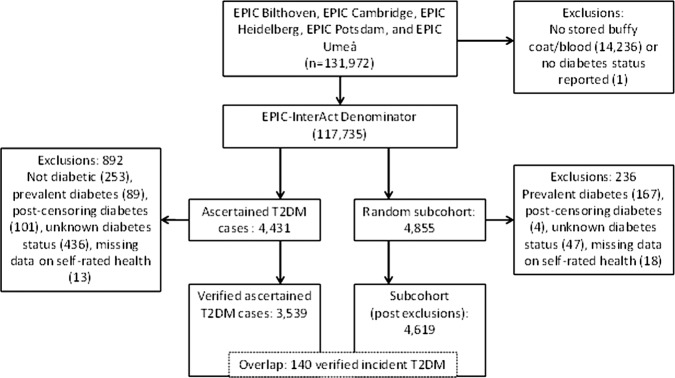
Self-rated health was assessed by a baseline questionnaire in 3399 incident type 2 diabetic case participants and a centre-stratified subcohort of 4619 individuals from the European Prospective Investigation into Cancer and Nutrition (EPIC)-InterAct study which was drawn from a total cohort of 340 234 participants in the EPIC.
Prentice-weighted Cox regression was used to estimate centre-specific HRs and 95% CIs for incident type 2 diabetes controlling for age, sex, centre, education, body mass index (BMI), smoking, alcohol consumption, energy intake, physical activity and hypertension. The centre-specific HRs were pooled across centres by random effects meta-analysis.
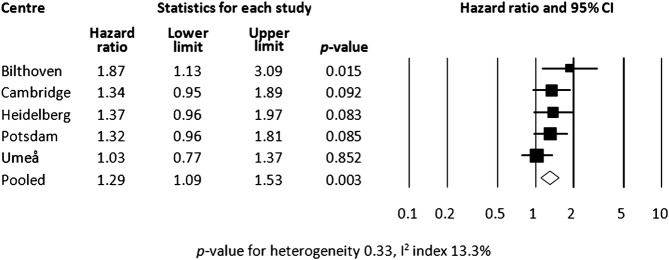
Low self-rated health was associated with a higher hazard of type 2 diabetes after adjusting for age and sex (pooled HR 1.67, 95% CI 1.48 to 1.88). After additional adjustment for health-related variables including BMI, the association was attenuated but remained statistically significant (pooled HR 1.29, 95% CI 1.09 to 1.53). I(2) index for heterogeneity across centres was 13.3% (p=0.33).
Low self-rated health was associated with a higher risk of type 2 diabetes. The association could be only partly explained by other health-related variables, of which obesity was the strongest. We found no indication of heterogeneity in the association between self-rated health and type 2 diabetes mellitus across the European centres.
研究自感健康状况与 2 型糖尿病风险之间的关系,并探讨这种关联在五个欧洲中心是否具有一致性。
基于人群的前瞻性病例-队列研究。
1992 年至 2000 年在五个欧洲中心(比勒陀利亚、剑桥、海德堡、波茨坦和于默奥)进行了招募。
3399 例新发 2 型糖尿病病例参与者和欧洲癌症与营养前瞻性调查-相互作用研究(EPIC-InterAct)中心分层子队列的 4619 名个体在基线问卷中评估了自感健康状况,该子队列来自 EPIC 总队列中的 340234 名参与者。
使用 Prentice 加权 Cox 回归估计中心特异性 HRs 和 95%置信区间(CI),以控制年龄、性别、中心、教育程度、体重指数(BMI)、吸烟、饮酒、能量摄入、体力活动和高血压等因素后,评估新发 2 型糖尿病的发生率。通过随机效应荟萃分析对各中心的中心特异性 HRs 进行汇总。
在调整年龄和性别后,低自感健康状况与 2 型糖尿病的发生风险较高相关(汇总 HR 1.67,95%CI 1.48 至 1.88)。在进一步调整与健康相关的变量(包括 BMI)后,关联减弱但仍具有统计学意义(汇总 HR 1.29,95%CI 1.09 至 1.53)。中心间异质性的 I²指数为 13.3%(p=0.33)。
低自感健康状况与 2 型糖尿病的风险增加相关。这种关联只能部分由其他与健康相关的变量来解释,其中肥胖是最强的关联因素。我们没有发现自感健康状况与 2 型糖尿病之间的关联在欧洲中心存在异质性的迹象。