Division of the Humanities and Social Sciences, California Institute of Technology, Pasadena, CA 91125, USA.
Sci Rep. 2013;3:1435. doi: 10.1038/srep01435.
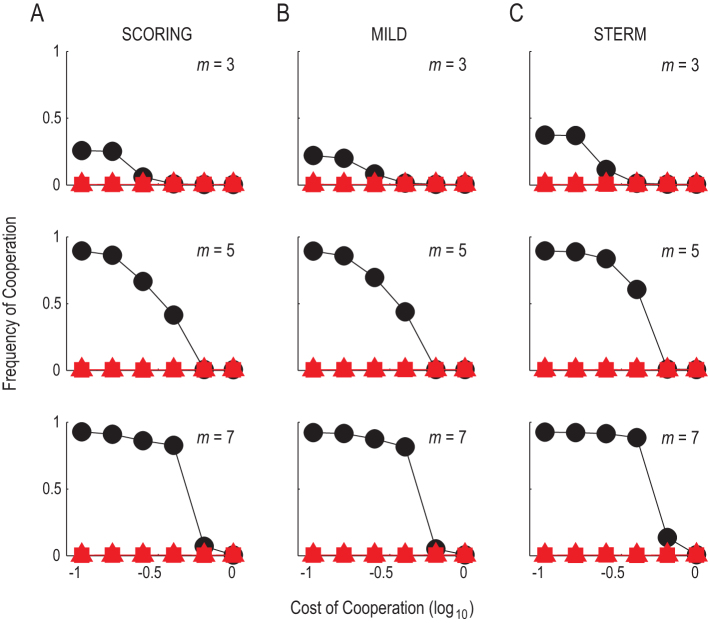
How natural selection can promote cooperative or altruistic behavior is a fundamental question in biological and social sciences. One of the persuasive mechanisms is "indirect reciprocity," working through reputation: cooperative behavior can prevail because the behavior builds the donor's good reputation and then s/he receives some reciprocal benefits from someone else in the community. However, an important piece missed in the previous studies is that the reputation-building process requires substantial cognitive abilities such as communication skills, potentially causing a loss of biological fitness. Here, by mathematical analyses and individual-based computer simulations, we show that natural selection never favors indirect reciprocal cooperation in the presence of the cost of reputation building, regardless of the cost-to-benefit ratio of cooperation or moral assessment rules (social norms). Our results highlight the importance of considering the cost of high-level cognitive abilities in studies of the evolution of humans' and animals' social behavior.
自然选择如何能够促进合作或利他行为,这是生物和社会科学中的一个基本问题。其中一个有说服力的机制是“间接互惠”,通过声誉发挥作用:合作行为之所以能够盛行,是因为这种行为建立了捐赠者的良好声誉,然后他/她会从社区中的其他人那里得到一些互惠的好处。然而,之前的研究中遗漏了一个重要的部分,即声誉建立过程需要大量的认知能力,如沟通技巧,这可能导致生物适应性的丧失。在这里,通过数学分析和基于个体的计算机模拟,我们表明,无论合作的成本效益比或道德评估规则(社会规范)如何,只要存在声誉建立的成本,自然选择就绝不会有利于间接互惠合作。我们的研究结果强调了在研究人类和动物社会行为的进化时,考虑高级认知能力的成本的重要性。