KAIST Graduate School of AI, 02455, Seoul, South Korea.
Booth School of Business, The University of Chicago, Chicago, IL, 60637, USA.
Nat Commun. 2023 Apr 12;14(1):2086. doi: 10.1038/s41467-023-37817-x.
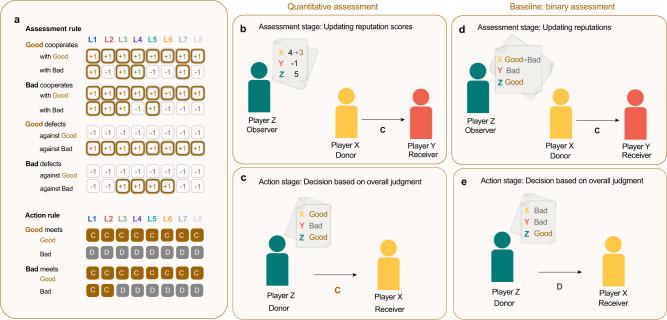
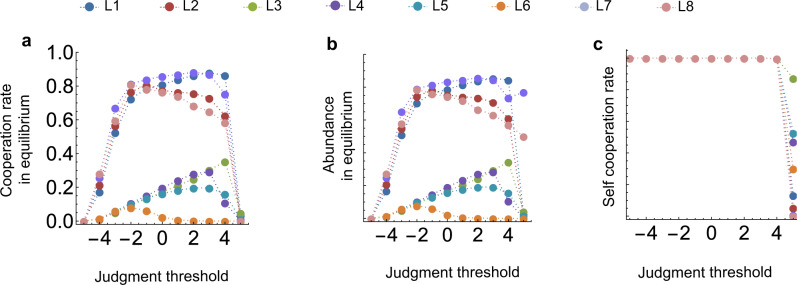
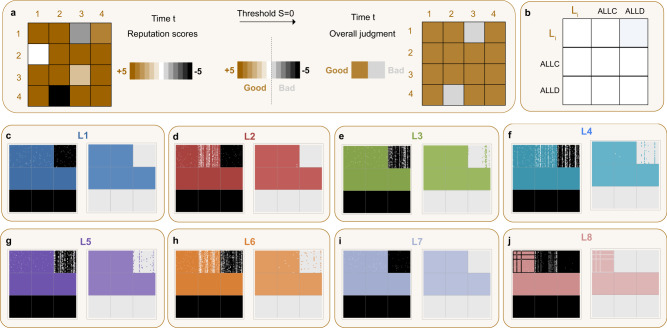
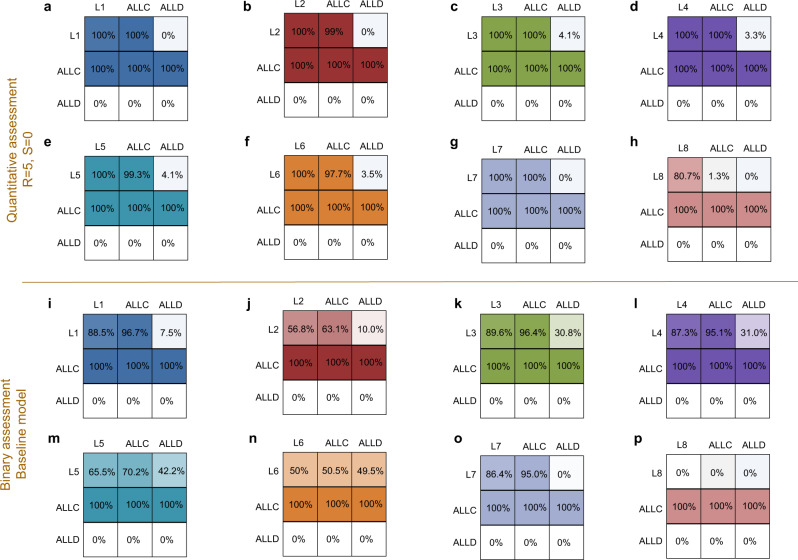
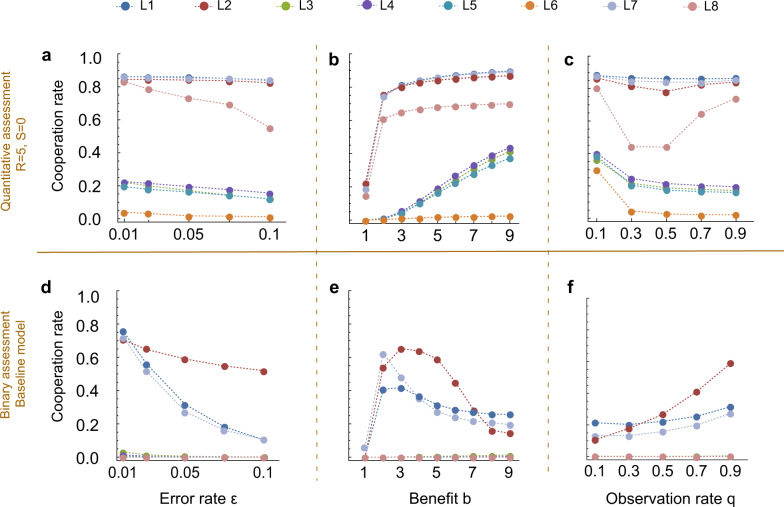
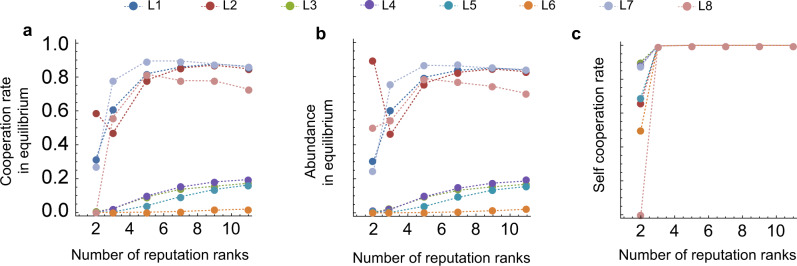
The field of indirect reciprocity investigates how social norms can foster cooperation when individuals continuously monitor and assess each other's social interactions. By adhering to certain social norms, cooperating individuals can improve their reputation and, in turn, receive benefits from others. Eight social norms, known as the "leading eight," have been shown to effectively promote the evolution of cooperation as long as information is public and reliable. These norms categorize group members as either 'good' or 'bad'. In this study, we examine a scenario where individuals instead assign nuanced reputation scores to each other, and only cooperate with those whose reputation exceeds a certain threshold. We find both analytically and through simulations that such quantitative assessments are error-correcting, thus facilitating cooperation in situations where information is private and unreliable. Moreover, our results identify four specific norms that are robust to such conditions, and may be relevant for helping to sustain cooperation in natural populations.
间接互惠领域研究了在个体不断监控和评估彼此社会互动的情况下,社会规范如何促进合作。通过遵守某些社会规范,合作的个体可以提高自己的声誉,并反过来从他人那里获得好处。八项社会规范,被称为“八大规范”,只要信息是公开和可靠的,就可以有效地促进合作的进化。这些规范将群体成员分为“好”或“坏”两类。在这项研究中,我们考察了一种个体彼此分配微妙的声誉分数的情况,并且只与那些声誉超过一定阈值的人合作。我们通过分析和模拟发现,这种定量评估是纠错的,因此在信息是私人和不可靠的情况下促进了合作。此外,我们的结果确定了四种在这种情况下稳健的特定规范,这可能有助于维持自然种群中的合作。