Institute of Plant Sciences, The Volcani Center, Agricultural Research Organization Bet Dagan, Israel.
Front Plant Sci. 2013 Mar 12;4:44. doi: 10.3389/fpls.2013.00044. eCollection 2013.
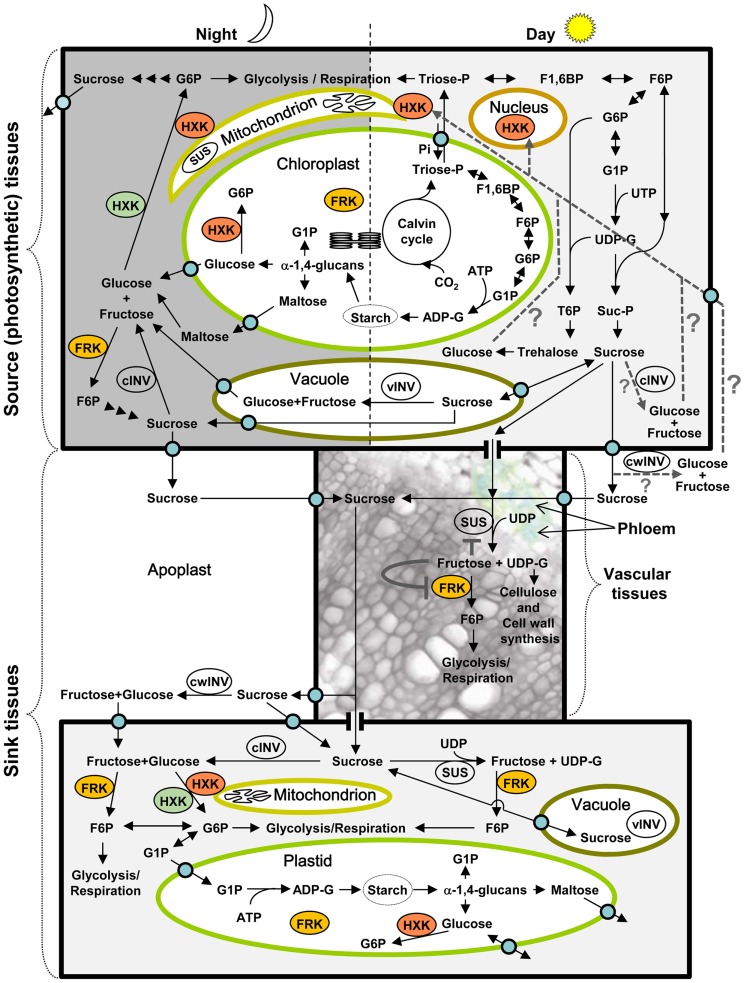
Hexose sugars, such as glucose and fructose produced in plants, are ubiquitous in most organisms and are the origin of most of the organic matter found in nature. To be utilized, hexose sugars must first be phosphorylated. The central role of hexose-phosphorylating enzymes has attracted the attention of many researchers, leading to novel discoveries. Only two families of enzymes capable of phosphorylating glucose and fructose have been identified in plants; hexokinases (HXKs), and fructokinases (FRKs). Intensive investigations of these two families in numerous plant species have yielded a wealth of knowledge regarding the genes number, enzymatic characterization, intracellular localization, and developmental and physiological roles of several HXKs and FRKs. The emerging picture indicates that HXK and FRK enzymes found at specific intracellular locations play distinct roles in plant metabolism and development. Individual HXKs were shown for the first time to be dual-function enzymes - sensing sugar levels independent of their catalytic activity and controlling gene expression and major developmental pathways, as well as hormonal interactions. FRK, on the other hand, seems to play a central metabolic role in vascular tissues, controlling the amounts of sugars allocated for vascular development. While a clearer picture of the roles of these two types of enzymes is emerging, many questions remain unsolved, such as the specific tissues and types of cells in which these enzymes function, the roles of individual HXK and FRK genes, and how these enzymes interact with hormones in the regulation of developmental processes. It is anticipated that ongoing efforts will broaden our knowledge of these important plant enzymes and their potential uses in the modification of plant traits.
己糖糖,如植物中产生的葡萄糖和果糖,在大多数生物中普遍存在,是自然界中发现的大多数有机物质的起源。为了被利用,己糖糖必须首先被磷酸化。己糖磷酸化酶的核心作用引起了许多研究人员的关注,导致了新的发现。在植物中只鉴定出了能够磷酸化葡萄糖和果糖的两种酶家族;己糖激酶(HXKs)和果糖激酶(FRKs)。对这两种家族在众多植物物种中的深入研究,为了解 HXK 和 FRK 基因的数量、酶学特性、细胞内定位以及几种 HXK 和 FRK 的发育和生理作用提供了丰富的知识。新出现的情况表明,在特定的细胞内位置发现的 HXK 和 FRK 酶在植物代谢和发育中发挥着不同的作用。首次表明 HXK 酶是双功能酶——能够独立于其催化活性感知糖水平,并控制基因表达和主要发育途径以及激素相互作用。另一方面,FRK 似乎在维管束组织中发挥着中心代谢作用,控制着分配给维管发育的糖的数量。虽然这两种酶的作用的清晰图景正在出现,但仍有许多问题尚未解决,例如这些酶在特定组织和类型的细胞中的作用、个别 HXK 和 FRK 基因的作用以及这些酶如何与激素在发育过程的调节中相互作用。预计正在进行的努力将拓宽我们对这些重要植物酶及其在修饰植物特性中的潜在用途的认识。