Hanafi Somayeh, Torkamandi Hassan, Hayatshahi Alireza, Gholami Kheirollah, Javadi Mohammadreza
Department of Pharmaceutical Care, Dr. Shariati Hospital, Tehran University of Medical Sciences, Tehran, Iran.
Iran J Nurs Midwifery Res. 2012 Jan;17(1):21-5.
Adverse drug reactions (ADR) are ranked as some of the major causes of patient morbidity and mortality. Spontaneous reporting of ADRs has remained the cornerstone of pharmacovigilance and is important in maintaining patient safety. This study was conducted to assess the nurses' knowledge and attitude towards pharmacovigilance, reasons for not reporting ADRs, and their pharmacovigilance practice.
A questionnaire was prepared to investigate knowledge, attitude and practice (KAP) of nurses regarding ADR reporting. In November 2009, the questionnaires were given to 500 nurses of a teaching hospital in Tehran.
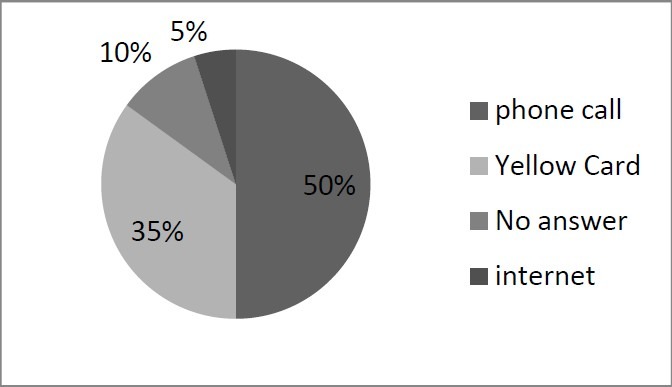
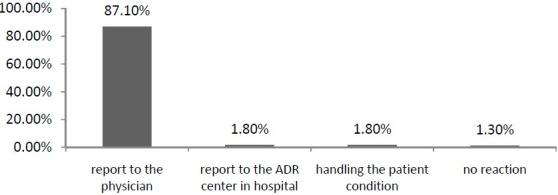
Knowledge and practice of participants were not satisfying; however, their attitude towards pharmacovigilance was at a high level. About 91% of the nurses had never reported an ADR. Most nurses liked to report the ADRs to the physicians (87.1%) and pharmacists in hospital's ADR center (1.8%) rather than the ADR National Center. The main cause of under-reporting of the suspected ADRs was unawareness about the existence of such a national center. Among nurses who had reported ADR for at least once, the majority preferred using phone (10 out of 50) or Yellow Cards (7 out of 50). Only 1 person out of 50 preferred using internet for submitting the reports.
Since the nurses in this study had little knowledge and poor practice regarding the pharmacovigilance and spontaneous reporting system, interventions such as holding pharmacovigilance workshops in the hospitals focusing on the aims of pharmacovigilance, completing the Yellow Card and clarifying the reporting criteria are strongly recommended.
药物不良反应(ADR)是导致患者发病和死亡的一些主要原因。药物不良反应的自发报告一直是药物警戒的基石,对维护患者安全至关重要。本研究旨在评估护士对药物警戒的知识和态度、未报告药物不良反应的原因及其药物警戒实践。
编制了一份问卷,以调查护士关于药物不良反应报告的知识、态度和实践(KAP)。2009年11月,向德黑兰一家教学医院的500名护士发放了问卷。
参与者的知识和实践不尽人意;然而,他们对药物警戒的态度处于较高水平。约91%的护士从未报告过药物不良反应。大多数护士喜欢向医生(87.1%)和医院药物不良反应中心的药剂师(1.8%)报告药物不良反应,而不是向国家药物不良反应中心报告。疑似药物不良反应报告不足的主要原因是不知道有这样一个国家中心。在至少报告过一次药物不良反应的护士中,大多数人更喜欢使用电话(50人中有10人)或黄卡(50人中有7人)。50人中只有1人更喜欢使用互联网提交报告。
由于本研究中的护士对药物警戒和自发报告系统了解甚少且实践不佳,强烈建议采取干预措施,如在医院举办侧重于药物警戒目标的药物警戒研讨会、填写黄卡并明确报告标准。