Department of Pathophysiology, Basic Medical College of Zhengzhou University, No,100 of Science Road, Zhengzhou, 450001, China.
BMC Cancer. 2013 Mar 18;13:124. doi: 10.1186/1471-2407-13-124.
Increased histone H3 phosphorylation is an essential regulatory mechanism for neoplastic cell transformation. We aimed to explore the role of histone H3 phosphorylation at serine10 (p-H3Ser10) in Epstein-Barr virus (EBV) latent membrane protein-1 (LMP1)-induced carcinogenesis of nasopharyngeal carcinoma (NPC).
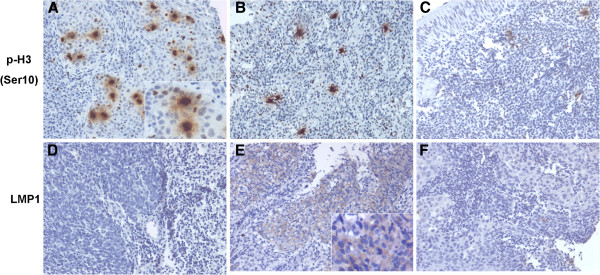
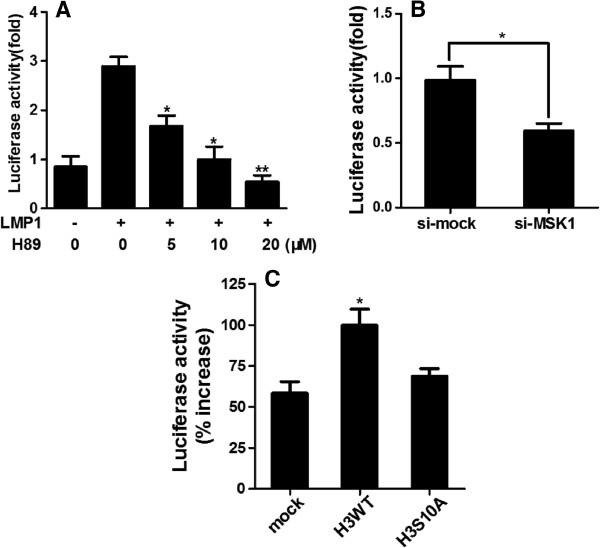
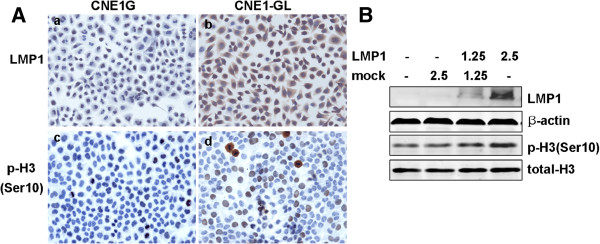
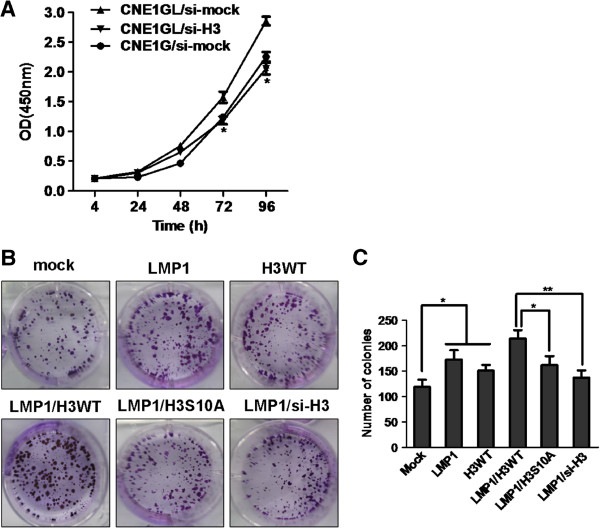
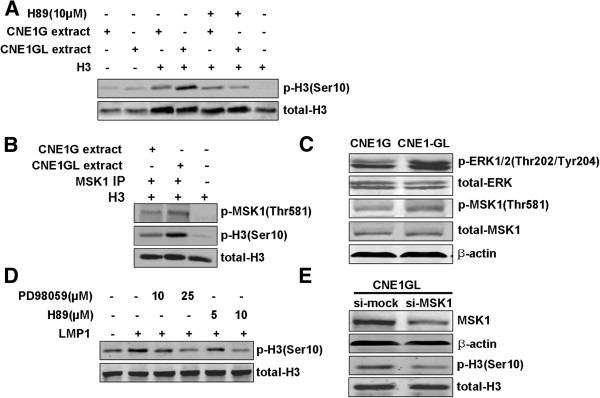
The expression of p-H3Ser10 was detected by the immunohistochemical analysis in NPC, chronic nasopharyngitis and normal nasopharynx tissues, and its correlation with LMP1 was analyzed in NPC tissues and cell lines. Using the small interfering RNA (siRNA)-H3 and histone H3 mutant (S10A), the effect of histone H3 Ser10 motif on LMP1-induced CNE1 cell proliferation, transformation and activator protein-1 (AP-1) activation were evaluated by CCK-8, focus-forming and reporter gene assay respectively. Mitogen- and stress-activated kinase 1 (MSK1) kinase activity and phosphorylation were detected by in vitro kinase assay and western blot. Using MSK1 inhibitor H89 or siRNA-MSK1, the regulatory role of MSK1 on histone H3 phosphorylation and AP-1 activation were analyzed.
Immunohistochemical analysis revealed that the expression of p-H3Ser10 was significantly higher in the poorly differentiated NPC tissues than that in chronic nasopharyngitis (p <0.05) and normal nasopharynx tissues (p <0.001). Moreover, high level of p-H3Ser10 was positively correlated with the expression of LMP1 in NPC tissues (χ2=6.700, p =0.01; C=0.350) and cell lines. The knockdown and mutant (S10A) of histone H3 suppressed LMP1-induced CNE1 cell proliferation, foci formation and AP-1 activation. In addition, LMP1 could increase MSK1 kinase activity and phosphorylation. MSK1 inhibitor H89 or knockdown of MSK1 by siRNA blocked LMP1-induced phosphorylation of histone H3 at Ser10 and AP-1 activation.
EBV-LMP1 can induce phosphorylation of histone H3 at Ser10 via MSK1. Increased phosphorylation of histone H3 at Ser10 is likely a crucial regulatory mechanism involved in LMP1-induced carcinogenesis of NPC.
组蛋白 H3 磷酸化的增加是肿瘤细胞转化的一个重要调节机制。我们旨在探讨组蛋白 H3 丝氨酸 10 磷酸化(p-H3Ser10)在 Epstein-Barr 病毒(EBV)潜伏膜蛋白 1(LMP1)诱导的鼻咽癌(NPC)发生中的作用。
采用免疫组化分析检测 NPC、慢性鼻咽炎和正常鼻咽组织中 p-H3Ser10 的表达,并分析 NPC 组织和细胞系中 p-H3Ser10 与 LMP1 的相关性。通过小干扰 RNA(siRNA-H3)和组蛋白 H3 突变体(S10A),用 CCK-8、焦点形成和报告基因检测分别评估组蛋白 H3 Ser10 基序对 LMP1 诱导的 CNE1 细胞增殖、转化和激活蛋白-1(AP-1)激活的影响。通过体外激酶测定和 Western blot 检测丝裂原和应激激活激酶 1(MSK1)激酶活性和磷酸化。用 MSK1 抑制剂 H89 或 siRNA-MSK1 分析 MSK1 对组蛋白 H3 磷酸化和 AP-1 激活的调节作用。
免疫组化分析显示,低分化 NPC 组织中 p-H3Ser10 的表达明显高于慢性鼻咽炎(p<0.05)和正常鼻咽组织(p<0.001)。此外,NPC 组织中 p-H3Ser10 的高水平与 LMP1 的表达呈正相关(χ2=6.700,p=0.01;C=0.350)和细胞系。组蛋白 H3 的敲低和突变(S10A)抑制了 LMP1 诱导的 CNE1 细胞增殖、焦点形成和 AP-1 激活。此外,LMP1 可增加 MSK1 激酶活性和磷酸化。MSK1 抑制剂 H89 或 siRNA 敲低 MSK1 可阻断 LMP1 诱导的组蛋白 H3 丝氨酸 10 磷酸化和 AP-1 激活。
EBV-LMP1 可通过 MSK1 诱导组蛋白 H3 丝氨酸 10 磷酸化。组蛋白 H3 丝氨酸 10 磷酸化的增加可能是 LMP1 诱导 NPC 发生致癌作用的一个重要调节机制。