Verma Rajneesh, Liu Jun, Holland Michael Kenneth, Temple-Smith Peter, Williamson Mark, Verma Paul John
Center for Reproduction and Development, Monash Institute of Medical Research, Monash University , Clayton, Australia .
Biores Open Access. 2013 Feb;2(1):72-6. doi: 10.1089/biores.2012.0297.
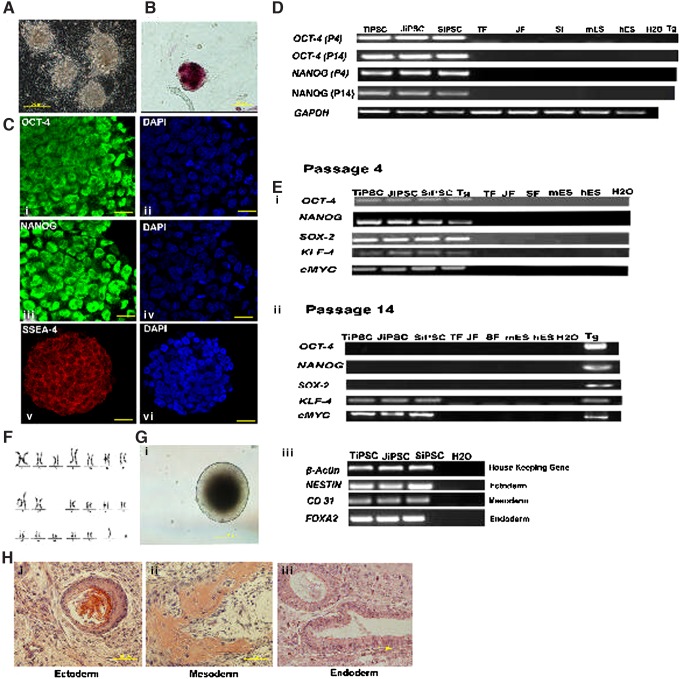
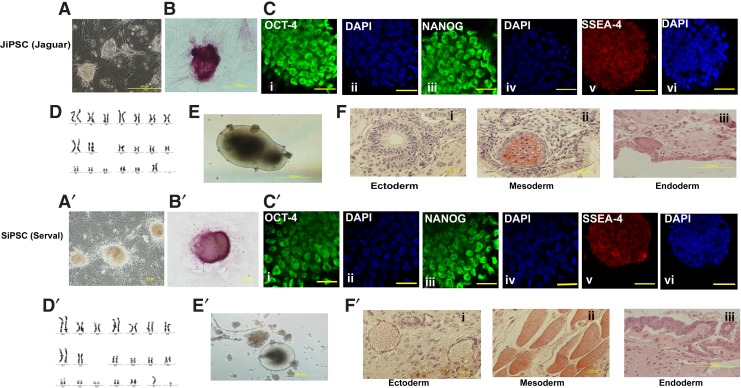
Nanog has an important role in pluripotency induction in bovines and snow leopards. To examine whether it was required for wild felids globally, we examined the induction of pluripotency in felids from Asia (Bengal tiger, Panthera tigris), Africa (serval, Leptailurus serval), and the Americas (jaguar, Panthera onca). Dermal fibroblasts were transduced with genes encoding the human transcription factors OCT4, SOX2, KLF4, and cMYC with or without NANOG. Both four- and five-factor induction resulted in colony formation at day 3 in all three species tested; however, we were not able to maintain colonies that were generated without NANOG beyond passage (P) 7. Five-factor induced pluripotent stem cell (iPSC) colonies from wild cats were expanded in vitro on feeder layers and were positive for alkaline phosphatase and protein expression of OCT-4, NANOG, and stage-specific embryonic antigen-4 at P4 and P14. Reverse-transcription polymerase chain reaction confirmed that all five human transgenes were transcribed at P4; however, OCT4, SOX2, and NANOG transgenes were silenced by P14. Endogenous OCT4 and NANOG transcripts were detected at P4 and P14 in all cell lines confirming successful reprogramming. At P14, the iPSCs from all three species remained euploid and differentiated in vivo and in vitro into derivatives of the three germ layers. This study describes an effective method for inducing pluripotency in three endangered wild cats from across the globe and confirms Nanog as an essential factor in the reprogramming event. Efficient production of iPSC from endangered felids creates a unique opportunity for species preservation through gamete production, nuclear transfer, embryo complementation, and future novel technologies.
Nanog在牛和雪豹的多能性诱导中发挥着重要作用。为了研究它是否是全球野生猫科动物所必需的,我们检测了来自亚洲(孟加拉虎,Panthera tigris)、非洲(薮猫,Leptailurus serval)和美洲(美洲豹,Panthera onca)的猫科动物的多能性诱导情况。用编码人类转录因子OCT4、SOX2、KLF4和cMYC的基因转导皮肤成纤维细胞,转导时添加或不添加NANOG。四因子和五因子诱导均在所有测试的三个物种中于第3天导致集落形成;然而,我们无法维持在没有NANOG的情况下产生的集落超过传代(P)7代。来自野生猫科动物的五因子诱导多能干细胞(iPSC)集落在饲养层上进行体外扩增,在P4和P14时碱性磷酸酶以及OCT-4、NANOG和阶段特异性胚胎抗原-4的蛋白表达呈阳性。逆转录聚合酶链反应证实所有五个人类转基因在P4时均被转录;然而,OCT4、SOX2和NANOG转基因在P14时被沉默。在所有细胞系的P4和P14时检测到内源性OCT4和NANOG转录本,证实重编程成功。在P14时,来自所有三个物种的iPSC保持整倍体,并在体内和体外分化为三个胚层的衍生物。本研究描述了一种在全球三种濒危野生猫科动物中诱导多能性的有效方法,并证实Nanog是重编程事件中的一个关键因素。从濒危猫科动物高效生产iPSC为通过配子生产、核移植、胚胎互补以及未来的新技术进行物种保护创造了独特的机会。