Instituto de Estructura de la Materia, Consejo Superior de Investigaciones Científicas, Serrano 121, 28006 Madrid, Spain.
Sci Rep. 2013;3:1507. doi: 10.1038/srep01507.
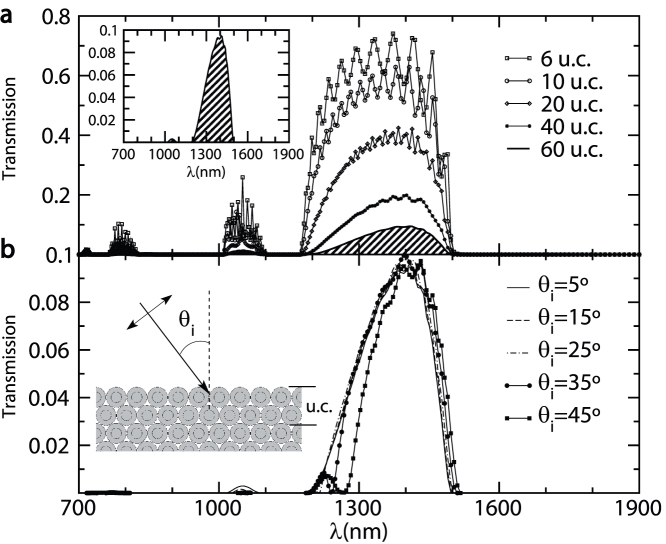
Recently, many fascinating properties predicted for metamaterials (negative refraction, superlensing, electromagnetic cloaking,…) were experimentally demonstrated. Unfortunately, the best achievements have no direct translation to the optical domain, without being burdened by technological and conceptual difficulties. Of particular importance within the realm of optical negative-index metamaterials (NIM), is the issue of simultaneously achieving strong electric and magnetic responses and low associated losses. Here, hybrid metal-semiconductor nanowires are proposed as building blocks of optical NIMs. The metamaterial thus obtained, highly isotropic in the plane normal to the nanowires, presents a negative index of refraction in the near-infrared, with values of the real part well below -1, and extremely low losses (an order of magnitude better than present optical NIMs). Tunability of the system allows to select the operating range in the whole telecom spectrum. The design is proven in configurations such as prisms and slabs, directly observing negative refraction.
最近,许多令人着迷的超材料特性(负折射、超透镜、电磁隐身等)已经被实验证实。不幸的是,最好的成果并没有直接转化到光学领域,没有摆脱技术和概念上的困难。在光学负折射率超材料(NIM)领域中,特别重要的问题是同时实现强电和磁响应以及低损耗。在这里,混合金属-半导体纳米线被提议作为光学 NIM 的构建模块。所得到的超材料在垂直于纳米线的平面上具有高度各向同性,在近红外区域呈现负折射率,实部值远低于-1,并且损耗极低(比目前的光学 NIM 好一个数量级)。该系统的可调谐性允许在整个电信频谱中选择工作范围。设计在棱镜和平板等配置中得到验证,直接观察到负折射。