Research Station Agroscope Reckenholz-Tänikon ART, Zürich, Switzerland.
PLoS One. 2013;8(3):e59286. doi: 10.1371/journal.pone.0059286. Epub 2013 Mar 14.
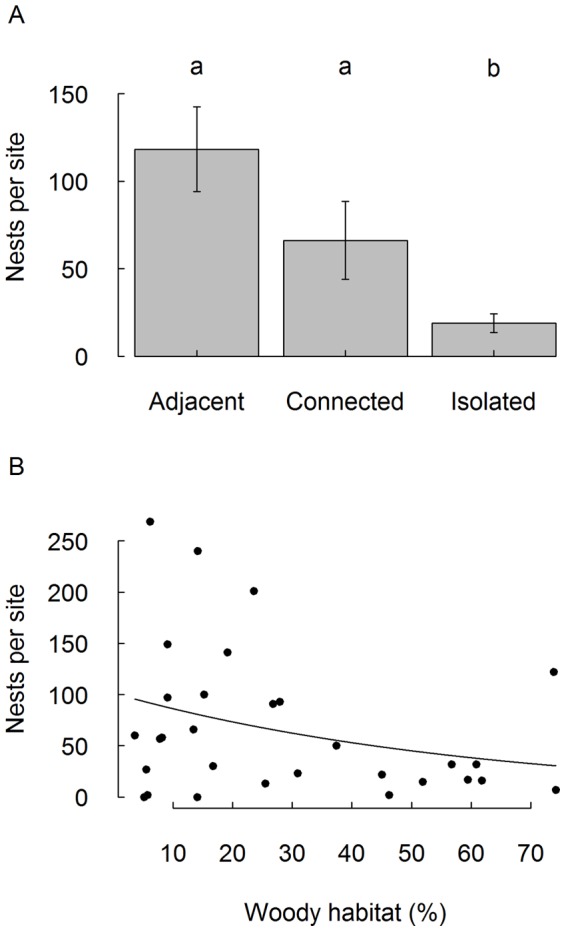
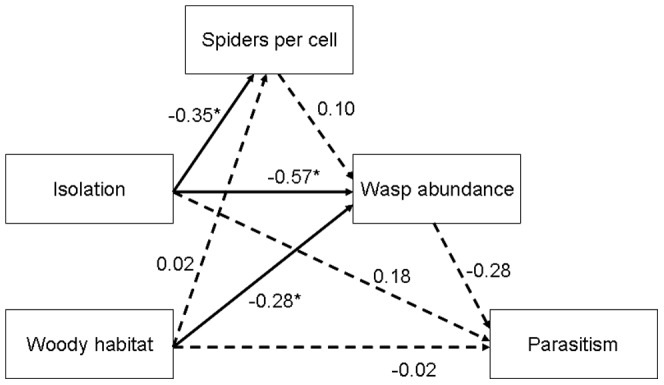
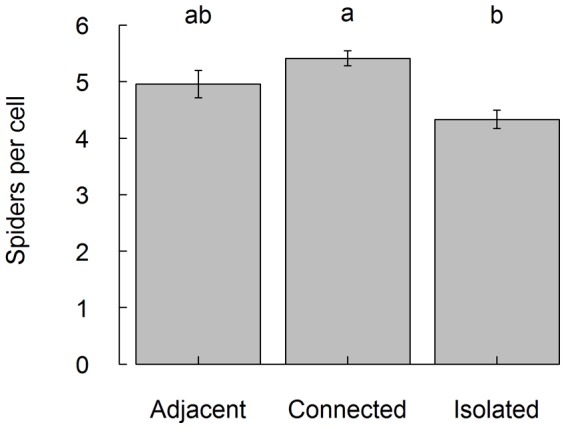
Habitat fragmentation strongly affects species distribution and abundance. However, mechanisms underlying fragmentation effects often remain unresolved. Potential mechanisms are (1) reduced dispersal of a species or (2) altered species interactions in fragmented landscapes. We studied if abundance of the spider-hunting and cavity-nesting wasp Trypoxylon figulus Linnaeus (Hymenoptera: Crabronidae) is affected by fragmentation, and then tested for any effect of larval food (bottom up regulation) and parasitism (top down regulation). Trap nests of T. figulus were studied in 30 agricultural landscapes of the Swiss Plateau. The sites varied in the level of isolation from forest (adjacent, in the open landscape but connected, isolated) and in the amount of woody habitat (from 4% to 74%). We recorded wasp abundance (number of occupied reed tubes), determined parasitism of brood cells and analysed the diversity and abundance of spiders that were deposited as larval food. Abundances of T. figulus were negatively related to forest cover in the landscape. In addition, T. figulus abundances were highest at forest edges, reduced by 33.1% in connected sites and by 79.4% in isolated sites. The mean number of spiders per brood cell was lowest in isolated sites. Nevertheless, structural equation modelling revealed that this did not directly determine wasp abundance. Parasitism was neither related to the amount of woody habitat nor to isolation and did not change with host density. Therefore, our study showed that the abundance of T. figulus cannot be fully explained by the studied trophic interactions. Further factors, such as dispersal and habitat preference, seem to play a role in the population dynamics of this widespread secondary carnivore in agricultural landscapes.
生境破碎化强烈影响物种的分布和丰度。然而,破碎化效应的机制仍未得到解决。潜在的机制是(1)物种扩散减少,或(2)破碎景观中物种相互作用的改变。我们研究了蜘蛛猎食者和洞穴筑巢的黄蜂 Trypoxylon figulus Linnaeus(膜翅目:Crabronidae)的丰度是否受到破碎化的影响,然后测试了幼虫食物(自上而下的调节)和寄生(自上而下的调节)的任何影响。在瑞士高原的 30 个农业景观中研究了 T. figulus 的陷阱巢。这些地点在与森林的隔离程度(相邻,在开阔景观中但相连,隔离)和木质栖息地的数量(从 4%到 74%)上有所不同。我们记录了黄蜂的丰度(占用的芦苇管数量),确定了育雏细胞的寄生情况,并分析了作为幼虫食物沉积的蜘蛛的多样性和丰度。T. figulus 的丰度与景观中的森林覆盖率呈负相关。此外,T. figulus 的丰度在森林边缘最高,在相连的地点减少了 33.1%,在隔离的地点减少了 79.4%。每个育雏细胞的蜘蛛平均数量在隔离地点最低。然而,结构方程模型显示,这并没有直接决定黄蜂的丰度。寄生既与木质栖息地的数量无关,也与隔离无关,也不会随宿主密度而变化。因此,我们的研究表明,T. figulus 的丰度不能完全用所研究的营养相互作用来解释。进一步的因素,如扩散和栖息地偏好,似乎在这种广泛分布的农业景观中二级肉食者的种群动态中发挥了作用。