Department of Cognitive and Behavioral Science, University of Tokyo, Tokyo, Japan.
PLoS One. 2013;8(3):e59312. doi: 10.1371/journal.pone.0059312. Epub 2013 Mar 13.
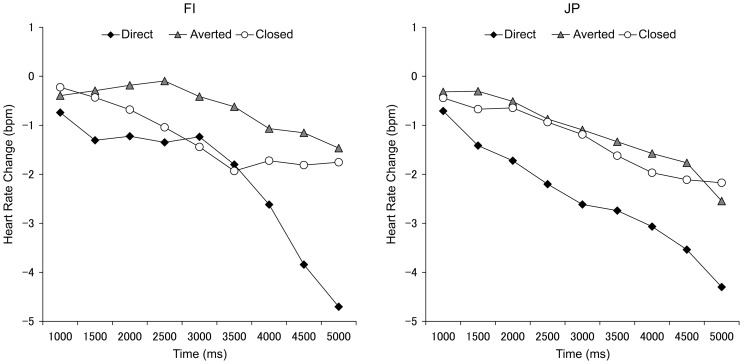
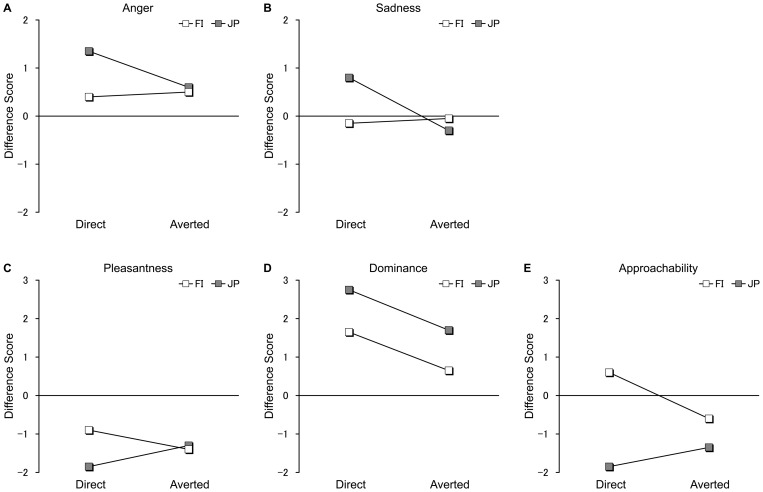
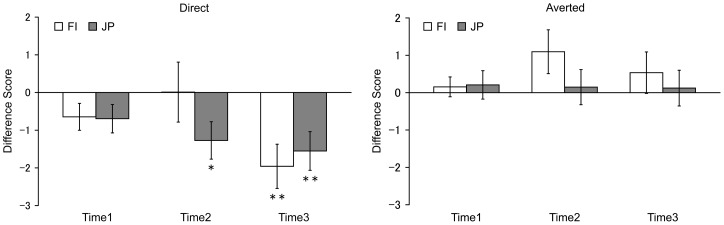
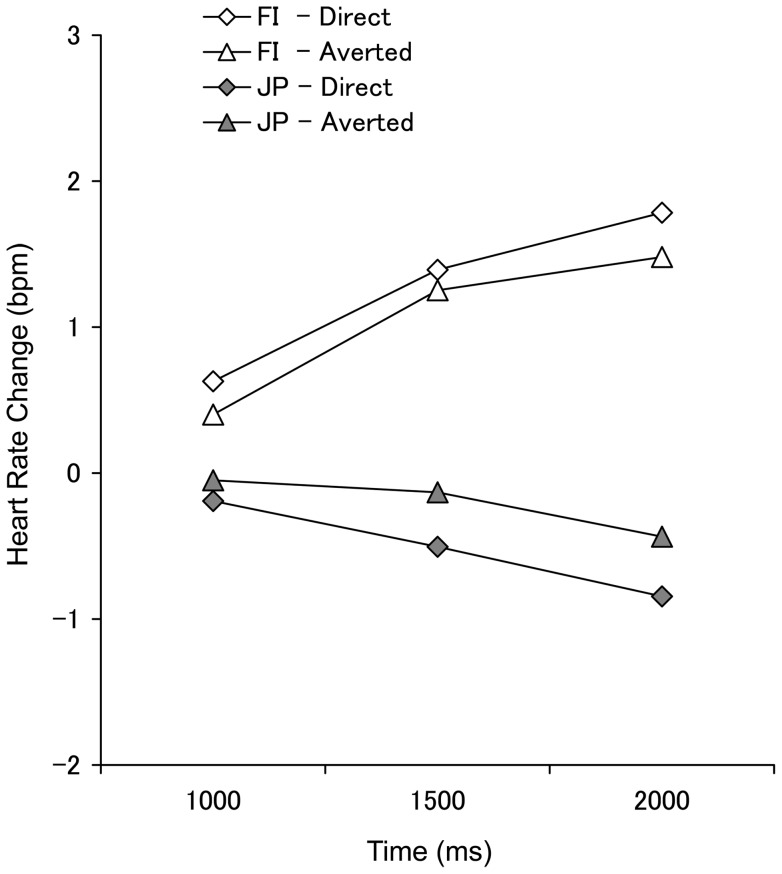
Eye contact has a fundamental role in human social interaction. The special appearance of the human eye (i.e., white sclera contrasted with a coloured iris) implies the importance of detecting another person's face through eye contact. Empirical studies have demonstrated that faces making eye contact are detected quickly and processed preferentially (i.e., the eye contact effect). Such sensitivity to eye contact seems to be innate and universal among humans; however, several studies suggest that cultural norms affect eye contact behaviours. For example, Japanese individuals exhibit less eye contact than do individuals from Western European or North American cultures. However, how culture modulates eye contact behaviour is unclear. The present study investigated cultural differences in autonomic correlates of attentional orienting (i.e., heart rate) and looking time. Additionally, we examined evaluative ratings of eye contact with another real person, displaying an emotionally neutral expression, between participants from Western European (Finnish) and East Asian (Japanese) cultures. Our results showed that eye contact elicited stronger heart rate deceleration responses (i.e., attentional orienting), shorter looking times, and higher ratings of subjective feelings of arousal as compared to averted gaze in both cultures. Instead, cultural differences in the eye contact effect were observed in various evaluative responses regarding the stimulus faces (e.g., facial emotion, approachability etc.). The rating results suggest that individuals from an East Asian culture perceive another's face as being angrier, unapproachable, and unpleasant when making eye contact as compared to individuals from a Western European culture. The rating results also revealed that gaze direction (direct vs. averted) could influence perceptions about another person's facial affect and disposition. These results suggest that cultural differences in eye contact behaviour emerge from differential display rules and cultural norms, as opposed to culture affecting eye contact behaviour directly at the physiological level.
眼神交流在人类社交互动中起着至关重要的作用。人类眼睛的特殊外观(即白色巩膜与有色虹膜形成对比)意味着通过眼神交流来察觉他人面部的重要性。实证研究表明,与人进行眼神交流的面部会被迅速察觉,并被优先处理(即眼神交流效应)。这种对眼神交流的敏感性似乎是人类与生俱来且普遍存在的;然而,一些研究表明,文化规范会影响眼神交流行为。例如,与来自西欧或北美文化的个体相比,日本个体的眼神交流较少。然而,文化如何调节眼神交流行为尚不清楚。本研究调查了自主神经相关性注意力指向(即心率)和注视时间在文化上的差异。此外,我们还考察了来自西欧(芬兰)和东亚(日本)文化的参与者对另一个真实的、表情中性的人的眼神接触的评价评分。我们的研究结果表明,与回避目光相比,无论是在哪个文化中,眼神交流都会引起更强的心率减速反应(即注意力指向)、更短的注视时间,以及更高的主观唤醒感评分。相反,在各种关于刺激面孔的评价反应中,观察到了眼神交流效应的文化差异(例如,面部表情、可接近性等)。评分结果表明,与来自西欧文化的个体相比,来自东亚文化的个体在进行眼神交流时,会认为另一个人的脸更生气、更不可接近、更不愉快。评分结果还表明,注视方向(直接注视与回避注视)会影响对他人面部情绪和性格的看法。这些结果表明,眼神交流行为的文化差异源于不同的展示规则和文化规范,而不是文化直接在生理水平上影响眼神交流行为。