School of Public Health & Global Health Institute, Wuhan University, Wuhan, Hubei, PR China.
PLoS Negl Trop Dis. 2013;7(3):e2122. doi: 10.1371/journal.pntd.0002122. Epub 2013 Mar 14.
More than 80% of schistosomiasis patients in China live in the lake and marshland regions. The purpose of our study is to assess the effect of a comprehensive strategy to control transmission of Schistosoma japonicum in marshland regions.
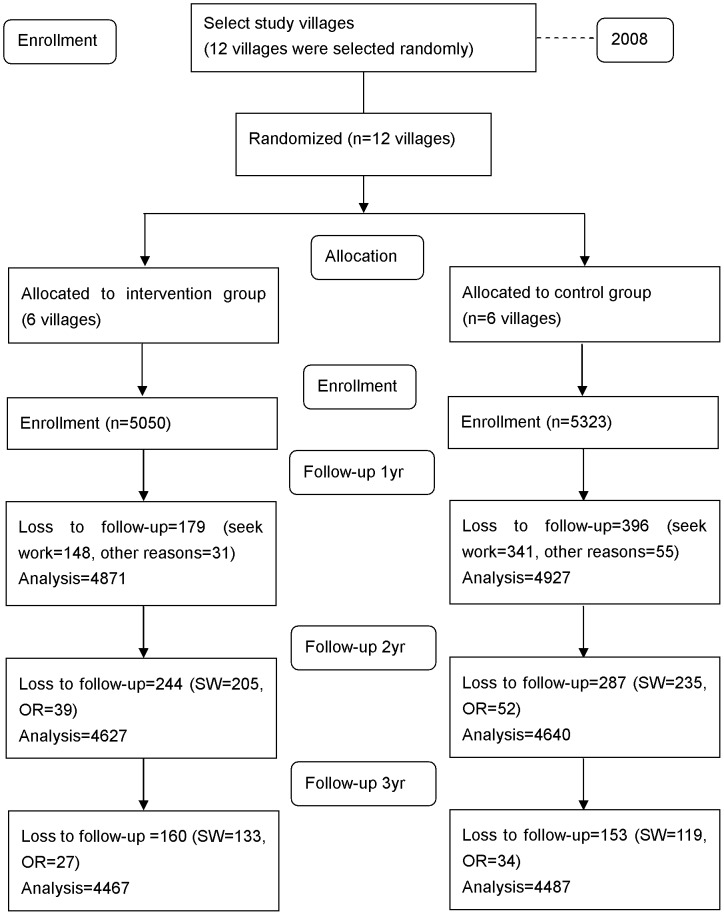
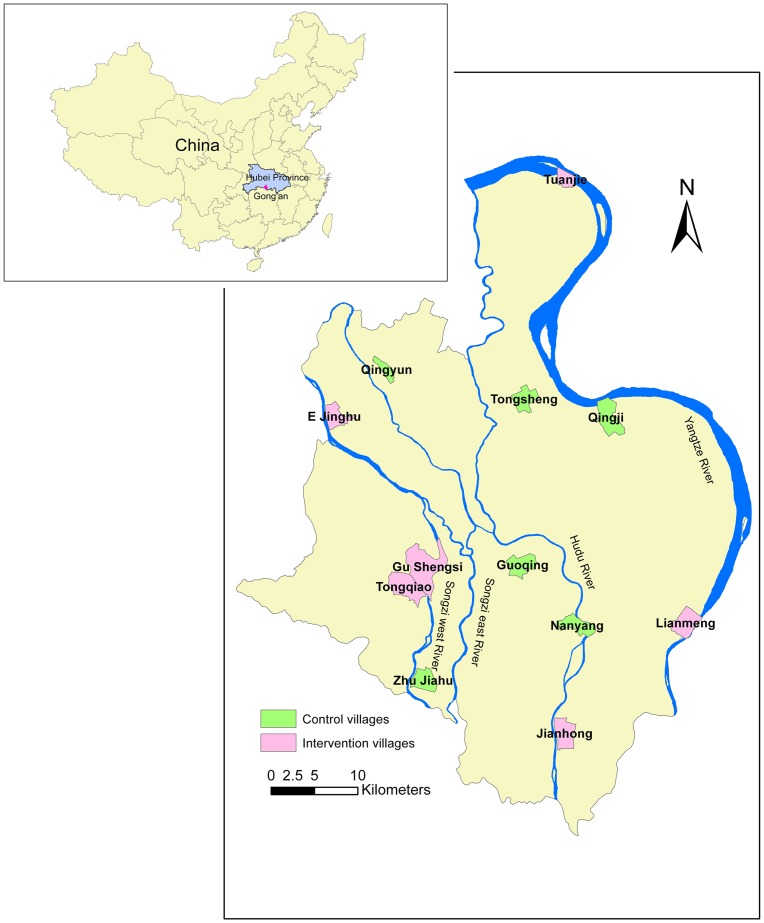
METHODOLOGY/PRINCIPAL FINDINGS: In a cluster randomized controlled trial, we implemented an integrated control strategy in twelve villages from 2009 through 2011 in Gong'an County, Hubei Province. The routine interventions included praziquantel chemotherapy and controlling snails, and were implemented in all villages. New interventions, mainly consisting of building fences to limit the grazing area for bovines, building safe pastures for grazing, improving the residents' health conditions and facilities, were only implemented in six intervention villages. Results showed that the rate of S. japonicum infection in humans, bovines, snails, cow dung and mice in the intervention group decreased from 3.41% in 2008 to 0.81% in 2011, 3.3% to none, 11 of 6,219 to none, 3.9% to none and 31.7% to 1.7%, respectively (P<0.001 for all comparisons). In contrast, there were no statistically significant reductions of S. japonicum infection in humans, bovines and snails from 2008 to 2011 in the control group (P>0.05 for all comparisons). Moreover, a generalized linear model showed that there was a higher infection risk in humans in the control group than in the intervention group (OR = 1.250, P = 0.001) and an overall significant downward trend in infection risk during the study period.
CONCLUSIONS/SIGNIFICANCE: The integrated control strategy, designed to reduce the role of bovines and humans as sources of S. japonicum infection, was highly effective in controlling the transmission of S. japonicum in marshland regions in China.
Chinese Clinical Trial Registry ChiCTR-PRC-12002405.
中国超过 80%的血吸虫病患者生活在湖区和沼泽地区。本研究旨在评估在沼泽地区实施综合血吸虫病传播控制策略的效果。
方法/主要发现:在一项整群随机对照试验中,我们于 2009 年至 2011 年在湖北省公安县的 12 个村庄实施了综合控制策略。常规干预措施包括吡喹酮化疗和控制钉螺,并在所有村庄实施。新的干预措施主要包括修建围栏限制耕牛放牧区、修建安全牧场放牧、改善居民卫生条件和设施,仅在 6 个干预村庄实施。结果表明,干预组人群、牛、螺、牛粪和鼠的日本血吸虫感染率从 2008 年的 3.41%下降到 2011 年的 0.81%、3.3%降至零、6219 只钉螺中检出 11 只降至零、3.9%降至零、31.7%降至 1.7%(所有比较均 P<0.001)。相比之下,对照组人群、牛和螺的日本血吸虫感染率从 2008 年到 2011 年没有统计学显著降低(所有比较均 P>0.05)。此外,广义线性模型显示,对照组人群的感染风险高于干预组(OR=1.250,P=0.001),且研究期间感染风险呈总体显著下降趋势。
结论/意义:旨在减少牛和人类作为日本血吸虫感染源作用的综合控制策略,在中国沼泽地区控制日本血吸虫传播非常有效。
中国临床试验注册中心 ChiCTR-PRC-12002405。