Moon Hye Jin, Choi Kyoung Hyo, Kim Dae Ha, Kim Ha Jeong, Cho Young Ki, Lee Kwang Hee, Kim Jung Hoo, Choi Yoo Jung
Department of Rehabilitation Medicine, Asan Medical Center, University of Ulsan College of Medicine, Seoul, Korea.
Ann Rehabil Med. 2013 Feb;37(1):110-7. doi: 10.5535/arm.2013.37.1.110. Epub 2013 Feb 28.
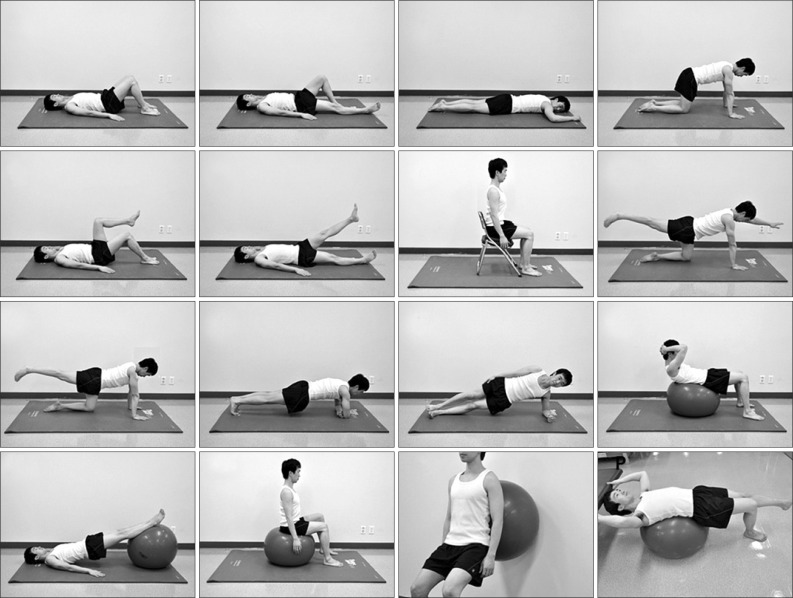
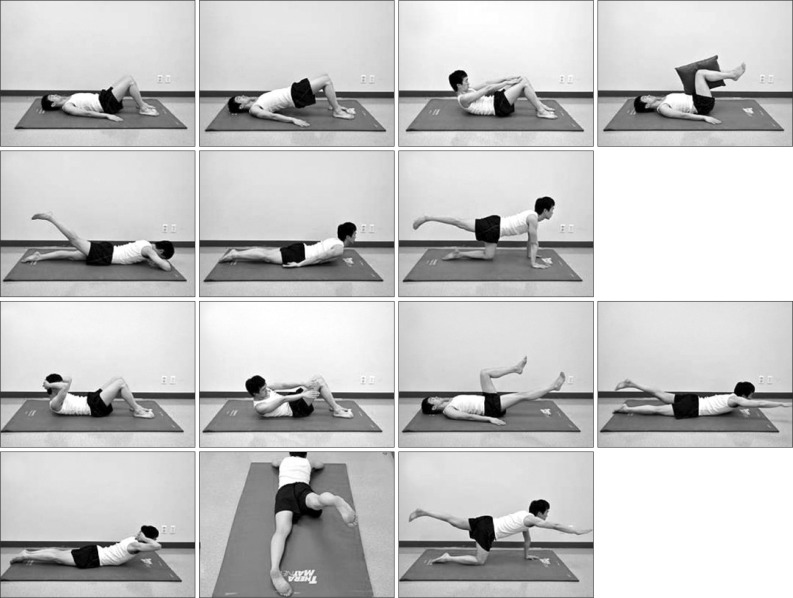
To compare the effects of lumbar stabilization exercises and lumbar dynamic strengthening exercises on the maximal isometric strength of the lumbar extensors, pain severity and functional disability in patients with chronic low back pain (LBP).
Patients suffering nonspecific LBP for more than 3 months were included prospectively and randomized into lumbar stabilization exercise group (n=11) or lumbar dynamic strengthening exercise group (n=10). Exercises were performed for 1 hour, twice weekly, for 8 weeks. The strength of the lumbar extensors was measured at various angles ranging from 0° to 72° at intervals of 12°, using a MedX. The visual analog scale (VAS) and the Oswestry Low Back Pain Disability Questionnaire (ODQ) were used to measure the severity of LBP and functional disability before and after the exercise.
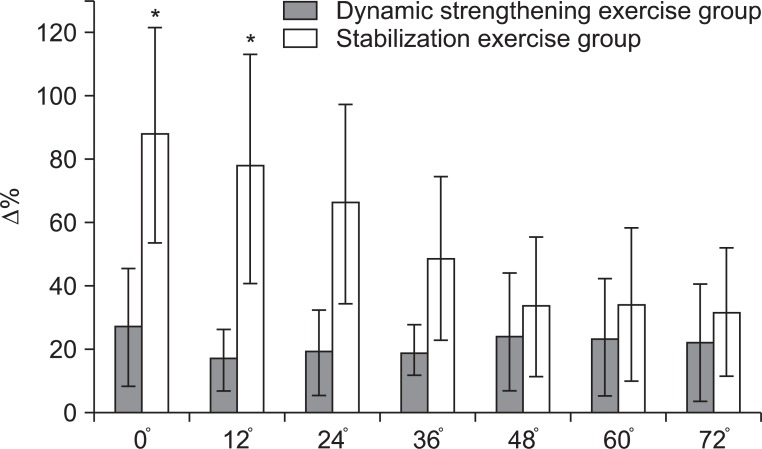
Compared with the baseline, lumbar extension strength at all angles improved significantly in both groups after 8 weeks. The improvements were significantly greater in the lumbar stabilization exercise group at 0° and 12° of lumbar flexion. VAS decreased significantly after treatment; however, the changes were not significantly different between the groups. ODQ scores improved significantly in the stabilization exercise group only.
Both lumbar stabilization and dynamic strengthening exercise strengthened the lumbar extensors and reduced LBP. However, the lumbar stabilization exercise was more effective in lumbar extensor strengthening and functional improvement in patients with nonspecific chronic LBP.
比较腰椎稳定训练和腰椎动态强化训练对慢性下腰痛(LBP)患者腰椎伸肌最大等长肌力、疼痛严重程度及功能障碍的影响。
前瞻性纳入非特异性LBP持续3个月以上的患者,并随机分为腰椎稳定训练组(n = 11)或腰椎动态强化训练组(n = 10)。训练每周进行2次,每次1小时,共8周。使用MedX在0°至72°范围内以12°间隔测量腰椎伸肌在不同角度的力量。采用视觉模拟量表(VAS)和Oswestry下腰痛功能障碍问卷(ODQ)在训练前后测量LBP的严重程度和功能障碍。
与基线相比,8周后两组各角度的腰椎伸展力量均显著提高。腰椎稳定训练组在腰椎前屈0°和12°时的改善明显更大。治疗后VAS显著降低;然而,两组之间的变化无显著差异。仅稳定训练组的ODQ评分显著改善。
腰椎稳定训练和动态强化训练均可增强腰椎伸肌力量并减轻LBP。然而,腰椎稳定训练在增强非特异性慢性LBP患者的腰椎伸肌力量和功能改善方面更有效。