State Key Laboratory of Cognitive Neuroscience and Learning, Beijing Normal University, Beijing, China.
PLoS One. 2013;8(3):e59886. doi: 10.1371/journal.pone.0059886. Epub 2013 Mar 20.
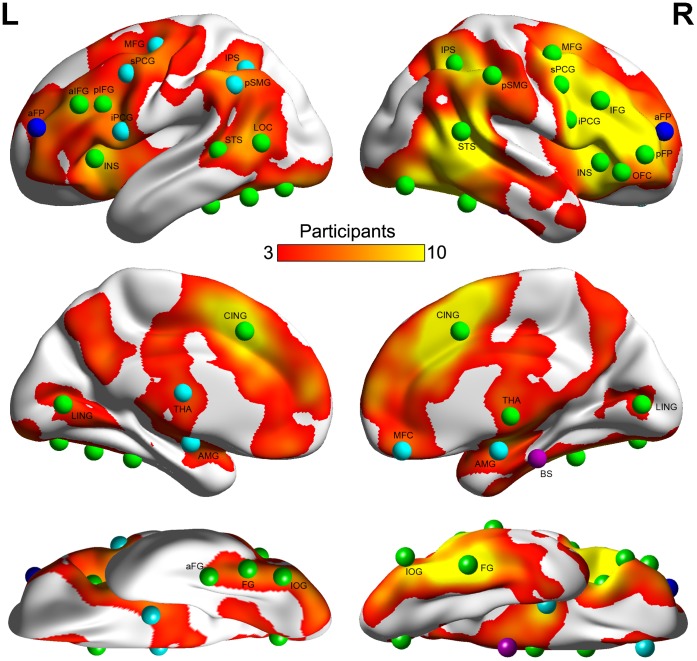
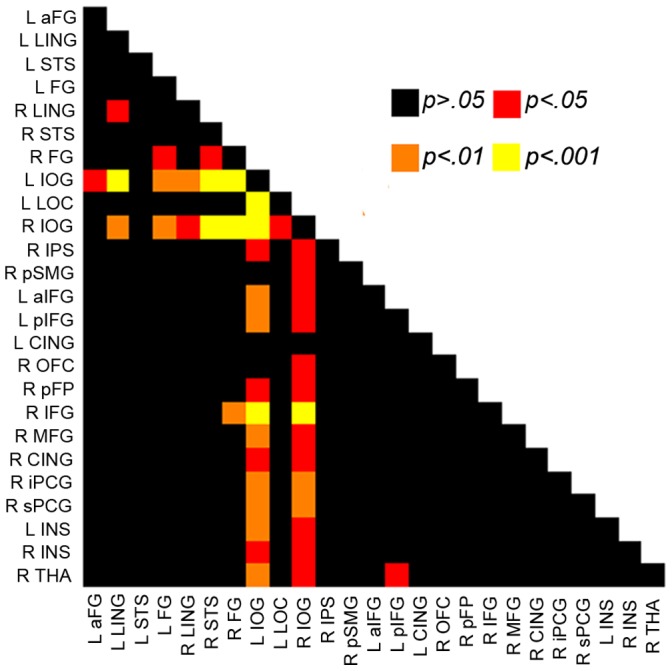
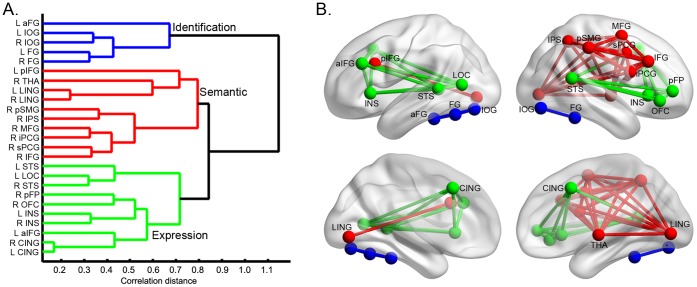
Numerous functional magnetic resonance imaging (fMRI) studies have identified multiple cortical regions that are involved in face processing in the human brain. However, few studies have characterized the face-processing network as a functioning whole. In this study, we used fMRI to identify face-selective regions in the entire brain and then explore the hierarchical structure of the face-processing network by analyzing functional connectivity among these regions. We identified twenty-five regions mainly in the occipital, temporal and frontal cortex that showed a reliable response selective to faces (versus objects) across participants and across scan sessions. Furthermore, these regions were clustered into three relatively independent sub-networks in a face-recognition task on the basis of the strength of functional connectivity among them. The functionality of the sub-networks likely corresponds to the recognition of individual identity, retrieval of semantic knowledge and representation of emotional information. Interestingly, when the task was switched to object recognition from face recognition, the functional connectivity between the inferior occipital gyrus and the rest of the face-selective regions were significantly reduced, suggesting that this region may serve as an entry node in the face-processing network. In sum, our study provides empirical evidence for cognitive and neural models of face recognition and helps elucidate the neural mechanisms underlying face recognition at the network level.
大量功能磁共振成像(fMRI)研究已经确定了人类大脑中参与面部处理的多个皮质区域。然而,很少有研究将面部处理网络作为一个整体来描述。在这项研究中,我们使用 fMRI 来识别整个大脑中的面部选择性区域,然后通过分析这些区域之间的功能连接来探索面部处理网络的层次结构。我们在 25 个主要位于枕叶、颞叶和额叶的区域中识别出了对人脸(相对于物体)有可靠反应的区域,这些区域在参与者和扫描过程中都表现出了这种反应。此外,根据它们之间功能连接的强度,这些区域在人脸识别任务中被聚类为三个相对独立的子网络。子网络的功能可能对应于个体身份的识别、语义知识的检索和情绪信息的表示。有趣的是,当任务从人脸识别切换到物体识别时,下枕叶与其余面部选择区域之间的功能连接显著减少,这表明该区域可能作为面部处理网络的入口节点。总之,我们的研究为面部识别的认知和神经模型提供了经验证据,并有助于阐明网络层面上的面部识别的神经机制。