The Rockefeller University, Howard Hughes Medical Institute, 1230 York Avenue, New York, New York 10065, USA.
Nature. 2013 Apr 4;496(7443):119-22. doi: 10.1038/nature11988. Epub 2013 Mar 27.
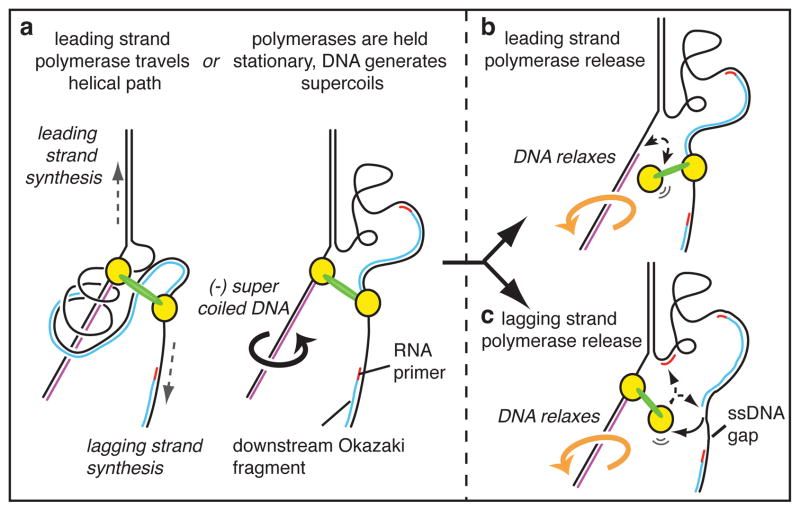
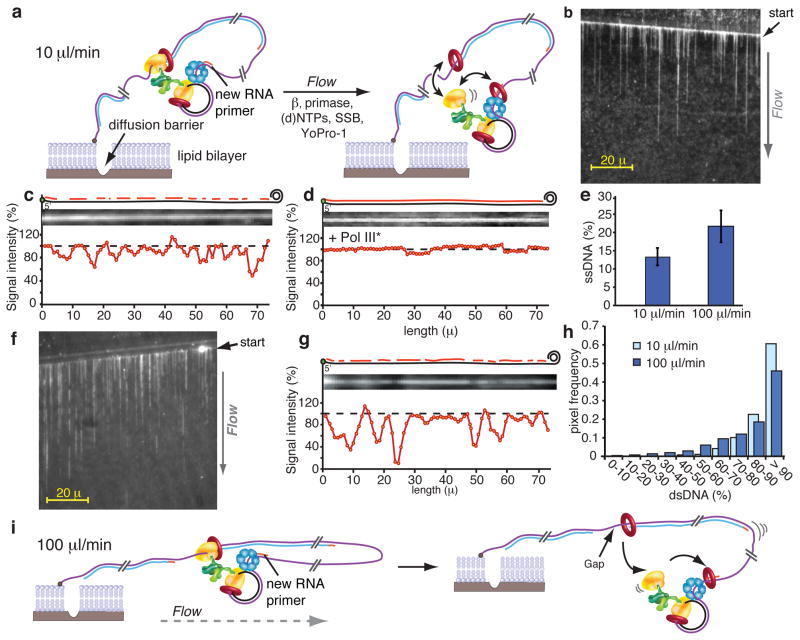
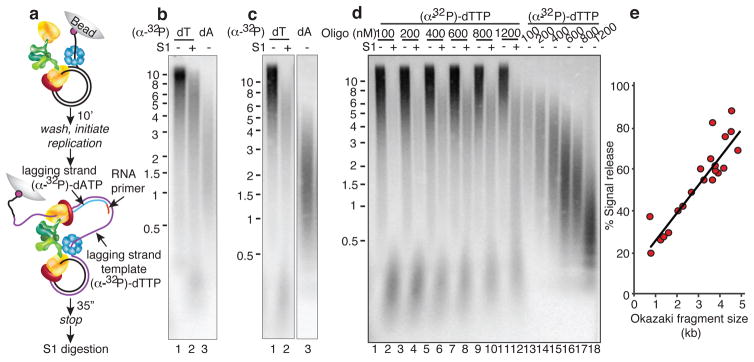
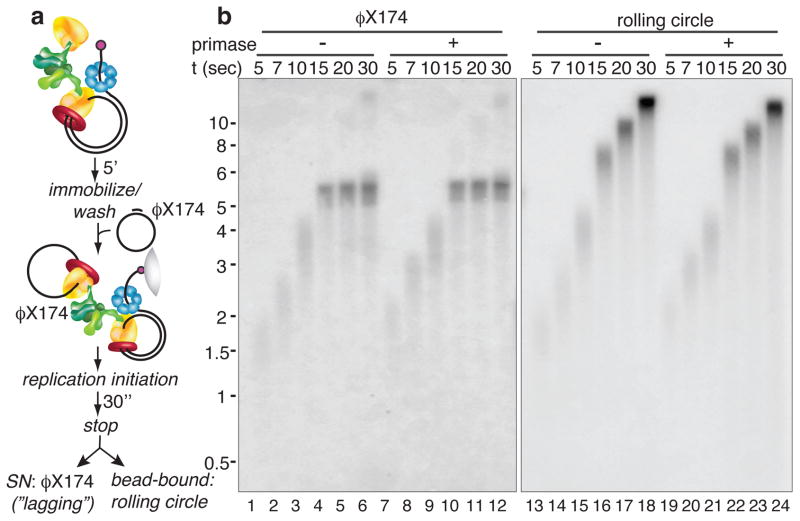
Chromosomal replication machines contain coupled DNA polymerases that simultaneously replicate the leading and lagging strands. However, coupled replication presents a largely unrecognized topological problem. Because DNA polymerase must travel a helical path during synthesis, the physical connection between leading- and lagging-strand polymerases causes the daughter strands to entwine, or produces extensive build-up of negative supercoils in the newly synthesized DNA. How DNA polymerases maintain their connection during coupled replication despite these topological challenges is unknown. Here we examine the dynamics of the Escherichia coli replisome, using ensemble and single-molecule methods, and show that the replisome may solve the topological problem independent of topoisomerases. We find that the lagging-strand polymerase frequently releases from an Okazaki fragment before completion, leaving single-strand gaps behind. Dissociation of the polymerase does not result in loss from the replisome because of its contact with the leading-strand polymerase. This behaviour, referred to as 'signal release', had been thought to require a protein, possibly primase, to pry polymerase from incompletely extended DNA fragments. However, we observe that signal release is independent of primase and does not seem to require a protein trigger at all. Instead, the lagging-strand polymerase is simply less processive in the context of a replisome. Interestingly, when the lagging-strand polymerase is supplied with primed DNA in trans, uncoupling it from the fork, high processivity is restored. Hence, we propose that coupled polymerases introduce topological changes, possibly by accumulation of superhelical tension in the newly synthesized DNA, that cause lower processivity and transient lagging-strand polymerase dissociation from DNA.
染色体复制机器包含偶联的 DNA 聚合酶,这些聚合酶同时复制前导链和滞后链。然而,偶联复制带来了一个尚未得到充分认识的拓扑问题。由于 DNA 聚合酶在合成过程中必须沿螺旋路径移动,前导链和滞后链聚合酶之间的物理连接会导致子链缠绕,或者在新合成的 DNA 中产生大量的负超螺旋积累。DNA 聚合酶在面临这些拓扑挑战的情况下,如何在偶联复制过程中保持它们的连接仍然未知。在这里,我们使用集合和单分子方法研究了大肠杆菌复制体的动力学,并表明复制体可能独立于拓扑异构酶解决拓扑问题。我们发现,滞后链聚合酶在完成之前经常从前导链的冈崎片段上释放,在后面留下单链缺口。由于聚合酶与前导链聚合酶接触,聚合酶的解离不会导致其从复制体中丢失。这种行为被称为“信号释放”,以前认为它需要一种蛋白质,可能是引物酶,才能从未完全延伸的 DNA 片段中撬起聚合酶。然而,我们观察到信号释放独立于引物酶,似乎根本不需要蛋白质触发。相反,滞后链聚合酶在复制体的背景下只是不太连续。有趣的是,当滞后链聚合酶在体外供应有引物的 DNA 时,它与叉子解偶联,其连续性就会恢复。因此,我们提出,偶联的聚合酶会引入拓扑变化,可能是通过在新合成的 DNA 中积累超螺旋张力,从而导致较低的连续性和滞后链聚合酶从 DNA 上的瞬时解离。