Fukunaga Issei, Hori Masaaki, Masutani Yoshitaka, Hamasaki Nozomi, Sato Shuji, Suzuki Yuriko, Kumagai Fumitaka, Kosuge Masatsugu, Hoshito Haruyoshi, Kamagata Koji, Shimoji Keigo, Nakanishi Atsushi, Aoki Shigeki, Senoo Atsushi
Department of Radiological Sciences, Graduate School of Human Health Sciences, Tokyo Metropolitan University, 7-2-10 Higashiogu, Arakawa, Tokyo 116-8551, Japan.
Radiol Phys Technol. 2013 Jul;6(2):343-8. doi: 10.1007/s12194-013-0206-5. Epub 2013 Mar 28.
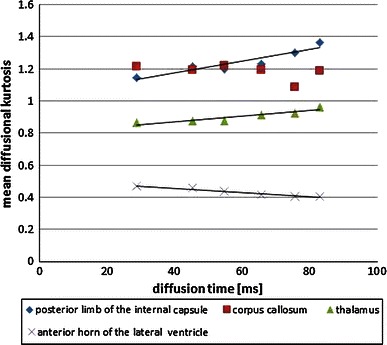
Diffusional kurtosis imaging (DKI) is a new technique based on non-Gaussian water diffusion analysis. However, the original DKI protocol (six b values and 30 motion-probing gradient (MPG) directions) requires more than 10 min of scanning time, which is too long for daily clinical use. We aimed to find suitable b value, MPG direction, and diffusion time settings for faster DKI. Four normal healthy subjects participated in the study. All DKI data sets were acquired on a clinical 3T-MRI scanner (Philips Medical Systems) with use of three protocols of 0-7500 s/mm(2) b values, 6-32 MPG directions, and 23-80 ms diffusion time. There was a remarkable difference in the standard deviation (SD) of the mean DK values in the number of MPG directions. The mean DK values were significantly higher in the posterior limb of the internal capsule (p = 0.003, r = 0.924) and thalamus (p = 0.005, r = 0.903), whereas the mean DK values of the cerebrospinal fluid (CSF) (p = 0.001, r = -0.976) were significantly lower when we used a longer diffusion time. Our results indicate that the SD of the mean DK values was higher in 15 MPG directions than in 20 MPG directions and more. Because the mean DK values of the CSF were significantly lower when we used longer diffusion times, we expect longer diffusion times to be useful for DKI. We propose the following imaging parameters for clinical use: 0, 1000, and 2000 s/mm(2) b values; 20 MPG directions; Δ/δ 45.3/13.3 ms.
扩散峰度成像(DKI)是一种基于非高斯水扩散分析的新技术。然而,原始的DKI方案(六个b值和30个运动探测梯度(MPG)方向)需要超过10分钟的扫描时间,这对于日常临床使用来说太长了。我们旨在找到合适的b值、MPG方向和扩散时间设置,以实现更快的DKI。四名正常健康受试者参与了该研究。所有DKI数据集均在临床3T-MRI扫描仪(飞利浦医疗系统公司)上采集,使用了三种协议,b值为0 - 7500 s/mm²,MPG方向为6 - 32个,扩散时间为23 - 80毫秒。MPG方向数量不同时,平均DK值的标准差(SD)存在显著差异。当使用较长扩散时间时,内囊后肢(p = 0.003,r = 0.924)和丘脑(p = 0.005,r = 0.903)的平均DK值显著更高,而脑脊液(CSF)的平均DK值(p = 0.001,r = -0.976)则显著更低。我们的结果表明,15个MPG方向时平均DK值的SD高于20个及更多MPG方向时。由于使用较长扩散时间时CSF的平均DK值显著更低,我们预计较长的扩散时间对DKI有用。我们提出以下临床使用的成像参数:b值为0、1000和2000 s/mm²;20个MPG方向;Δ/δ为45.3/13.3毫秒。