Dept, of Plant Science, Plant Genomics and Breeding Institute, College of Agriculture and Life Sciences, Seoul National University, Seoul, 151-921, Republic of Korea.
BMC Plant Biol. 2013 Apr 2;13:56. doi: 10.1186/1471-2229-13-56.
Miniature inverted-repeat transposable elements (MITEs) are expected to play important roles in evolution of genes and genome in plants, especially in the highly duplicated plant genomes. Various MITE families and their roles in plants have been characterized. However, there have been fewer studies of MITE families and their potential roles in evolution of the recently triplicated Brassica genome.
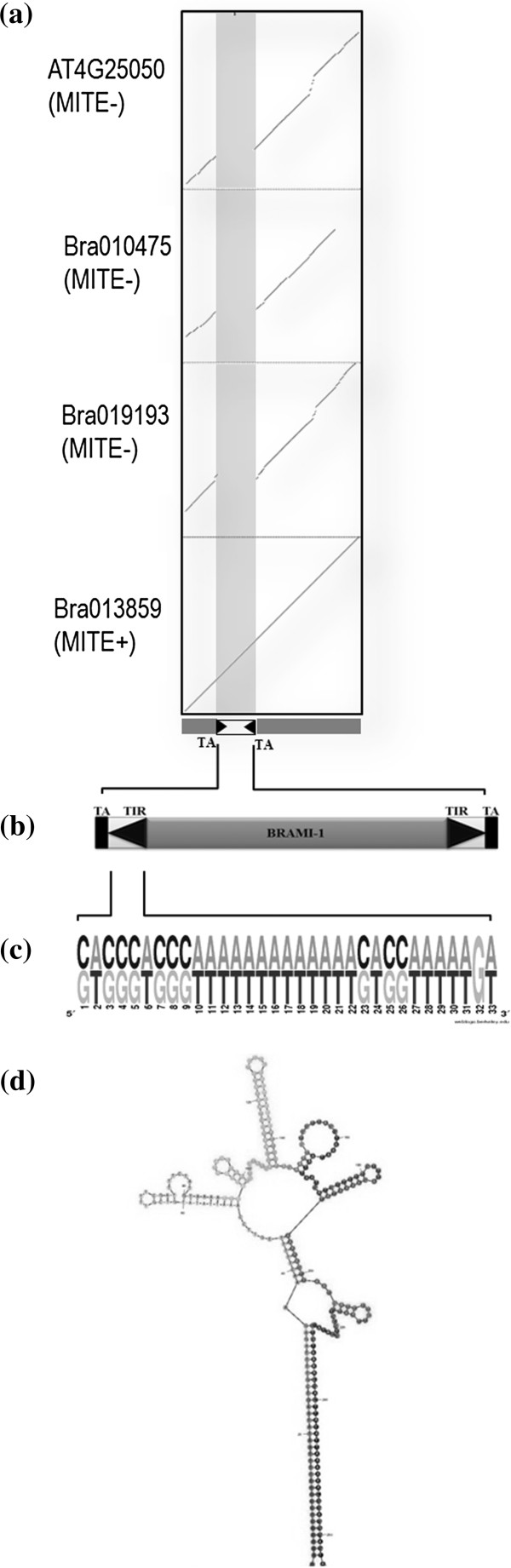
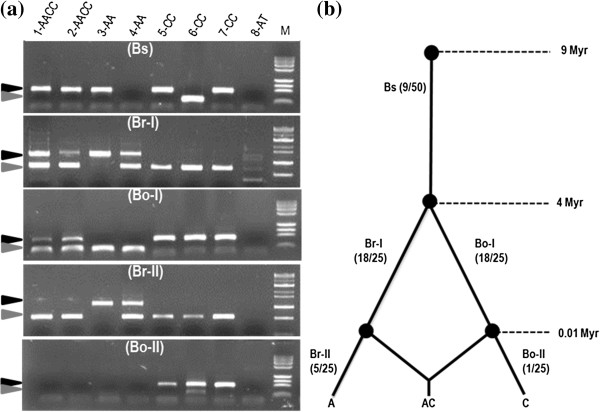
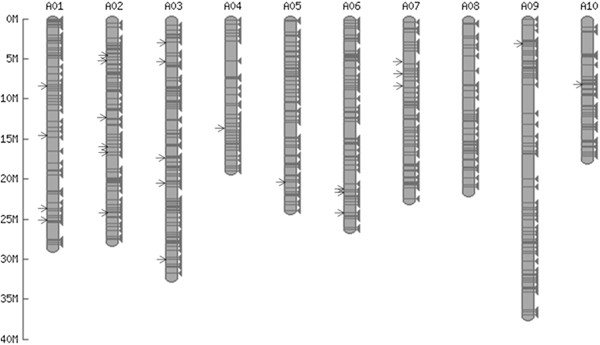
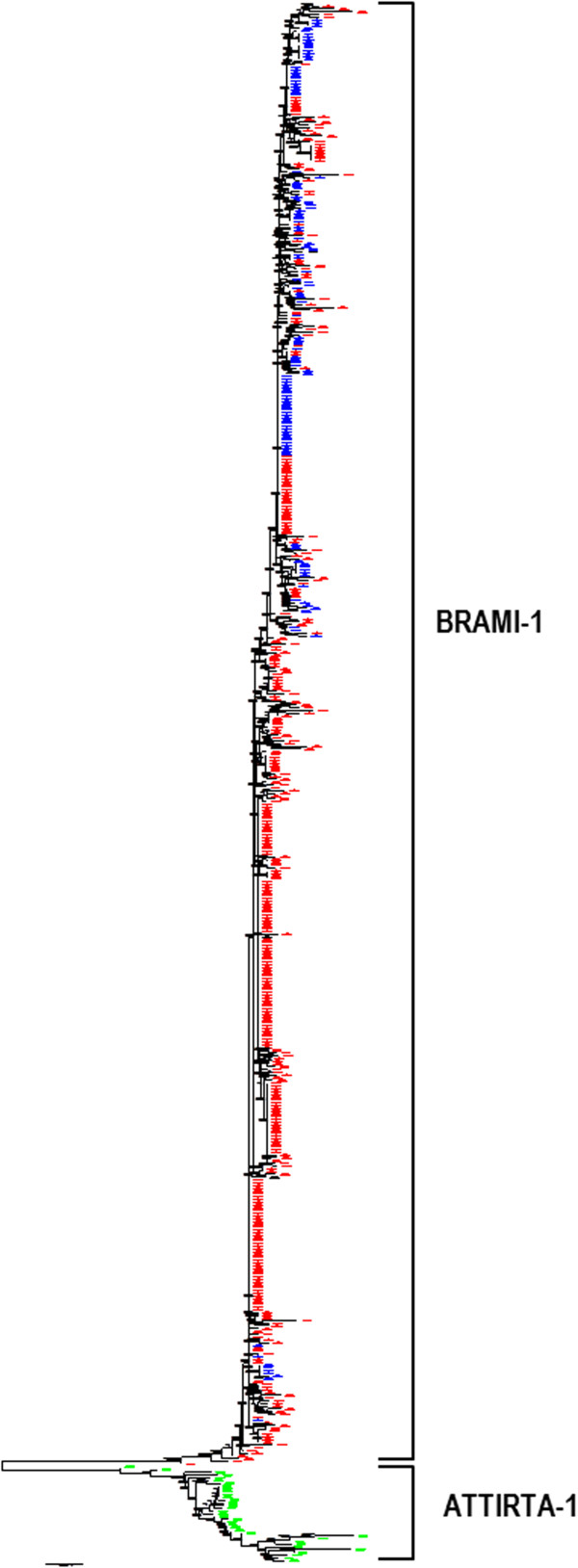
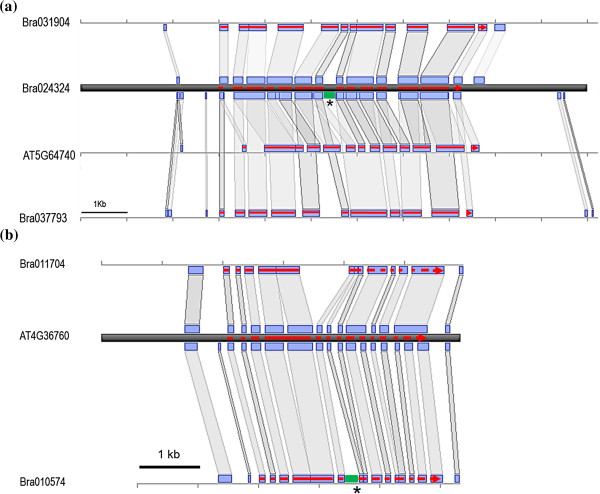
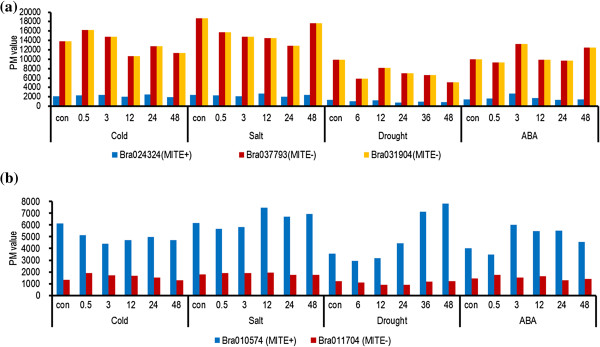
We identified a new MITE family, BRAMI-1, belonging to the Stowaway super-family in the Brassica genome. In silico mapping revealed that 697 members are dispersed throughout the euchromatic regions of the B. rapa pseudo-chromosomes. Among them, 548 members (78.6%) are located in gene-rich regions, less than 3 kb from genes. In addition, we identified 516 and 15 members in the 470 Mb and 15 Mb genomic shotgun sequences currently available for B. oleracea and B. napus, respectively. The resulting estimated copy numbers for the entire genomes were 1440, 1464 and 2490 in B. rapa, B. oleracea and B. napus, respectively. Concurrently, only 70 members of the related Arabidopsis ATTIRTA-1 MITE family were identified in the Arabidopsis genome. Phylogenetic analysis revealed that BRAMI-1 elements proliferated in the Brassica genus after divergence from the Arabidopsis lineage. MITE insertion polymorphism (MIP) was inspected for 50 BRAMI-1 members, revealing high levels of insertion polymorphism between and within species of Brassica that clarify BRAMI-1 activation periods up to the present. Comparative analysis of the 71 genes harbouring the BRAMI-1 elements with their non-insertion paralogs (NIPs) showed that the BRAMI-1 insertions mainly reside in non-coding sequences and that the expression levels of genes with the elements differ from those of their NIPs.
A Stowaway family MITE, named as BRAMI-1, was gradually amplified and remained present in over than 1400 copies in each of three Brassica species. Overall, 78% of the members were identified in gene-rich regions, and it is assumed that they may contribute to the evolution of duplicated genes in the highly duplicated Brassica genome. The resulting MIPs can serve as a good source of DNA markers for Brassica crops because the insertions are highly dispersed in the gene-rich euchromatin region and are polymorphic between or within species.
微型反向重复转座元件(MITEs)有望在植物基因和基因组的进化中发挥重要作用,尤其是在高度重复的植物基因组中。已经对各种 MITE 家族及其在植物中的作用进行了描述。然而,对于 MITE 家族及其在最近三倍体芸薹属基因组进化中的潜在作用的研究较少。
我们在芸薹属基因组中鉴定出一个新的 MITE 家族 BRAMI-1,属于 Stowaway 超家族。计算机映射显示,697 个成员分散在拟南芥染色体的常染色质区域。其中,548 个成员(78.6%)位于基因丰富区,距离基因不到 3kb。此外,我们在目前可用于甘蓝型油菜和甘蓝型油菜的 470Mb 和 15Mb 基因组鸟枪法序列中分别鉴定出 516 和 15 个成员。整个基因组的估计拷贝数分别为 1440、1464 和 2490,在白菜、甘蓝和油菜中。同时,在拟南芥基因组中仅鉴定出与拟南芥 ATTIRTA-1 MITE 家族相关的 70 个成员。系统发育分析表明,BRAMI-1 元件在与拟南芥谱系分化后在芸薹属中大量增殖。对 50 个 BRAMI-1 成员进行了 MITE 插入多态性(MIP)检测,揭示了芸薹属种间和种内的高水平插入多态性,阐明了 BRAMI-1 的激活时期一直延续到现在。对含有 BRAMI-1 元件的 71 个基因及其非插入同系物(NIPs)进行比较分析表明,BRAMI-1 插入主要位于非编码序列中,并且含有元件的基因的表达水平与它们的 NIPs 不同。
一种名为 BRAMI-1 的 Stowaway 家族 MITE 在三个芸薹属物种中逐渐扩增并保持超过 1400 个拷贝。总体而言,78%的成员被鉴定在基因丰富区,假设它们可能有助于高度重复的芸薹属基因组中重复基因的进化。所得的 MIP 可以作为芸薹属作物的良好 DNA 标记来源,因为插入在富含基因的常染色质区域中高度分散,并且在种间或种内具有多态性。