Pharmaceutical Biotechnology, Department of Pharmacy, Ludwig-Maximilians-Universität, Butenandtstrasse 5-13, D-81377, Munich, Germany.
BMC Cancer. 2013 Apr 2;13:176. doi: 10.1186/1471-2407-13-176.
Chemotherapeutic treatment of hepatocellular carcinoma often leads to chemoresistance during therapy or upon relapse of tumors. For the development of better treatments a better understanding of biochemical changes in the resistant tumors is needed. In this study, we focus on the characterization of in vivo chemoresistant human hepatocellular carcinoma HUH-REISO established from a metronomically cyclophosphamide (CPA) treated HUH7 xenograft model.
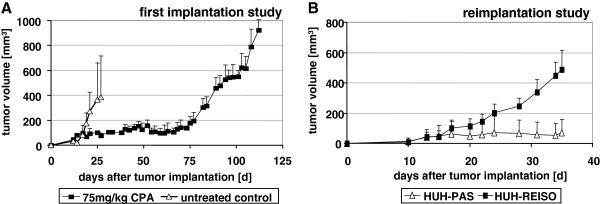
SCID mice bearing subcutaneous HUH7 tumors were treated i.p. with 75 mg/kg CPA every six days. Tumors were evaluated by immunohistochemistry, a functional blood-flow Hoechst dye assay, and qRT-PCR for ALDH-1, Notch-1, Notch-3, HES-1, Thy-1, Oct-4, Sox-2 and Nanog mRNA levels. Cell lines of these tumors were analyzed by qRT-PCR and in endothelial transdifferentiation studies on matrigel.
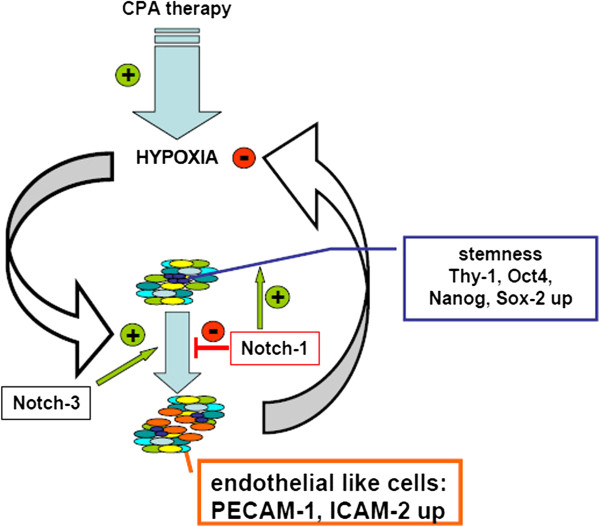
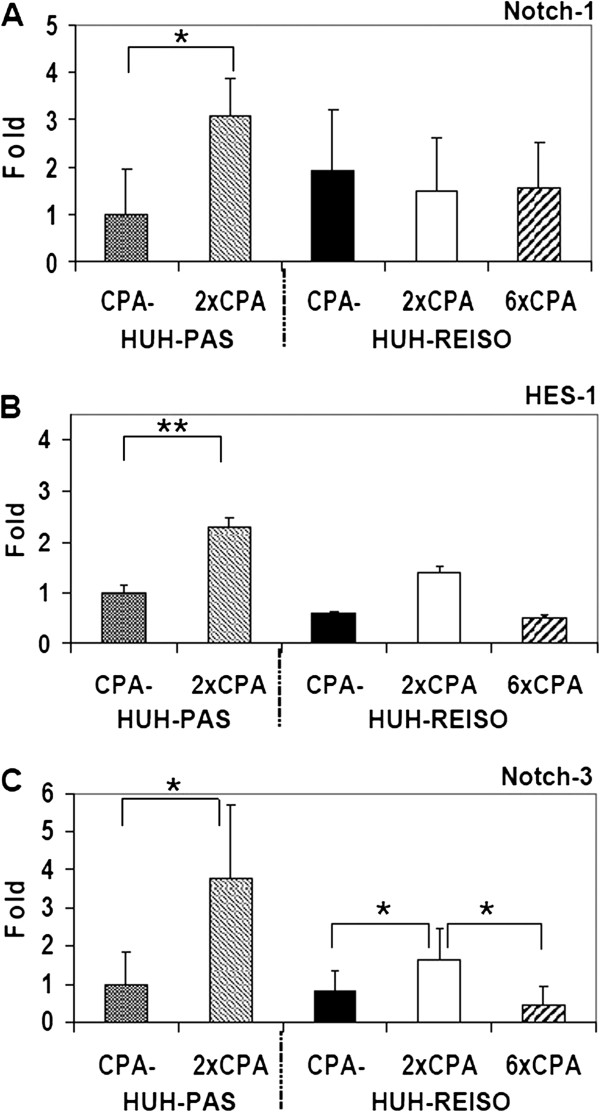
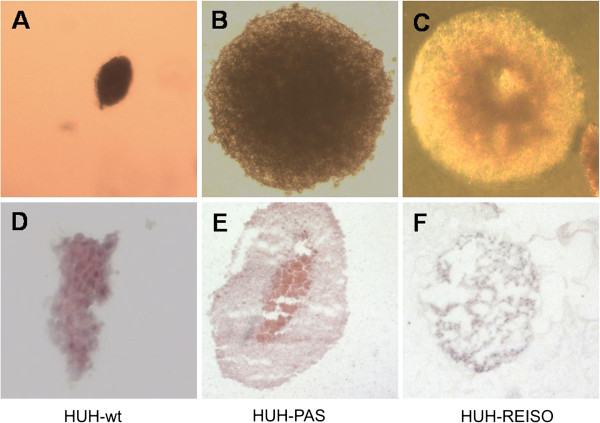
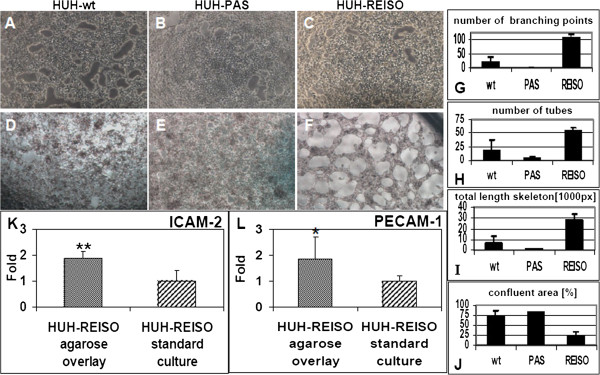
HUH-REISO cells, although slightly more sensitive against activated CPA in vitro than parental HUH-7 cells, fully retained their in vivo CPA chemoresistance upon xenografting into SCID mice. Histochemical analysis of HUH-REISO tumors in comparison to parental HUH-7 cells and passaged HUH-PAS cells (in vivo passaged without chemotherapeutic pressure) revealed significant changes in host vascularization of tumors and especially in expression of the tumor-derived human endothelial marker gene PECAM-1/CD31 in HUH-REISO. In transdifferentiation studies with limited oxygen and metabolite diffusion, followed by a matrigel assay, only the chemoresistant HUH-REISO cells exhibited tube formation potential and expression of human endothelial markers ICAM-2 and PECAM-1/CD31. A comparative study on stemness and plasticity markers revealed upregulation of Thy-1, Oct-4, Sox-2 and Nanog in resistant xenografts. Under therapeutic pressure by CPA, tumors of HUH-PAS and HUH-REISO displayed regulations in Notch-1 and Notch-3 expression.
Chemoresistance of HUH-REISO was not manifested under standard in vitro but under in vivo conditions. HUH-REISO cells showed increased pluripotent capacities and the ability of transdifferentiation to endothelial like cells in vitro and in vivo. These cells expressed typical endothelial surface marker and functionality. Although the mechanism behind chemoresistance of HUH-REISO and involvement of plasticity remains to be clarified, we hypothesize that the observed Notch regulations and upregulation of stemness genes in resistant xenografts are involved in the observed cell plasticity.
肝癌的化学疗法治疗常常导致治疗过程中或肿瘤复发时的耐药性。为了开发更好的治疗方法,需要更好地了解耐药肿瘤中的生化变化。在这项研究中,我们专注于从节拍式环磷酰胺(CPA)治疗的 HUH7 异种移植模型中建立的体内耐药人肝癌 HUH-REISO 的特征。
皮下携带 HUH7 肿瘤的 SCID 小鼠接受腹腔内 75mg/kg CPA 治疗,每六天一次。通过免疫组织化学、功能性血流 Hoechst 染料测定和 qRT-PCR 评估肿瘤,用于 ALDH-1、Notch-1、Notch-3、HES-1、Thy-1、Oct-4、Sox-2 和 Nanog mRNA 水平。对这些肿瘤的细胞系进行 qRT-PCR 分析,并在 Matrigel 上进行内皮细胞转分化研究。
与亲本 HUH-7 细胞相比,虽然 HUH-REISO 细胞在体外对激活的 CPA 略敏感,但在异种移植到 SCID 小鼠中后完全保留了体内的 CPA 耐药性。与亲本 HUH-7 细胞和传代 HUH-PAS 细胞(体内无化疗压力传代)相比,对 HUH-REISO 肿瘤的组织化学分析显示肿瘤宿主血管化发生显著变化,特别是在肿瘤衍生的人内皮标记基因 PECAM-1/CD31 的表达方面。在有限氧和代谢物扩散的转分化研究后,进行 Matrigel 测定,只有耐药的 HUH-REISO 细胞表现出管形成潜力和人内皮标记物 ICAM-2 和 PECAM-1/CD31 的表达。对干性和可塑性标记物的比较研究表明,耐药异种移植物中 Thy-1、Oct-4、Sox-2 和 Nanog 的表达上调。在 CPA 的治疗压力下,HUH-PAS 和 HUH-REISO 肿瘤显示 Notch-1 和 Notch-3 表达的调节。
在标准的体外条件下,而不是在体内条件下,未显示 HUH-REISO 的耐药性。HUH-REISO 细胞在体外和体内显示出增加的多能能力和向内皮样细胞的转分化能力。这些细胞表达典型的内皮表面标记物和功能。尽管 HUH-REISO 的耐药机制和可塑性的参与仍有待澄清,但我们假设观察到的耐药异种移植物中的 Notch 调节和干性基因的上调与观察到的细胞可塑性有关。