Department of Chemical Engineering, University of Massachusetts, Goessmann Lab 159, 686 N, Pleasant St, Amherst, MA 01003-3110, USA.
Biotechnol Biofuels. 2013 Apr 1;6(1):44. doi: 10.1186/1754-6834-6-44.
A key step in any process that converts lignocellulose to biofuels is the efficient fermentation of both hexose and pentose sugars. The co-culture of respiratory-deficient Saccharomyces cerevisiae and wild-type Scheffersomyces stipitis has been identified as a promising system for microaerobic ethanol production because S. cerevisiae only consumes glucose while S. stipitis efficiently converts xylose to ethanol.
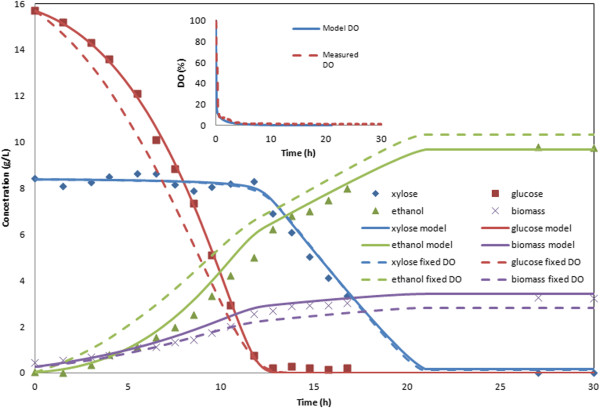
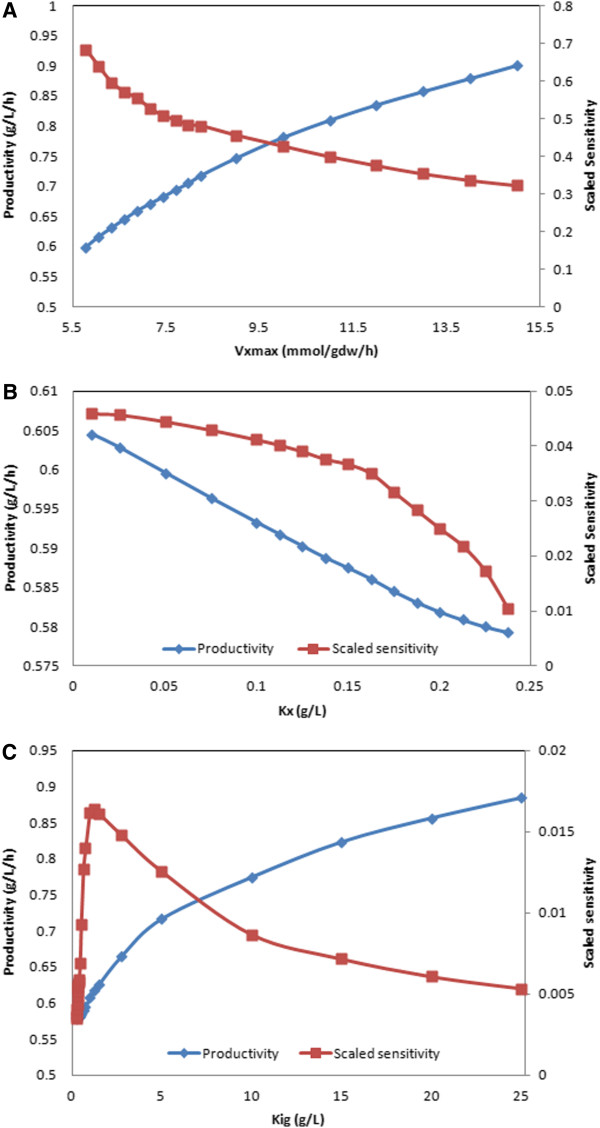
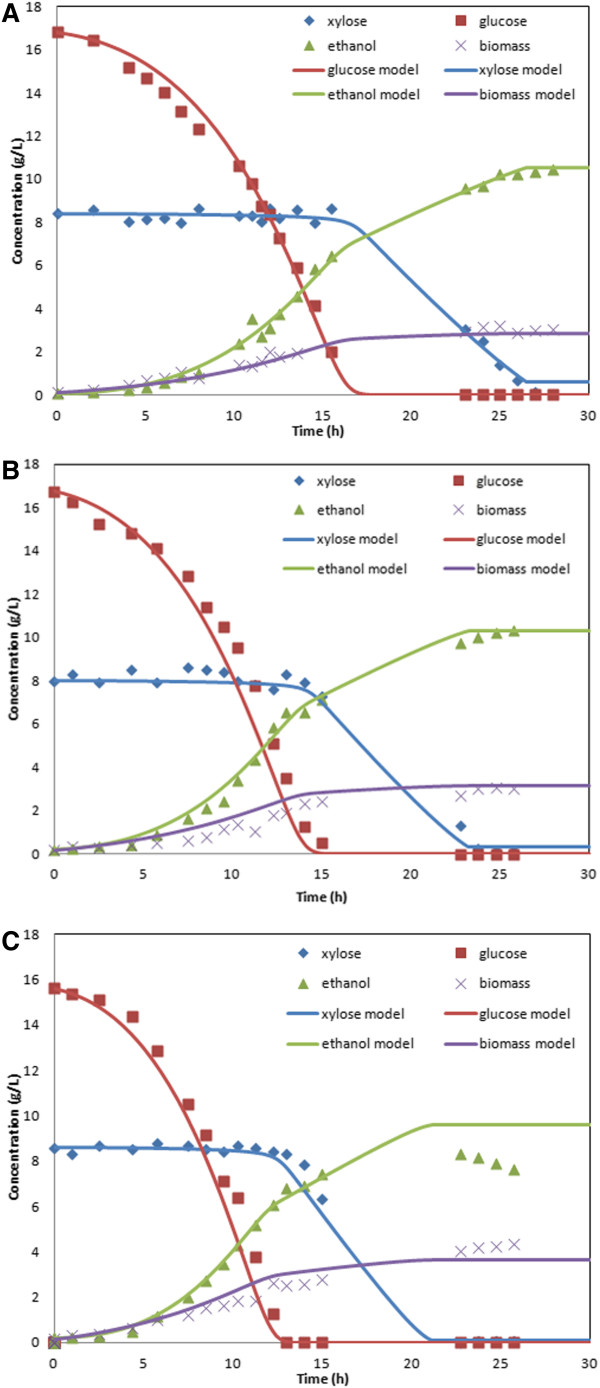
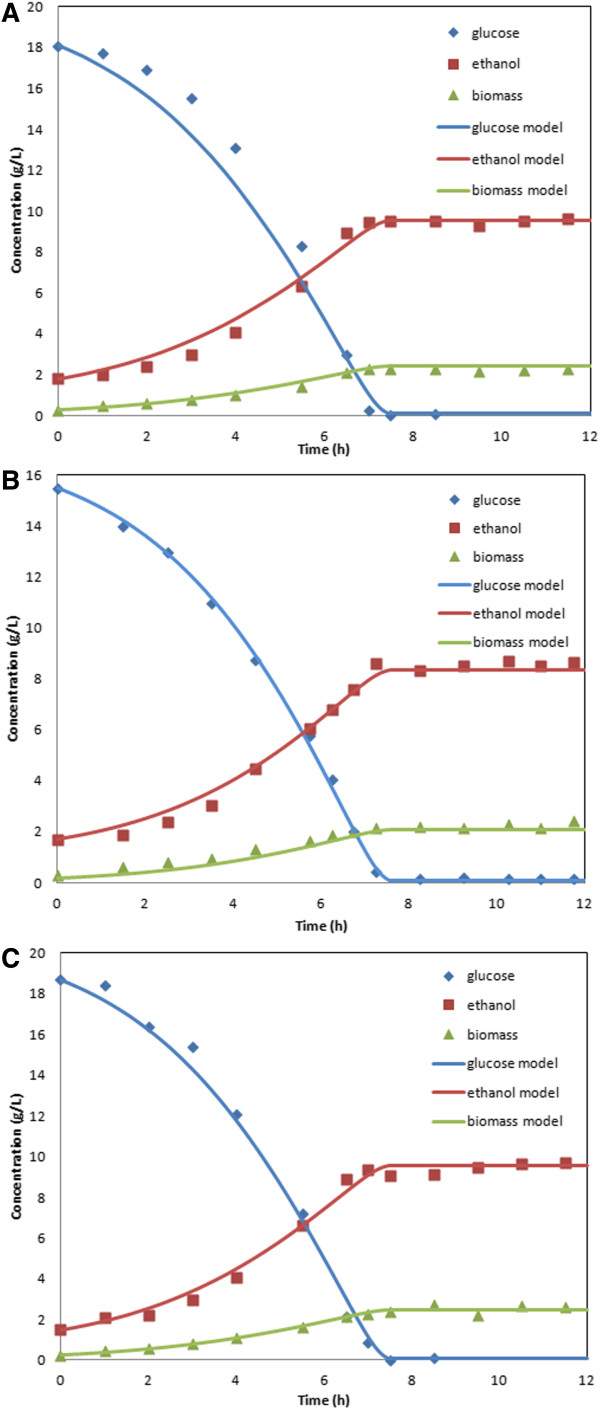
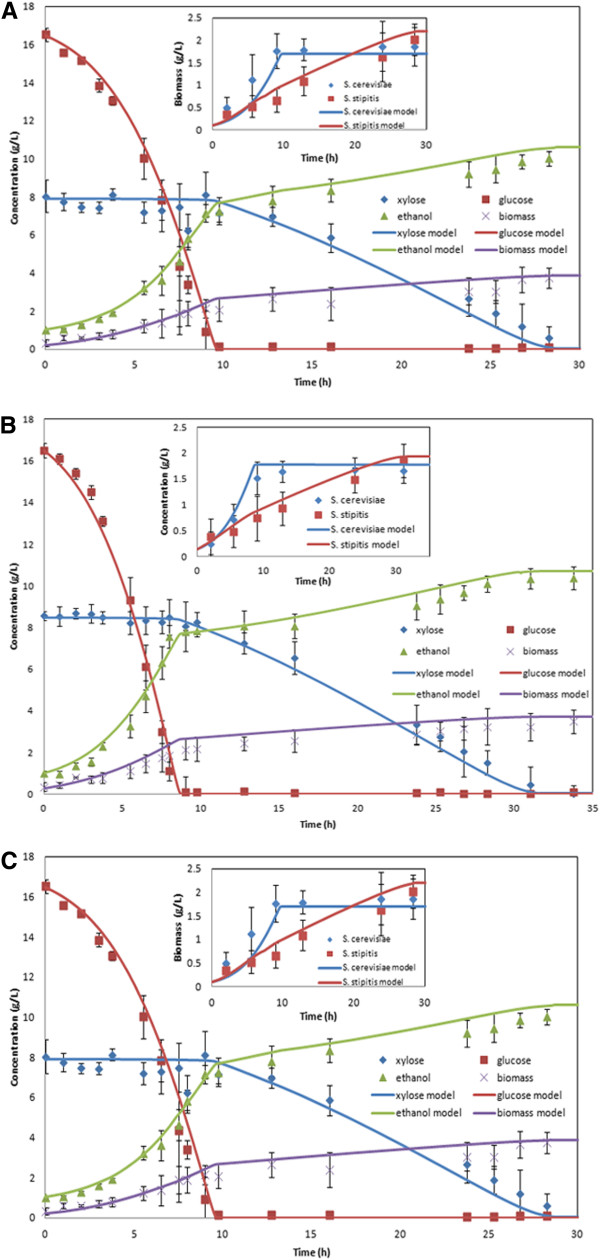
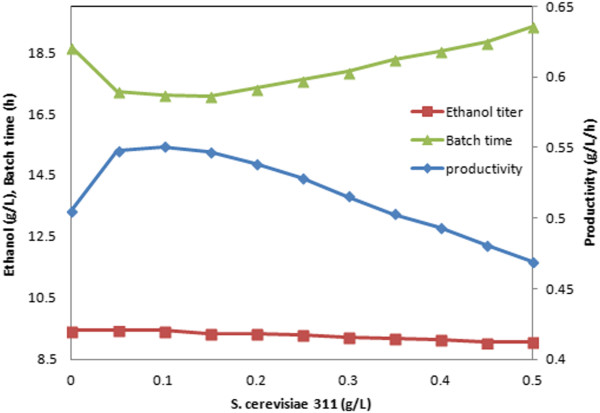
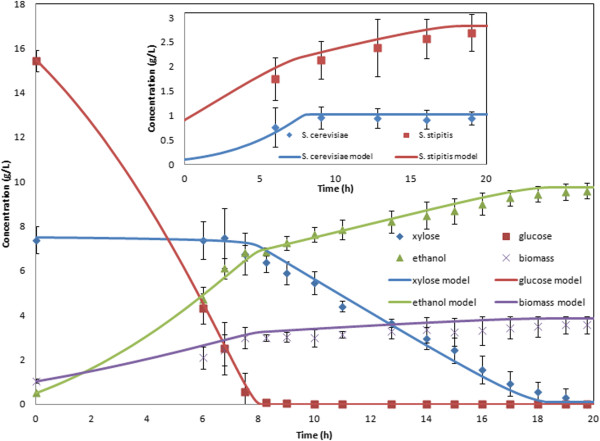
To better predict how these two yeasts behave in batch co-culture and to optimize system performance, a dynamic flux balance model describing co-culture metabolism was developed from genome-scale metabolic reconstructions of the individual organisms. First a dynamic model was developed for each organism by estimating substrate uptake kinetic parameters from batch pure culture data and evaluating model extensibility to different microaerobic growth conditions. The co-culture model was constructed by combining the two individual models assuming a cellular objective of total growth rate maximization. To obtain accurate predictions of batch co-culture data collected at different microaerobic conditions, the S. cerevisiae maximum glucose uptake rate was reduced from its pure culture value to account for more efficient S. stipitis glucose uptake in co-culture. The dynamic co-culture model was used to predict the inoculum concentration and aeration level that maximized batch ethanol productivity. The model predictions were validated with batch co-culture experiments performed at the optimal conditions. Furthermore, the dynamic model was used to predict how engineered improvements to the S. stipitis xylose transport system could improve co-culture ethanol production.
These results demonstrate the utility of the dynamic co-culture metabolic model for guiding process and metabolic engineering efforts aimed at increasing microaerobic ethanol production from glucose/xylose mixtures.
将木质纤维素转化为生物燃料的任何过程中的关键步骤都是高效发酵六碳糖和五碳糖。呼吸缺陷型酿酒酵母和野生型毕赤酵母共培养已被确定为微需氧乙醇生产的有前途的系统,因为酿酒酵母仅消耗葡萄糖,而毕赤酵母则有效地将木糖转化为乙醇。
为了更好地预测这两种酵母在分批共培养中的行为,并优化系统性能,从单个生物体的基因组规模代谢重建中开发了一个描述共培养代谢的动态通量平衡模型。首先,通过从分批纯培养数据估计基质摄取动力学参数并评估模型对不同微需氧生长条件的扩展性,为每个生物体开发了一个动态模型。通过假设细胞总生长速率最大化的目标,将两个单独的模型构建为共培养模型。为了准确预测在不同微需氧条件下收集的分批共培养数据,将酿酒酵母的最大葡萄糖摄取速率从其纯培养值降低,以说明在共培养中毕赤酵母更有效地摄取葡萄糖。使用动态共培养模型预测了最大批次乙醇生产率的接种浓度和通气水平。使用在最佳条件下进行的分批共培养实验验证了模型预测。此外,该动态模型用于预测对毕赤酵母木糖转运系统进行工程改进如何提高共培养乙醇产量。
这些结果表明,动态共培养代谢模型可用于指导旨在提高葡萄糖/木糖混合物微需氧乙醇生产的工艺和代谢工程工作。