Department of Biological Chemistry, University of Michigan Medical School, University of Michigan Ann Arbor, MI, USA.
Front Microbiol. 2013 Apr 1;4:69. doi: 10.3389/fmicb.2013.00069. eCollection 2013.
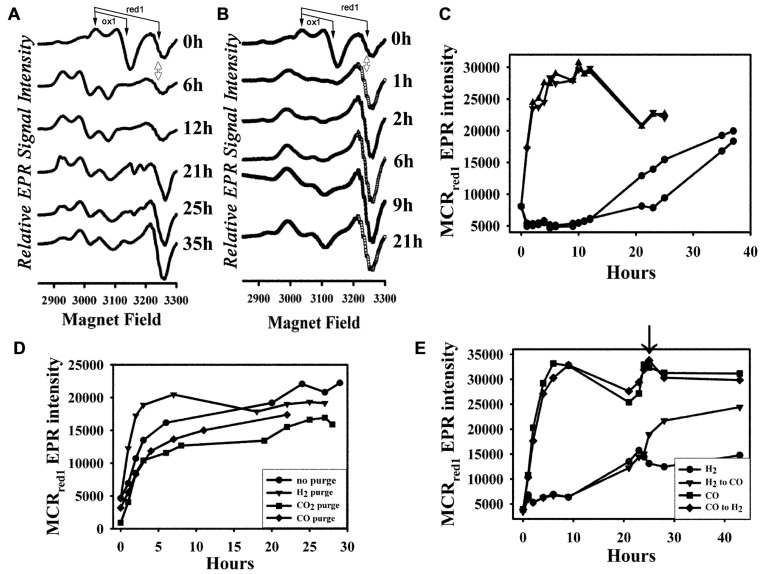
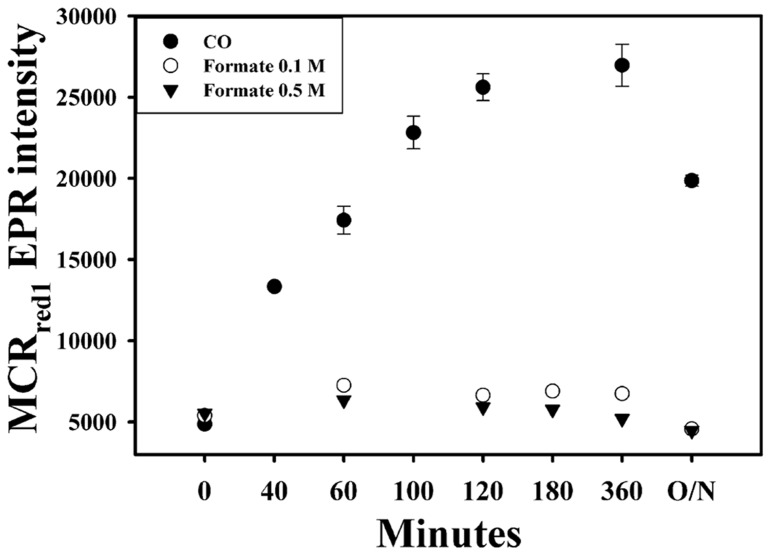
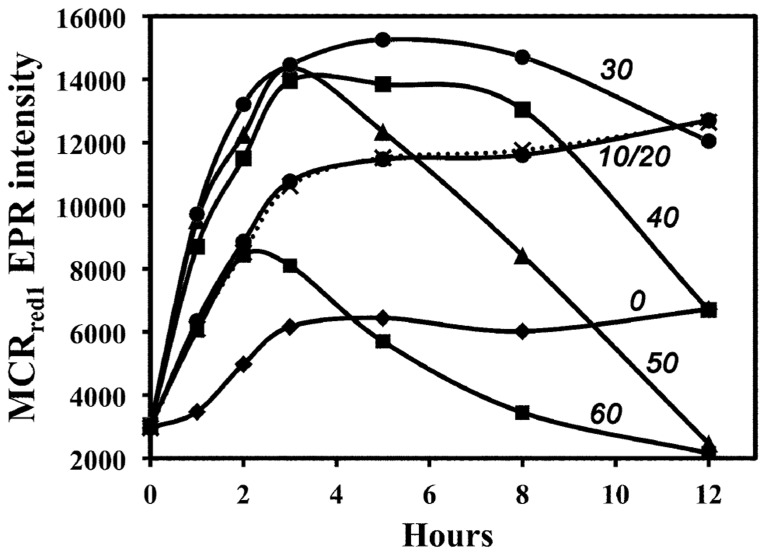
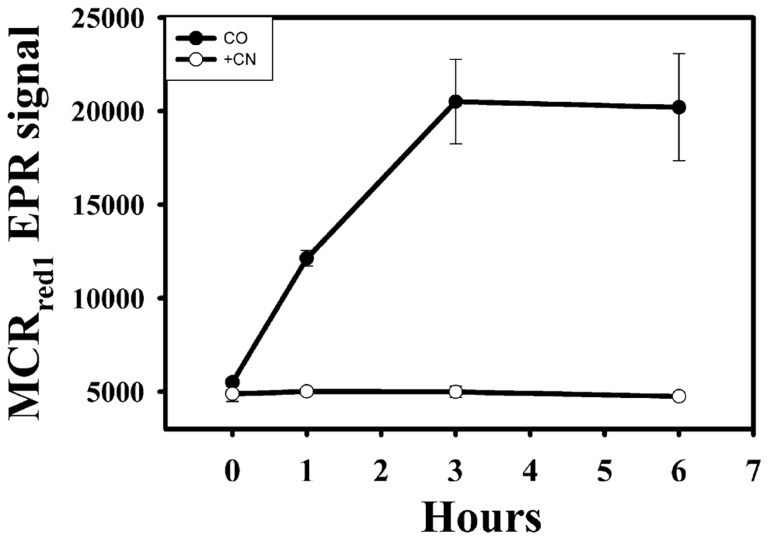
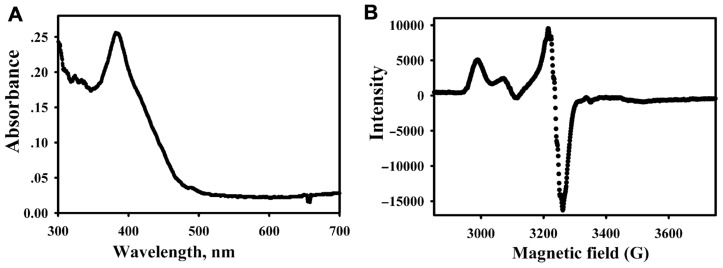
Methyl-coenzyme M reductase (MCR) from methanogenic archaea catalyzes the rate-limiting and final step in methane biosynthesis. Using coenzyme B as the two-electron donor, MCR reduces methyl-coenzyme M (CH3-SCoM) to methane and the mixed disulfide, CoBS-SCoM. MCR contains an essential redox-active nickel tetrahydrocorphinoid cofactor, Coenzyme F430, at its active site. The active form of the enzyme (MCRred1) contains Ni(I)-F430. Rapid and efficient conversion of MCR to MCRred1 is important for elucidating the enzymatic mechanism, yet this reduction is difficult because the Ni(I) state is subject to oxidative inactivation. Furthermore, no in vitro methods have yet been described to convert Ni(II) forms into MCRred1. Since 1991, it has been known that MCRred1 from Methanothermobacter marburgensis can be generated in vivo when cells are purged with 100% H2. Here we show that purging cells or cell extracts with CO can also activate MCR. The rate of in vivo activation by CO is about 15 times faster than by H2 (130 and 8 min(-1), respectively) and CO leads to twofold higher MCRred1 than H2. Unlike H2-dependent activation, which exhibits a 10-h lag time, there is no lag for CO-dependent activation. Based on cyanide inhibition experiments, carbon monoxide dehydrogenase is required for the CO-dependent activation. Formate, which also is a strong reductant, cannot activate MCR in M. marburgensis in vivo.
产甲烷古菌甲基辅酶 M 还原酶(MCR)催化甲烷生物合成的限速和最后一步。MCR 以辅酶 B 作为两电子供体,将甲基辅酶 M(CH3-SCoM)还原为甲烷和混合二硫物 CoBS-SCoM。MCR 在其活性位点含有一个必需的氧化还原活性镍四氢卟啉辅因子辅酶 F430。酶的活性形式(MCRred1)含有 Ni(I)-F430。快速有效地将 MCR 转化为 MCRred1 对于阐明酶的机制很重要,但这种还原很困难,因为 Ni(I) 状态易受到氧化失活的影响。此外,尚未描述任何体外方法将 Ni(II) 形式转化为 MCRred1。自 1991 年以来,人们已经知道,当细胞用 100% H2 吹扫时,来自 Methanothermobacter marburgensis 的 MCRred1 可以在体内产生。这里我们表明,用 CO 吹扫细胞或细胞提取物也可以激活 MCR。CO 介导的体内激活速率比 H2 快约 15 倍(分别为 130 和 8 min(-1)),并且 CO 导致的 MCRred1 比 H2 高两倍。与 H2 依赖性激活不同,H2 依赖性激活具有 10 小时的滞后时间,CO 依赖性激活没有滞后时间。基于氰化物抑制实验,一氧化碳脱氢酶是 CO 依赖性激活所必需的。在体内,甲酸,这也是一种强还原剂,不能激活 M. marburgensis 中的 MCR。