Division of Allergy and Clinical Immunology, Bnai-Zion Medical Center, Golomb Street 47, Haifa, 31048, Israel.
BMC Med. 2013 Apr 4;11:94. doi: 10.1186/1741-7015-11-94.
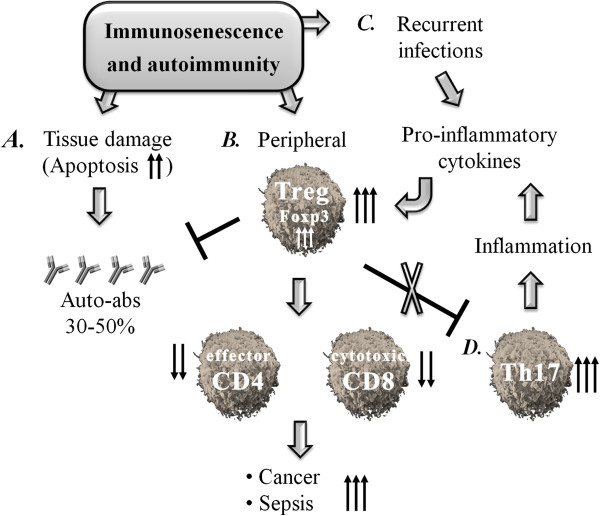
Older persons have higher autoimmunity but a lower prevalence of autoimmune diseases. A possible explanation for this is the expansion of many protective regulatory mechanisms highly characteristic in the elderly. Of note is the higher production of peripheral T-regulatory cells.The frequent development of autoimmunity in the elderly was suggested to take place in part due to the selection of T cells with increased affinity to self-antigens or to latent viruses. These cells were shown to have a greater ability to be pro-inflammatory, thereby amplifying autoimmunity. During aging, thymic T-regulatory cell output decreases in association with the loss of thymic capacity to generate new T cells. However, to balance the above mentioned autoimmunity and prevent the development of autoimmune diseases, there is an age-related increase in peripheral CD4+ CD25highFoxP3+ T-regulatory cells. It remains unclear whether this is an age-related immune dysfunction or a defense response. Whatever the reason, the expansion of T-regulatory cells requires payment in terms of an increased incidence of cancer and higher susceptibility to infections.
老年人自身免疫性疾病的发病率较高,但患病率较低。对此的一种解释可能是许多高度特化于老年人的保护性调节机制的扩张。值得注意的是,外周 T 调节性细胞的产生增加。老年人中自身免疫性疾病的频繁发生被认为部分是由于选择了与自身抗原或潜伏病毒具有更高亲和力的 T 细胞。这些细胞显示出更强的促炎能力,从而放大了自身免疫。随着年龄的增长,胸腺 T 调节性细胞的输出与胸腺产生新 T 细胞的能力下降有关。然而,为了平衡上述自身免疫并防止自身免疫性疾病的发生,外周 CD4+CD25highFoxP3+T 调节性细胞的数量会随着年龄的增长而增加。目前尚不清楚这是与年龄相关的免疫功能障碍还是防御反应。无论原因是什么,T 调节性细胞的扩张都需要以增加癌症发病率和更高的感染易感性为代价。