Nutrition Policy and Scientific Advice Unit, Department of Nutrition for Health and Development, World Health Organization, 1211 Geneva 27, Switzerland.
BMJ. 2013 Apr 3;346:f1326. doi: 10.1136/bmj.f1326.
To assess the effect of decreased sodium intake on blood pressure, related cardiovascular diseases, and potential adverse effects such as changes in blood lipids, catecholamine levels, and renal function.
Systematic review and meta-analysis.
Cochrane Central Register of Controlled Trials, Medline, Embase, WHO International Clinical Trials Registry Platform, the Latin American and Caribbean health science literature database, and the reference lists of previous reviews.
Randomised controlled trials and prospective cohort studies in non-acutely ill adults and children assessing the relations between sodium intake and blood pressure, renal function, blood lipids, and catecholamine levels, and in non-acutely ill adults all cause mortality, cardiovascular disease, stroke, and coronary heart disease.
Potential studies were screened independently and in duplicate and study characteristics and outcomes extracted. When possible we conducted a meta-analysis to estimate the effect of lower sodium intake using the inverse variance method and a random effects model. We present results as mean differences or risk ratios, with 95% confidence intervals.
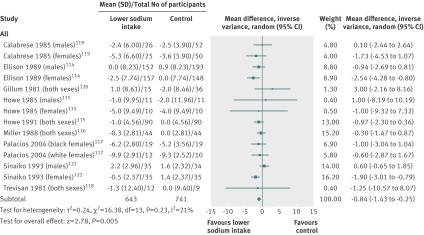
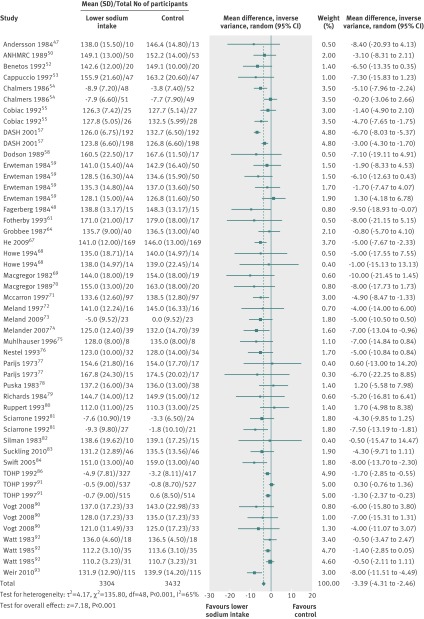
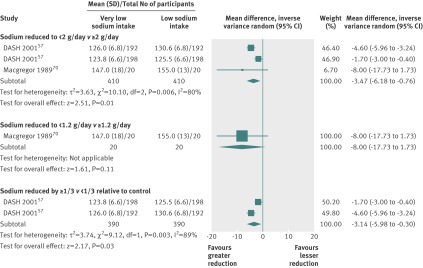
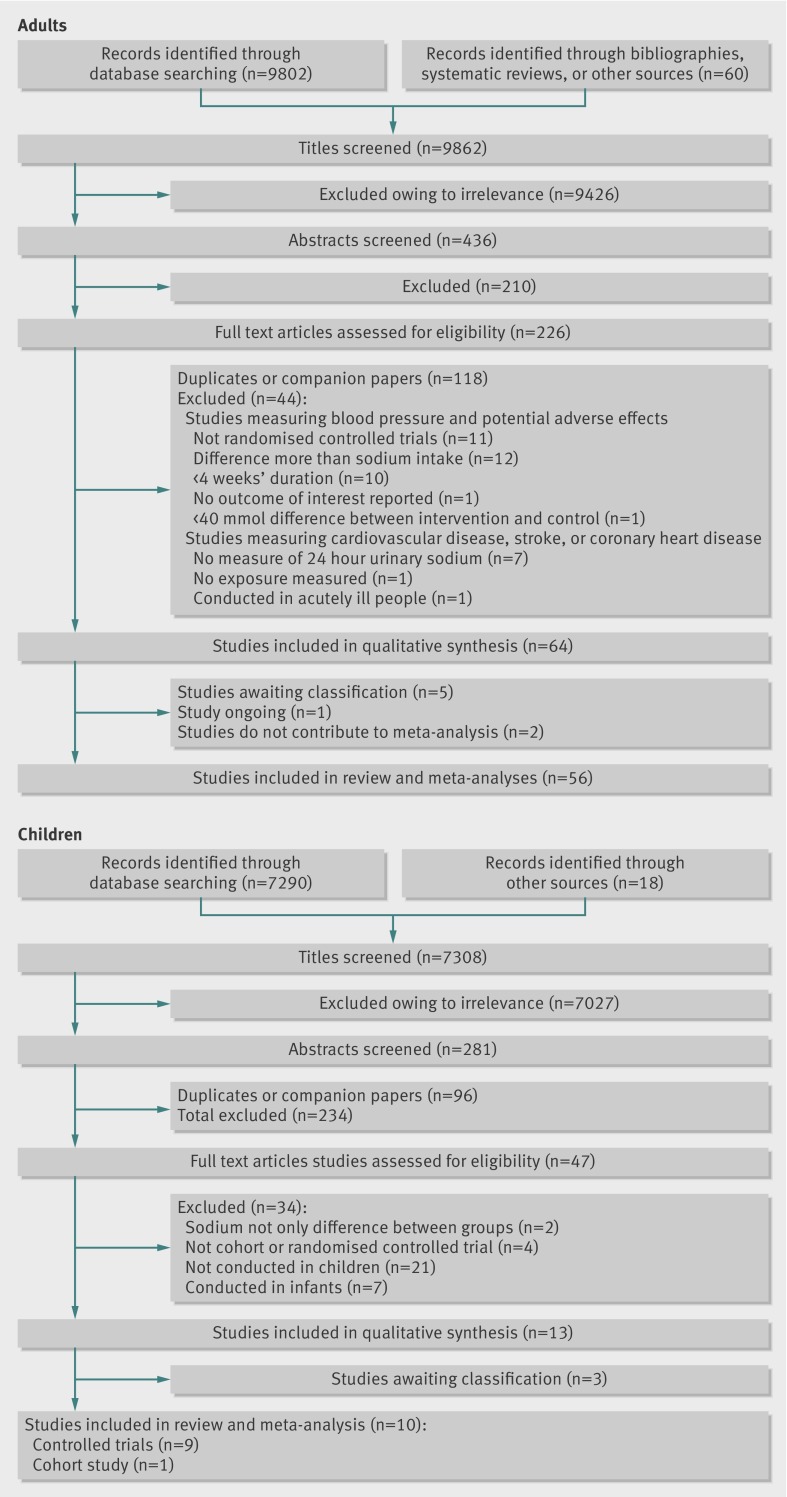
We included 14 cohort studies and five randomised controlled trials reporting all cause mortality, cardiovascular disease, stroke, or coronary heart disease; and 37 randomised controlled trials measuring blood pressure, renal function, blood lipids, and catecholamine levels in adults. Nine controlled trials and one cohort study in children reporting on blood pressure were also included. In adults a reduction in sodium intake significantly reduced resting systolic blood pressure by 3.39 mm Hg (95% confidence interval 2.46 to 4.31) and resting diastolic blood pressure by 1.54 mm Hg (0.98 to 2.11). When sodium intake was <2 g/day versus ≥ 2 g/day, systolic blood pressure was reduced by 3.47 mm Hg (0.76 to 6.18) and diastolic blood pressure by 1.81 mm Hg (0.54 to 3.08). Decreased sodium intake had no significant adverse effect on blood lipids, catecholamine levels, or renal function in adults (P>0.05). There were insufficient randomised controlled trials to assess the effects of reduced sodium intake on mortality and morbidity. The associations in cohort studies between sodium intake and all cause mortality, incident fatal and non-fatal cardiovascular disease, and coronary heart disease were non-significant (P>0.05). Increased sodium intake was associated with an increased risk of stroke (risk ratio 1.24, 95% confidence interval 1.08 to 1.43), stroke mortality (1.63, 1.27 to 2.10), and coronary heart disease mortality (1.32, 1.13 to 1.53). In children, a reduction in sodium intake significantly reduced systolic blood pressure by 0.84 mm Hg (0.25 to 1.43) and diastolic blood pressure by 0.87 mm Hg (0.14 to 1.60).
High quality evidence in non-acutely ill adults shows that reduced sodium intake reduces blood pressure and has no adverse effect on blood lipids, catecholamine levels, or renal function, and moderate quality evidence in children shows that a reduction in sodium intake reduces blood pressure. Lower sodium intake is also associated with a reduced risk of stroke and fatal coronary heart disease in adults. The totality of evidence suggests that most people will likely benefit from reducing sodium intake.
评估减少钠摄入量对血压、相关心血管疾病以及血脂、儿茶酚胺水平和肾功能变化等潜在不良影响的效果。
系统评价和荟萃分析。
Cochrane 对照试验中心注册库、Medline、Embase、世界卫生组织国际临床试验注册平台、拉丁美洲和加勒比健康科学文献数据库以及先前综述的参考文献列表。
评估钠摄入量与血压、肾功能、血脂和儿茶酚胺水平之间关系的非急性病成年人和儿童的随机对照试验和前瞻性队列研究,以及非急性病成年人全因死亡率、心血管疾病、卒中和冠心病的所有原因死亡率、心血管疾病、卒中和冠心病的前瞻性队列研究。
独立并重复筛选潜在研究,并提取研究特征和结果。当可能时,我们使用倒数方差法和随机效应模型进行荟萃分析来估计较低钠摄入量的效果。我们以平均值差异或风险比(95%置信区间)表示结果。
我们纳入了 14 项队列研究和 5 项报告全因死亡率、心血管疾病、卒中和冠心病的随机对照试验;以及 37 项测量成年人血压、肾功能、血脂和儿茶酚胺水平的随机对照试验。还纳入了 9 项儿童控制试验和 1 项关于血压的队列研究。在成年人中,减少钠摄入量可显著降低静息收缩压 3.39 毫米汞柱(95%置信区间 2.46 至 4.31)和静息舒张压 1.54 毫米汞柱(0.98 至 2.11)。当钠摄入量<2 克/天与≥2 克/天相比,收缩压降低 3.47 毫米汞柱(0.76 至 6.18),舒张压降低 1.81 毫米汞柱(0.54 至 3.08)。减少钠摄入量对成年人的血脂、儿茶酚胺水平或肾功能没有显著不良影响(P>0.05)。随机对照试验不足以评估减少钠摄入量对死亡率和发病率的影响。队列研究中钠摄入量与全因死亡率、致命和非致命心血管疾病以及冠心病之间的关联没有统计学意义(P>0.05)。增加钠摄入量与卒中风险增加相关(风险比 1.24,95%置信区间 1.08 至 1.43)、卒中死亡率(1.63,1.27 至 2.10)和冠心病死亡率(1.32,1.13 至 1.53)。在儿童中,减少钠摄入量可显著降低收缩压 0.84 毫米汞柱(0.25 至 1.43)和舒张压 0.87 毫米汞柱(0.14 至 1.60)。
非急性病成年人的高质量证据表明,减少钠摄入量可降低血压,且对血脂、儿茶酚胺水平或肾功能无不良影响,儿童的中等质量证据表明,减少钠摄入量可降低血压。较低的钠摄入量也与成年人中风和致命性冠心病风险降低相关。总体证据表明,大多数人可能会从减少钠摄入量中受益。