Chantal BIYA International Reference Centre (CIRCB) for research on HIV/AIDS prevention and management, Yaounde, Cameroon.
BMC Public Health. 2013 Apr 8;13:308. doi: 10.1186/1471-2458-13-308.
Rapid scale-up of antiretroviral therapy (ART) and limited access to genotyping assays in low-resource settings (LRS) are inevitably accompanied by an increasing risk of HIV drug resistance (HIVDR). The current study aims to evaluate early warning indicators (EWI) as an efficient strategy to limit the development and spread of preventable HIVDR in these settings, in order to sustain the performance of national antiretroviral therapy (ART) rollout programmes.
Surveys were conducted in 2008, 2009 and 2010 within 10 Cameroonian ART clinics, based on five HIVDR EWIs: (1) Good prescribing practices; (2) Patient lost to follow-up; (3) Patient retention on first line ART; (4) On-time drug pick-up; (5) Continuous drug supply. Analysis was performed as per the World Health Organisation (WHO) protocol.
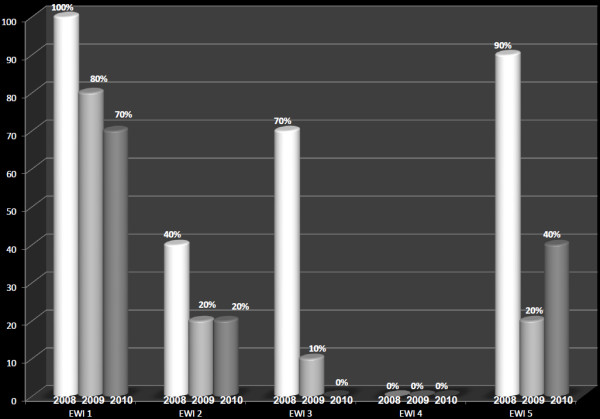
An overall decreasing performance of the national ART programme was observed from 2008 to 2010: EWI(1) (100% to 70%); EWI(2) (40% to 20%); EWI(3) (70% to 0%); EWI(4) (0% throughout); EWI(5) (90% to 40%). Thus, prescribing practices (EWI(1)) were in conformity with national guidelines, while patient adherence (EWI(2), EWI(3), and EWI(4)) and drug supply (EWI(5)) were lower overtime; with a heavy workload (median ratio ≈1/64 staff/patients) and community disengagement observed all over the study sites.
In order to limit risks of HIVDR emergence in poor settings like Cameroon, continuous drug supply, community empowerment to support adherence, and probably a reduction in workload by task shifting, are the potential urgent measures to be undertaken. Such evidence-based interventions, rapidly generated and less costly, would be relevant in limiting the spread of preventable HIVDR and in sustaining the performance of ART programmes in LRS.
在资源有限的环境下(LRS),抗逆转录病毒疗法(ART)的快速扩展和有限的基因分型检测手段不可避免地伴随着 HIV 耐药性(HIVDR)风险的增加。本研究旨在评估早期预警指标(EWI)作为限制这些环境中可预防 HIVDR 发展和传播的有效策略,以维持国家抗逆转录病毒治疗(ART)推广计划的实施。
2008 年、2009 年和 2010 年,在喀麦隆的 10 个 ART 诊所进行了调查,基于 5 个 HIVDR EWI:(1)良好的处方实践;(2)患者失访;(3)一线 ART 患者保留;(4)按时取药;(5)持续药物供应。分析按照世界卫生组织(WHO)的方案进行。
从 2008 年到 2010 年,国家 ART 项目的总体表现呈下降趋势:EWI(1)(100%至 70%);EWI(2)(40%至 20%);EWI(3)(70%至 0%);EWI(4)(一直为 0%);EWI(5)(90%至 40%)。因此,处方实践(EWI(1))符合国家指南,而患者依从性(EWI(2)、EWI(3)和 EWI(4))和药物供应(EWI(5))随时间推移而下降;在整个研究地点都观察到繁重的工作量(中位数比率≈1/64 名员工/患者)和社区脱离。
为了限制像喀麦隆这样的贫困环境中 HIVDR 出现的风险,持续的药物供应、社区赋权以支持依从性,以及可能通过任务转移来减轻工作量,是需要采取的潜在紧急措施。这些基于证据的干预措施,快速产生且成本较低,可以有效地限制可预防 HIVDR 的传播,并维持 LRS 中 ART 项目的实施。