Rutherford Grant, Friesen Marcia R, McLeod Robert D
Electrical & Computer Engineering, University of Manitoba, Canada.
Online J Public Health Inform. 2012;4(3). doi: 10.5210/ojphi.v4i3.4292. Epub 2012 Dec 19.
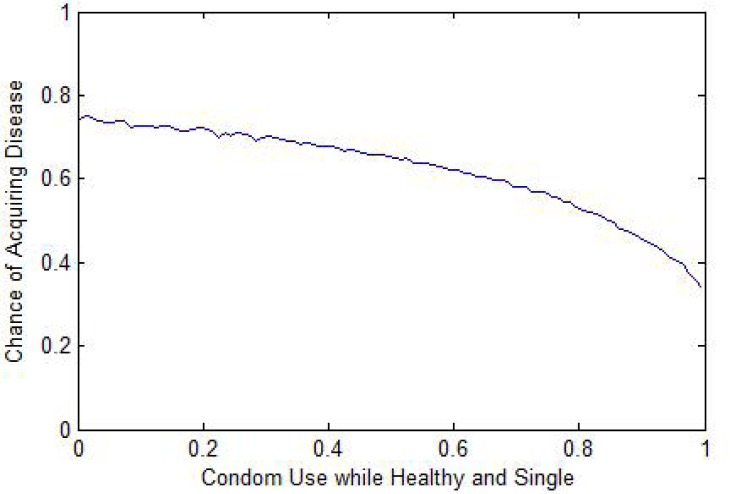
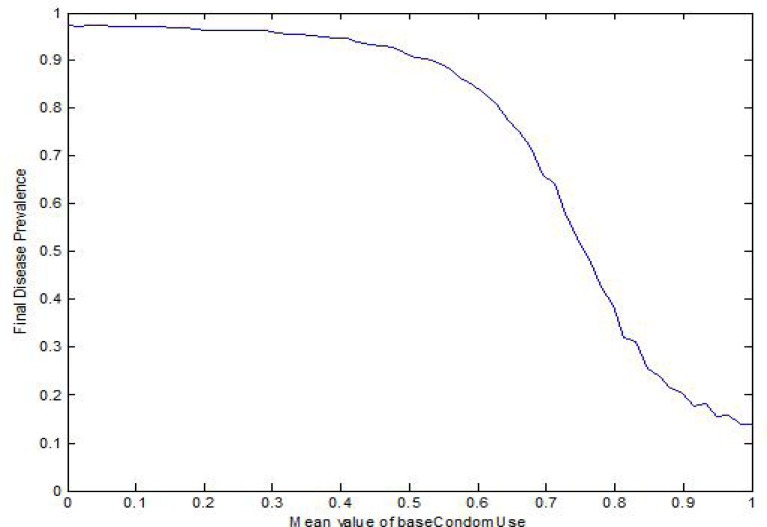
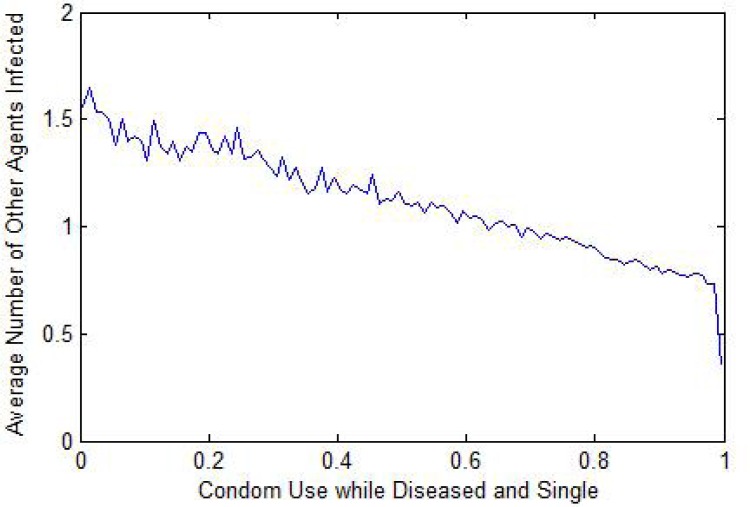
This work uses agent-based modelling (ABM) to simulate sexually transmitted infection (STIs) spread within a population of 1000 agents over a 10-year period, as a preliminary investigation of the suitability of ABM methodology to simulate STI spread. The work contrasts compartmentalized mathematical models that fail to account for individual agents, and ABMs commonly applied to simulate the spread of respiratory infections. The model was developed in C++ using the Boost 1.47.0 libraries for the normal distribution and OpenGL for visualization. Sixteen agent parameters interact individually and in combination to govern agent profiles and behaviours relative to infection probabilities. The simulation results provide qualitative comparisons of STI mitigation strategies, including the impact of condom use, promiscuity, the form of the friend network, and mandatory STI testing. Individual and population-wide impacts were explored, with individual risk being impacted much more dramatically by population-level behaviour changes as compared to individual behaviour changes.
本研究采用基于主体的建模(ABM)方法,对1000个主体在10年期间内性传播感染(STIs)的传播情况进行模拟,作为对ABM方法模拟性传播感染传播适用性的初步调查。该研究将未能考虑个体主体的 compartmentalized 数学模型,与常用于模拟呼吸道感染传播的ABM进行了对比。该模型使用C++语言开发,利用Boost 1.47.0库进行正态分布计算,并使用OpenGL进行可视化。16个主体参数单独或组合相互作用,以控制与感染概率相关的主体特征和行为。模拟结果提供了性传播感染缓解策略的定性比较,包括避孕套使用、滥交、朋友网络形式以及强制性性传播感染检测的影响。研究探讨了个体和全人群的影响,结果表明,与个体行为变化相比,人群层面的行为变化对个体风险的影响更为显著。