Laboratory of Pharmacology & Experimental Therapeutics, IBILI, Faculty of Medicine, University of Coimbra, Azinhaga de Santa Comba, Celas, Coimbra, 3000-548, Portugal.
Cardiovasc Diabetol. 2013 Apr 9;12:61. doi: 10.1186/1475-2840-12-61.
The aim of this study is to evaluate the effect of gender and menopause in cardiometabolic risk in a type 2 diabetes mellitus (T2DM) population, based on classical and non-traditional markers.
Seventy four volunteers and 110 T2DM patients were enrolled in the study. Anthropometric data, blood pressure, body mass index (BMI), waist circumference (WC) and the following serum markers were analyzed: glucose, Total-c, TGs, LDL-c, Oxidized-LDL, total HDL-c and large and small HDL-c subpopulations, paraoxonase 1 activity, hsCRP, uric acid, TNF-α, adiponectin and VEGF.
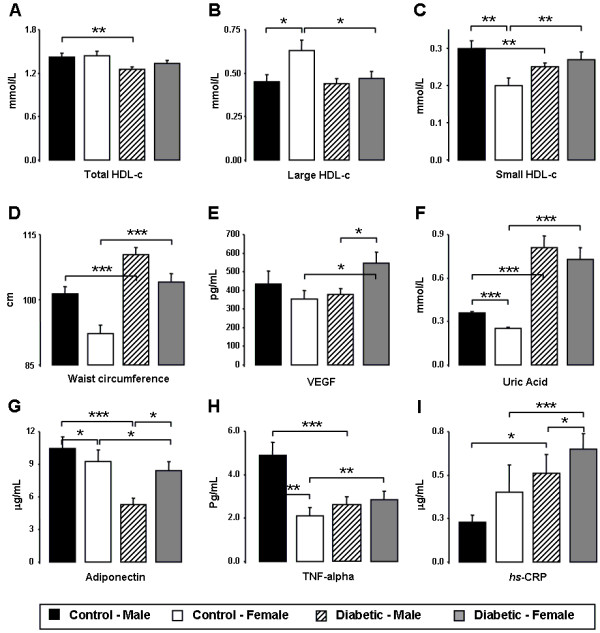
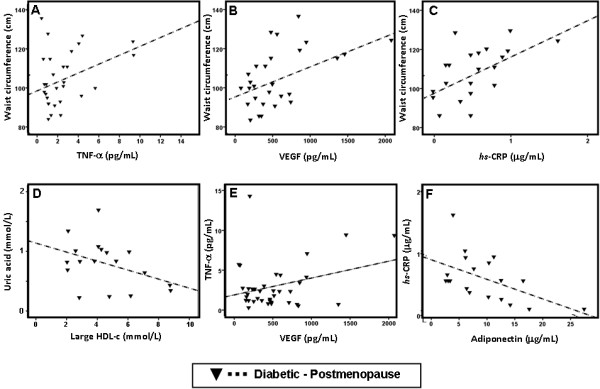
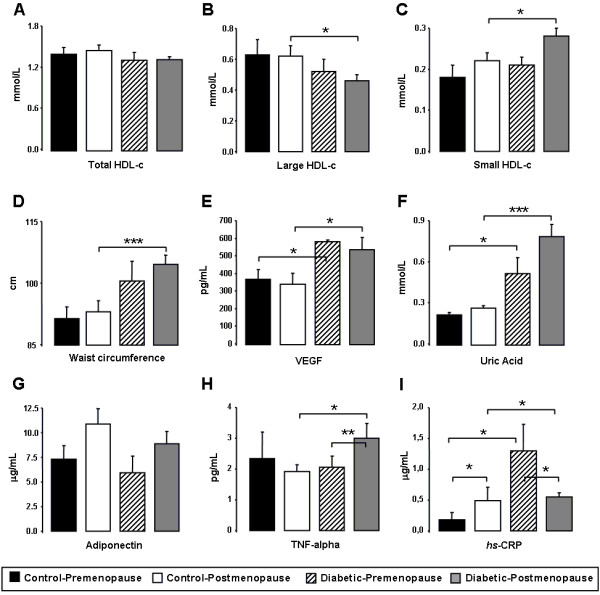
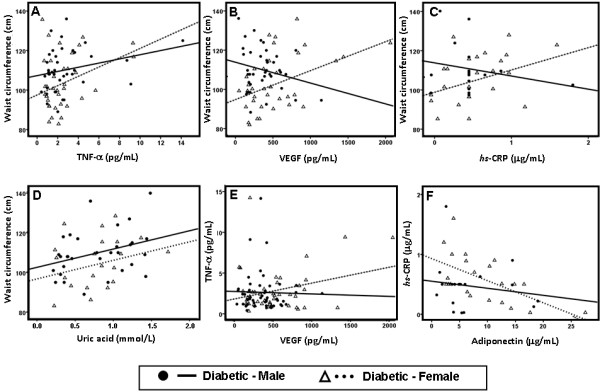
Non-diabetic women, compared to men, presented lower glycemia, WC, small HDL-c, uric acid, TNF-α and increased large HDL-c. Diabetes abrogates the protective effect of female gender, since diabetic women showed increased BMI, WC, small HDL-c, VEGF, uric acid, TNF-α and hsCRP, as well as reduced adiponectin, when compared with non-diabetic. In diabetic females, but not in males, WC is directly and significantly associated with TNF-α, VEGF, hsCRP and uric acid; TNF-α is directly associated with VEGF and hsCRP, and inversely with adiponectin. Postmenopausal females presented a worsen cardiometabolic profile, viewed by the increased WC, small HDL-c, VEGF, uric acid, TNF-α and hsCRP. In this population, WC is directly and significantly associated with TNF-α, VEGF, hsCRP; TNF-α is directly associated with VEGF; and uric acid is inversely associated with large HDL-c and hsCRP with adiponectin, also inversely.
Diabetes abrogates the protective effect of gender on non-diabetic women, and postmenopausal diabetic females presented worsen cardiometabolic risk, including a more atherogenic lipid sketch and a pro-inflammatory and pro-angiogenic profile. The classical cardiovascular risk factors (CVRFs) fail to completely explain these differences, which are better clarified using "non-traditional" factors, such as HDL-c subpopulations, rather than total HDL-c content, and markers of inflammation and angiogenesis, namely TNF-α, hsCRP, uric acid and VEGF. Multi-therapeutic intervention, directed to obesity, atherogenic lipid particles and inflammatory mediators is advisory in order to efficiently prevent the serious diabetic cardiovascular complications.
本研究旨在基于经典和非传统标志物,评估性别和绝经期对 2 型糖尿病(T2DM)患者心血管代谢风险的影响。
74 名志愿者和 110 名 T2DM 患者入组本研究。分析了人体测量数据、血压、体重指数(BMI)、腰围(WC)和以下血清标志物:血糖、总胆固醇(TC)、甘油三酯(TGs)、低密度脂蛋白胆固醇(LDL-c)、氧化型 LDL、总高密度脂蛋白胆固醇(HDL-c)和大、小 HDL-c 亚群、对氧磷酶 1 活性、高敏 C 反应蛋白(hsCRP)、尿酸、肿瘤坏死因子-α(TNF-α)、脂联素和血管内皮生长因子(VEGF)。
与男性相比,非糖尿病女性的血糖、WC、小 HDL-c、尿酸、TNF-α 和大 HDL-c 水平较低。糖尿病消除了女性的保护作用,因为与非糖尿病女性相比,糖尿病女性的 BMI、WC、小 HDL-c、VEGF、尿酸、TNF-α 和 hsCRP 增加,而脂联素降低。在糖尿病女性中,而非男性中,WC 与 TNF-α、VEGF、hsCRP 和尿酸直接且显著相关;TNF-α 与 VEGF 和 hsCRP 直接相关,与脂联素呈负相关。绝经后女性的 WC、小 HDL-c、VEGF、尿酸、TNF-α 和 hsCRP 等心血管代谢指标恶化。在该人群中,WC 与 TNF-α、VEGF、hsCRP 直接相关;TNF-α 与 VEGF 直接相关;尿酸与大 HDL-c 和 hsCRP 与脂联素呈负相关。
糖尿病消除了非糖尿病女性的性别保护作用,绝经后糖尿病女性的心血管代谢风险恶化,包括更具动脉粥样硬化的脂质特征和促炎及促血管生成特征。传统心血管危险因素(CVRFs)不能完全解释这些差异,而使用 HDL-c 亚群等“非传统”因素,而非总 HDL-c 含量以及炎症和血管生成标志物,如 TNF-α、hsCRP、尿酸和 VEGF,可更好地阐明这些差异。为了有效预防严重的糖尿病心血管并发症,建议采用多治疗干预,针对肥胖、致动脉粥样硬化的脂质颗粒和炎症介质。