Department of Epidemiology and Population Health, Albert Einstein College of Medicine, Bronx, New York, United States of America.
PLoS One. 2013;8(4):e60083. doi: 10.1371/journal.pone.0060083. Epub 2013 Apr 3.
Genome-wide association studies (GWAS) have identified multiple SNPs associated with prostate cancer (PrCa). Population isolates may have different sets of risk alleles for PrCa constituting unique population and individual risk profiles.
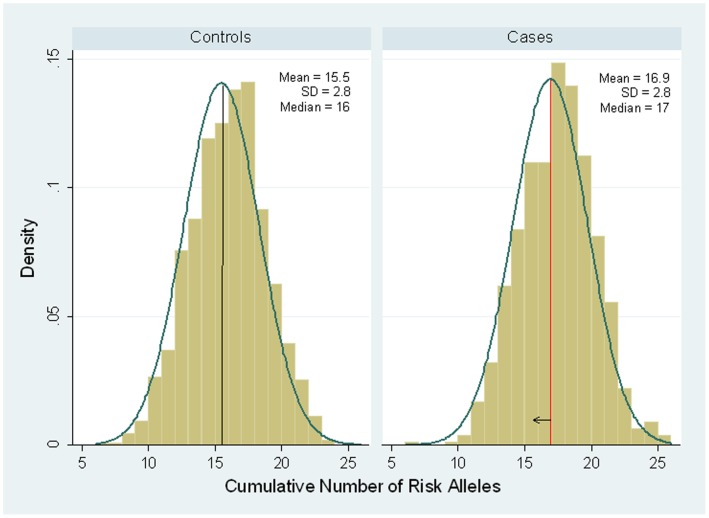
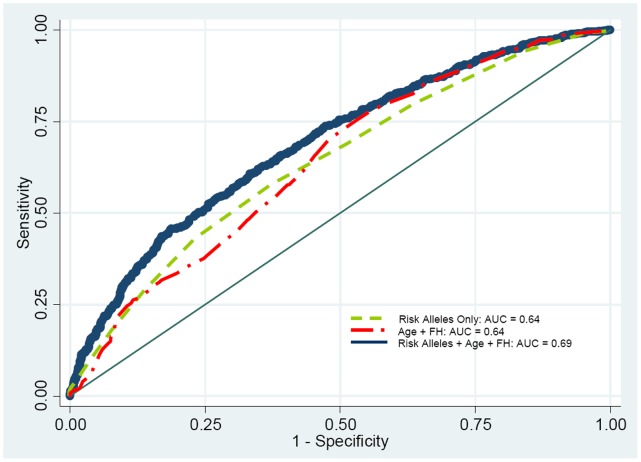
To test this hypothesis, associations between 31 GWAS SNPs of PrCa were examined among 979 PrCa cases and 1,251 controls of Ashkenazic descent using logistic regression. We also investigated risks by age at diagnosis, pathological features of PrCa, and family history of cancer. Moreover, we examined associations between cumulative number of risk alleles and PrCa and assessed the utility of risk alleles in PrCa risk prediction by comparing the area under the curve (AUC) for different logistic models.
Of the 31 genotyped SNPs, 8 were associated with PrCa at p ≤ 0.002 (corrected p-value threshold) with odds ratios (ORs) ranging from 1.22 to 1.42 per risk allele. Four SNPs were associated with aggressive PrCa, while three other SNPs showed potential interactions for PrCa by family history of PrCa (rs8102476; 19q13), lung cancer (rs17021918; 4q22), and breast cancer (rs10896449; 11q13). Men in the highest vs. lowest quartile of cumulative number of risk alleles had ORs of 3.70 (95% CI 2.76-4.97); 3.76 (95% CI 2.57-5.50), and 5.20 (95% CI 2.94-9.19) for overall PrCa, aggressive cancer and younger age at diagnosis, respectively. The addition of cumulative risk alleles to the model containing age at diagnosis and family history of PrCa yielded a slightly higher AUC (0.69 vs. 0.64).
These data define a set of risk alleles associated with PrCa in men of Ashkenazic descent and indicate possible genetic differences for PrCa between populations of European and Ashkenazic ancestry. Use of genetic markers might provide an opportunity to identify men at highest risk for younger age of onset PrCa; however, their clinical utility in identifying men at highest risk for aggressive cancer remains limited.
全基因组关联研究(GWAS)已经确定了多个与前列腺癌(PrCa)相关的 SNP。人群隔离可能具有不同的风险等位基因集,构成独特的人群和个体风险特征。
使用逻辑回归方法,在 979 例前列腺癌病例和 1251 例阿什肯纳兹血统对照中,检验了 31 个与前列腺癌相关的 GWAS SNP 之间的关联。我们还通过诊断时的年龄、前列腺癌的病理特征和癌症家族史来研究风险。此外,我们还研究了累积风险等位基因数量与前列腺癌之间的关系,并通过比较不同逻辑模型的曲线下面积(AUC)来评估风险等位基因在前列腺癌风险预测中的效用。
在 31 个基因分型 SNP 中,有 8 个 SNP 与前列腺癌相关(p ≤ 0.002,校正后的 p 值阈值),风险等位基因的比值比(OR)范围为 1.22 至 1.42。有 4 个 SNP 与侵袭性前列腺癌相关,而另外 3 个 SNP 显示出与前列腺癌家族史(rs8102476;19q13)、肺癌(rs17021918;4q22)和乳腺癌(rs10896449;11q13)的潜在交互作用。累积风险等位基因最高与最低四分位数的男性患总体前列腺癌、侵袭性癌症和诊断时年龄较小的 OR 分别为 3.70(95%CI 2.76-4.97)、3.76(95%CI 2.57-5.50)和 5.20(95%CI 2.94-9.19)。将累积风险等位基因添加到包含诊断时年龄和前列腺癌家族史的模型中,AUC 略有升高(0.69 对 0.64)。
这些数据定义了一组与阿什肯纳兹血统男性前列腺癌相关的风险等位基因,并表明欧洲和阿什肯纳兹血统人群之间前列腺癌可能存在遗传差异。遗传标记的使用可能为识别发病年龄较小的前列腺癌高危男性提供机会;然而,它们在识别高危侵袭性癌症男性方面的临床实用性仍然有限。