School of Psychology, University of New South Wales, Sydney, Australia.
PLoS One. 2013;8(4):e60711. doi: 10.1371/journal.pone.0060711. Epub 2013 Apr 5.
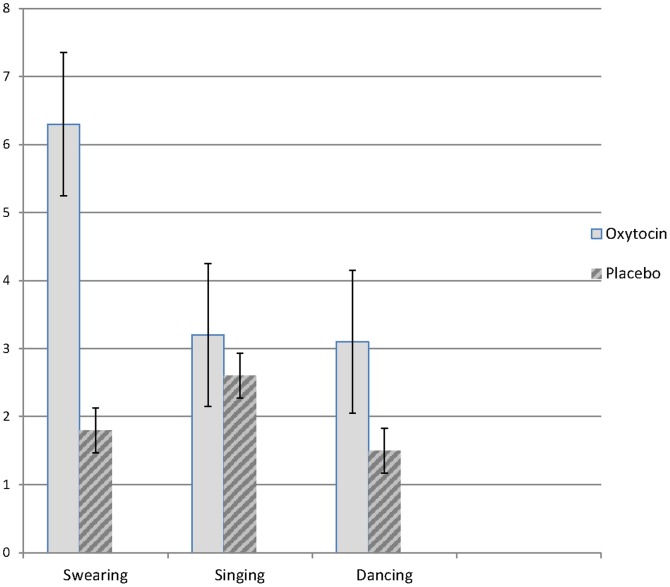
It has long been argued that hypnosis cannot promote behaviors that people will not otherwise engage in. Oxytocin can enhance trust in others, and may promote the extent to which a hypnotized person complies with the suggestion of a hypnotist. This double-blind placebo study administered oxytocin or placebo to high hypnotizable participants (N = 28), who were then administered hypnotic suggestions for socially unorthodox behaviors, including swearing during the experiment, singing out loud, and dancing in response to a posthypnotic cue. Participants who received oxytocin were significantly more likely to swear and dance than those who received the placebo. This finding may be interpreted in terms of oxytocin increasing social compliance in response as a function of (a) increased trust in the hypnotist, (b) reduced social anxiety, or (c) enhanced sensitivity to cues to respond to experimental expectations. These results point to the potential role of oxytocin in social persuasion.
一直以来,人们都认为催眠不能促进人们原本不会参与的行为。催产素可以增强对他人的信任,可能会促进被催眠者遵从催眠师暗示的程度。这项双盲安慰剂研究将催产素或安慰剂给予高催眠易感性的参与者(N=28),然后给予催眠暗示进行非传统的社交行为,包括在实验期间说脏话、大声唱歌和根据催眠后暗示跳舞。与接受安慰剂的参与者相比,接受催产素的参与者更有可能说脏话和跳舞。这一发现可以从以下几个方面来解释:(a)对催眠师的信任增加,(b)社交焦虑减少,或(c)对响应实验期望的线索的敏感性增强。这些结果表明催产素在社会说服方面的潜在作用。