National Neuroscience Institute Singapore, Singapore ; Duke-National University of Singapore Graduate Medical School Singapore, Singapore ; Department of Physiology, National University of Singapore Singapore, Singapore.
Front Neurol. 2013 Apr 8;4:33. doi: 10.3389/fneur.2013.00033. eCollection 2013.
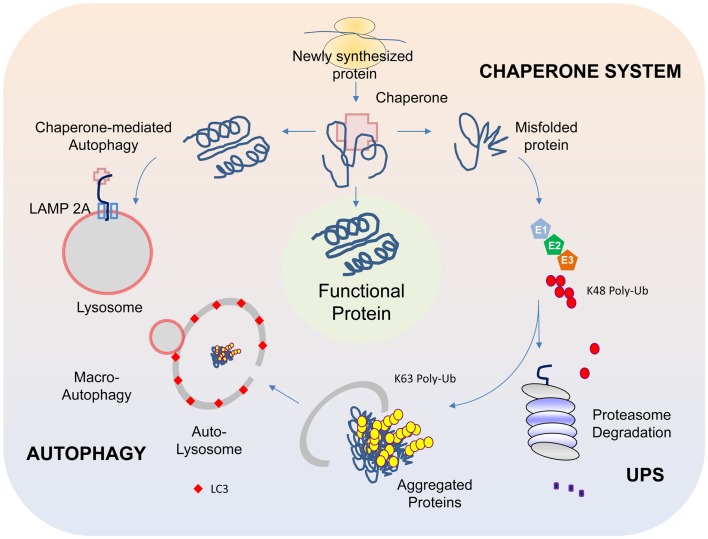
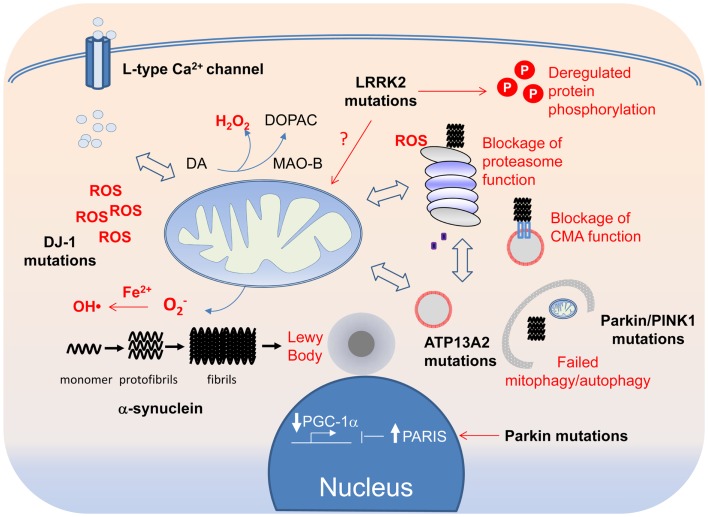
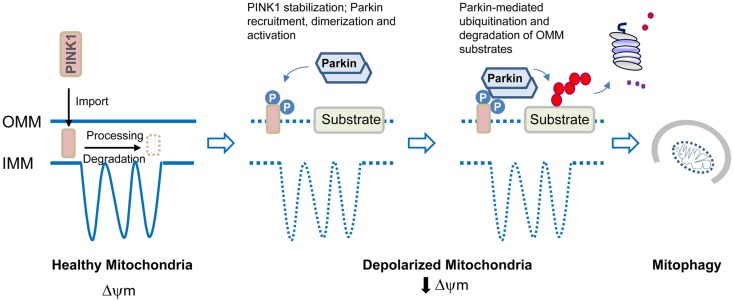
Although a subject of intense research, the mechanisms underlying dopaminergic neurodegeneration in Parkinson's disease (PD) remains poorly understood. However, a broad range of studies conducted over the past few decades, including epidemiological, genetic, and post-mortem analysis, as well as in vitro and in vivo modeling, have contributed significantly to our understanding of the pathogenesis of the disease. In particular, the recent identification and functional characterization of several genes, including α-synuclein, parkin, DJ-1, PINK1, and LRRK2, whose mutations are causative of rare familial forms of PD have provided tremendous insights into the molecular pathways underlying dopaminergic neurodegeneration. Collectively, these studies implicate aberrant mitochondrial and protein homeostasis as key contributors to the development of PD, with oxidative stress likely acting as an important nexus between the two pathogenic events. Aberrations in homeostatic processes leading to protein aggregation and mitochondrial dysfunction may arise intrinsically in substantia nigra pars compacta dopaminergic neurons as a result of impairments in the ubiquitin-proteasome system, failure in autophagy-mediated clearance, alterations of mitochondrial dynamics, redox imbalance, iron mishandling, dopamine dysregulation, or simply from the chronic pace-making activity of nigra-localized L-type calcium channels, or extrinsically from non-autonomous sources of stress. Given the myriad of culprits implicated, the pathogenesis of PD necessarily involves an intricate network of interwoven pathways rather than a linear sequence of events. Obviously, understanding how the various disease-associated pathways interact with and influence each other is of mechanistic and therapeutic importance. Here, we shall discuss some key PD-related pathways and how they are interwoven together into a tapestry of events.
虽然多巴胺能神经元退行性变是帕金森病(PD)的一个研究热点,但其发病机制仍未完全阐明。然而,过去几十年来进行的广泛研究,包括流行病学、遗传学和尸检分析,以及体外和体内模型研究,极大地促进了我们对疾病发病机制的理解。特别是最近鉴定和功能特征分析了几个基因,包括α-突触核蛋白、Parkin、DJ-1、PINK1 和 LRRK2,它们的突变导致了罕见的家族性 PD 形式,为多巴胺能神经元退行性变的分子途径提供了重要的见解。总的来说,这些研究表明,异常的线粒体和蛋白质稳态是 PD 发展的关键因素,氧化应激可能是这两个致病事件之间的重要联系。导致蛋白质聚集和线粒体功能障碍的内稳态过程的改变可能是由于泛素-蛋白酶体系统受损、自噬介导的清除失败、线粒体动力学改变、氧化还原失衡、铁处理不当、多巴胺失调或仅仅是由于黑质局部 L 型钙通道的慢性起搏活动,内在地出现在黑质致密部多巴胺神经元中,或者外在地出现在非自主应激源中。鉴于涉及到的众多罪魁祸首,PD 的发病机制必然涉及到相互交织的复杂途径网络,而不是线性的事件序列。显然,了解各种与疾病相关的途径如何相互作用和影响彼此对于机制和治疗都具有重要意义。在这里,我们将讨论一些与 PD 相关的关键途径,以及它们如何交织在一起形成一个事件的织锦。